
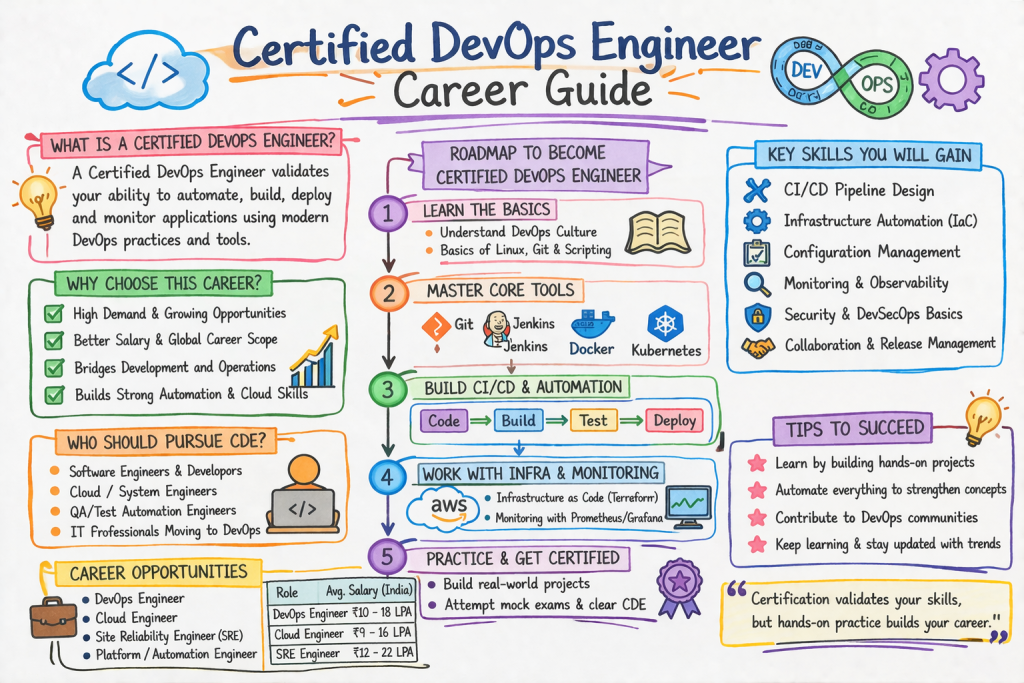
Software teams do not succeed today by writing code alone. They succeed when they can build, test, release, monitor, and improve software in a fast and reliable way. That is why the Certified DevOps Engineer (CDE) program is valuable. The official DevOpsSchool page describes CDE as a 3-hour exam-only program built to validate expertise in core DevOps practices, including CI/CD pipelines, infrastructure automation, configuration management, and monitoring tools.
For working engineers and managers, this certification is useful because it creates a practical bridge between day-to-day DevOps work and a formal career credential. The same official page says the certification is aimed at professionals who want to prove both knowledge and hands-on skills, not just theory.
This guide explains what the certification is, who should take it, what skills it supports, how to prepare, which path to choose next, and how it connects with DevOps, DevSecOps, SRE, AIOps, MLOps, DataOps, and FinOps career growth. The broader DevOpsSchool certification site also shows related tracks including DevOps Certified Professional, DevSecOps Certified Professional, MLOps Certified Professional, Site Reliability Engineering, and AiOps Certified Professional, which supports that wider path-based view.
Why Certified DevOps Engineer matters
A strong DevOps engineer helps teams reduce manual work, improve deployment quality, shorten release cycles, and make production systems easier to manage. The official CDE page frames the certification around implementing core DevOps practices rather than learning isolated tools, which is why it fits real engineering roles better than a purely concept-driven certificate.
The value is especially clear for professionals who already work around delivery pipelines, automation, cloud infrastructure, or release engineering. The official page says the certification covers CI/CD, infrastructure automation, configuration management, and monitoring, which are central parts of real DevOps ownership.
For managers, this kind of certification helps map team capability. For engineers, it helps turn practical work into a structured progression. DevOpsSchool’s wider certification catalog reinforces that CDE sits inside a larger family of professional growth paths rather than standing alone.
Certification overview table
| Track | Level | Who it’s for | Prerequisites | Skills covered | Recommended order | Link |
|---|---|---|---|---|---|---|
| DevOps | Engineer | Professionals validating core DevOps implementation skills | Strong foundation in Jenkins, Docker, Kubernetes, Git, and Ansible; official path also points to Master in DevOps Engineering | CI/CD pipelines, infrastructure automation, configuration management, monitoring | After foundational DevOps preparation or MDE path | https://www.devopsschool.com/certification/certified-devops-engineer.html |
What is Certified DevOps Engineer?
What it is
Certified DevOps Engineer is a professional-level DevOps certification focused on practical implementation. DevOpsSchool describes it as a program for professionals who want to validate expertise in implementing core DevOps practices and hands-on skills across delivery and operations workflows.
It is best understood as a certification for people who need to connect tools, process, and automation into one usable engineering model. The official wording emphasizes both knowledge and practical skill, which makes it stronger than a purely classroom-style badge.
Who should take it
This certification fits engineers who already touch software delivery, automation, release flow, or cloud operations and want more structure in their career path. The official CDE page specifically presents it for professionals validating DevOps implementation ability.
In practical terms, it works well for DevOps Engineers, Cloud Engineers, platform-focused engineers, build and release engineers, and software engineers shifting toward automation-heavy roles. That role mapping is a reasonable inference from the official scope and the broader DevOpsSchool certification ecosystem.
Managers can also benefit from understanding this certification because it reflects the kind of end-to-end delivery thinking modern engineering teams increasingly expect. That is an inference from the exam focus and related professional tracks, not a direct official role claim.
Skills you’ll gain
A serious preparation journey for CDE should strengthen your understanding of how software moves from source control to production. Based on the official scope, that includes pipeline thinking, automation discipline, environment consistency, configuration management, and service observability.
You should also build better confidence in practical DevOps areas such as release flow, infrastructure repeatability, monitoring awareness, and integration between development and operations responsibilities. Those outcomes follow directly from the exam’s stated focus areas.
Skills you’ll gain
- CI/CD pipeline understanding
- Infrastructure automation thinking
- Configuration management discipline
- Monitoring and operational visibility basics
- Stronger practical DevOps workflow knowledge
- Better readiness for adjacent tracks like SRE and DevSecOps
Real-world projects you should be able to do after it
A good DevOps certification should improve what you can build in real environments. After proper preparation, you should be more comfortable creating or supporting a basic CI/CD pipeline, automating parts of deployment, handling configuration in a repeatable way, and improving service delivery visibility. Those are natural project outcomes from the official exam focus.
Real-world projects you should be able to do after it
- Build a practical CI/CD workflow for application delivery
- Automate deployment-related tasks and environment consistency
- Use configuration management patterns more effectively
- Improve monitoring and operational readiness
- Participate more confidently in release and platform discussions
Preparation plan
7–14 days
This path works best for experienced engineers who already use DevOps tools regularly. Since the official page expects a strong foundation in Jenkins, Docker, Kubernetes, Git, and Ansible, a short plan is mainly for revision, practice, and structured recap.
30 days
This is the most practical route for many working professionals. Use the month to cover DevOps basics, CI/CD, automation, configuration management, and monitoring in a steady way, then finish with mock review and one end-to-end mini project. That pacing matches the breadth of the official exam scope.
60 days
This is the safer option for role switchers, support engineers, or developers who know only part of the toolchain. The extra time helps convert scattered understanding into full delivery lifecycle confidence, which is important because the certification validates implementation ability, not just tool names.
Common mistakes
Many candidates fail to prepare in a connected way. The biggest mistake is studying tools separately instead of understanding how DevOps links code, testing, deployment, automation, and monitoring into one workflow. That warning follows directly from the official exam structure.
Common mistakes
- Memorizing terms without building a full workflow
- Focusing only on one tool like Jenkins or Docker
- Ignoring monitoring and configuration management
- Underestimating the practical side of the exam
- Skipping revision because of prior work experience
Best next certification after this
Your next certification should depend on whether you want deeper DevOps depth, cross-functional specialization, or leadership growth. DevOpsSchool’s certification catalog lists related professional tracks such as DevOps Certified Professional, DevSecOps Certified Professional, MLOps Certified Professional, Site Reliability Engineering, and AiOps Certified Professional, which makes those natural follow-on directions.
The Gurukul Galaxy reference article is the source you provided for next-step certification planning, and it supports using track-based progression across DevOps, DevSecOps, SRE, AIOps/MLOps, DataOps, and FinOps families. A recent DevOpsSchool ecosystem roadmap article summarizes those same six paths clearly, which supports this progression model.
Best next certification after this
- Same track: DevOps Certified Professional
- Cross-track: DevSecOps Certified Professional or Site Reliability Engineering Certified Professional
- Leadership: Certified DevOps Architect or Certified DevOps Manager
Choose your path
DevOps
A direct growth sequence is Certified DevOps Engineer → DevOps Certified Professional → DevOps Architect or DevOps Manager. DevOpsSchool publicly lists DCP and related higher-level DevOps certifications in its broader ecosystem, which supports this path.
DevSecOps
A strong security-oriented path is Certified DevOps Engineer → DevSecOps Certified Professional → deeper DevSecOps specialization. DevOpsSchool’s catalog includes DevSecOps Certified Professional, and recent ecosystem guidance frames DevSecOps as a major adjacent path from DevOps.
SRE
A reliability-focused path is Certified DevOps Engineer → Site Reliability Engineering Certified Professional → reliability architecture growth later. DevOpsSchool’s certification catalog includes an SRE track, and the six-path roadmap article explicitly positions SRE as a major branch from DevOps foundations.
AIOps / MLOps
For intelligent operations and ML-enabled platform work, a practical route is Certified DevOps Engineer → AiOps Certified Professional or MLOps Certified Professional → advanced specialization. Both AiOps and MLOps appear in the DevOpsSchool certification catalog.
DataOps
For data platform engineers, the route can move from DevOps foundations into DataOps-focused certification and later architecture or leadership depth. The six-path roadmap article explicitly includes DataOps as one of the major branches from DevOps-style professional growth.
FinOps
For cloud cost and accountability roles, a DevOps-to-FinOps progression is logical because delivery teams increasingly own usage efficiency alongside deployment speed. The same six-path roadmap article includes FinOps as a major adjacent track.
Role → Recommended certifications
| Role | Recommended certifications |
|---|---|
| DevOps Engineer | Certified DevOps Engineer, DevOps Certified Professional |
| SRE | Certified DevOps Engineer, Site Reliability Engineering Certified Professional |
| Platform Engineer | Certified DevOps Engineer, DevOps Certified Professional, DevOps Architect |
| Cloud Engineer | Certified DevOps Engineer, DevOps Certified Professional |
| Security Engineer | Certified DevOps Engineer, DevSecOps Certified Professional |
| Data Engineer | Certified DevOps Engineer, DataOps-focused specialization |
| FinOps Practitioner | Certified DevOps Engineer, FinOps-focused specialization |
| Engineering Manager | Certified DevOps Engineer, DevOps Manager, DevOps Architect |
These mappings combine the official CDE scope with the publicly listed related tracks in DevOpsSchool’s certification catalog and the six-branch roadmap model. Where exact role mapping is not explicitly stated, this is a grounded career-path inference.
Next certifications to take
Same track
DevOps Certified Professional is the most natural next step because it deepens the same discipline and is publicly listed in DevOpsSchool’s certification catalog.
Cross-track
DevSecOps Certified Professional or Site Reliability Engineering Certified Professional are the strongest cross-track choices because they extend DevOps into either security-first delivery or reliability-first operations. Both are explicitly present in the public certification catalog and roadmap content.
Leadership
DevOps Architect or DevOps Manager is the right next move for professionals who are stepping into broader ownership, governance, design, or team leadership. This is supported by the role-based progression shown in the MDE roadmap and wider certification family.How to decide if CDE is right for you
How to decide if CDE is right for you
CDE is right for you if:
You want a foundation before choosing SRE, DevSecOps, MLOps, DataOps, or FinOpsCDE is right for you if:
You already work in software delivery and want stronger automation skills
You want to move from development into DevOps or platform engineering
You support deployments but want structured DevOps understanding
You want a practical certification instead of a purely theory-heavy one
You need confidence for interviews, role change, or career growth
You want a foundation before choosing SRE, DevSecOps, MLOps, DataOps, or FinOps
You already work in software delivery and want stronger automation skills
You want to move from development into DevOps or platform engineering
You support deployments but want structured DevOps understanding
You want a practical certification instead of a purely theory-heavy one
You need confidence for interviews, role change, or career growth
Top institutions which provide help in training cum certifications for Certified DevOps Engineer
DevOpsSchool is the clearest primary institution here because it hosts the official Certified DevOps Engineer page and the wider related certification catalog. It is the direct official source for the CDE program itself.
Cotocus, Scmgalaxy, and BestDevOps are often referenced by learners in the wider DevOps training ecosystem, but I could not verify from the sources I checked that they are official providers of this exact CDE credential. The safest supported statement is that DevOpsSchool is the directly verifiable official certification source.
devsecopsschool, sreschool, aiopsschool, dataopsschool, and finopsschool make sense as specialization destinations after DevOps foundations because the roadmap content explicitly treats DevSecOps, SRE, AIOps/MLOps, DataOps, and FinOps as major next-step branches.
FAQs focused on difficulty, time, value, and sequence
1. Is Certified DevOps Engineer difficult?
It is moderately challenging because it expects existing familiarity with core DevOps tools and validates implementation-focused skills, not just theory.
2. How long is the exam?
The official page says the exam is 3 hours long.
3. Is it an online exam?
Yes. The official page describes it as an online-proctored exam from a remote location.
4. What is the exam format?
The official listing says it uses multiple choice and multiple select questions.
5. What should I know before starting?
The official page expects a strong foundation in Jenkins, Docker, Kubernetes, Git, and Ansible.
6. Is there a training path too?
Yes. DevOpsSchool separately lists the Master in DevOps Engineering (MDE) program, which functions as the deeper preparation route into advanced DevOps capability.
7. What is the best same-track certification after CDE?
DevOps Certified Professional is the most natural same-track continuation.
8. What is the best cross-track option?
DevSecOps or SRE are the strongest cross-track moves because both are clearly adjacent in the public roadmap.
9. Is this useful for cloud engineers?
Yes. The skill areas listed on the official page align closely with cloud delivery, automation, and platform operations work.
10. Is it useful for managers?
Indirectly, yes. It gives managers a structured view of what practical DevOps capability looks like. That is a grounded inference from the certification scope.
11. Can it help with role transition?
Yes. Because it validates end-to-end DevOps implementation skills, it can help engineers move from general development or operations work into more delivery-focused roles.
12. Is it part of a bigger long-term roadmap?
Yes. Publicly listed adjacent tracks include DevOps, DevSecOps, SRE, AiOps, MLOps, DataOps, and FinOps.
FAQs on Certified DevOps Engineer
1. What is Certified DevOps Engineer?
It is DevOpsSchool’s certification for validating core DevOps implementation skills such as CI/CD, infrastructure automation, configuration management, and monitoring.
2. Who is it for?
It is for professionals who want to validate practical DevOps expertise and hands-on skill.
3. Is it theory-only?
No. The official page explicitly says it tests both knowledge and hands-on skills.
4. How long is the exam?
Three hours.
5. What format is the exam?
Multiple choice and multiple select.
6. Is it remote?
Yes, it is online-proctored.
7. What foundation is expected?
Jenkins, Docker, Kubernetes, Git, and Ansible.
8. What comes after it?
Common next steps are DevOps Certified Professional, DevSecOps Certified Professional, or Site Reliability Engineering Certified Professional, depending on your direction.
Conclusion
Certified DevOps Engineer is a practical credential for professionals who want to prove they can work across real DevOps delivery concerns, not just talk about tooling. The official program centers on CI/CD, automation, configuration management, and monitoring, which makes it relevant to day-to-day engineering work in modern delivery teams. It is especially valuable when you want a structured checkpoint before moving deeper into DevOps, or branching into DevSecOps, SRE, AIOps/MLOps, DataOps, or FinOps. For engineers, it can sharpen direction. For managers, it can clarify capability. For career growth, it is a strong foundation-level professional move.

