
Introduction
Choosing an aircraft for charter travel is not simply a matter of selecting the largest cabin or the newest-looking aircraft. The right choice depends on the mission: passenger count, route length, airport access, luggage requirements, weather, schedule, cabin expectations, and operational constraints.
Charter fleets can include turboprops, very light jets, light jets, midsize jets, super-midsize jets, large-cabin aircraft, and ultra-long-range aircraft. Helicopters may also form part of a broader charter itinerary when the journey involves short sectors or locations without convenient runway access. Business aviation encompasses a particularly wide range of aircraft, from propeller aircraft to jets and helicopters.
The practical lesson is straightforward: aircraft selection should follow the mission rather than the other way around.
A small aircraft can be the sensible solution for a short regional trip, while a larger aircraft becomes justified when range, passenger capacity, baggage, nonstop international travel, or cabin requirements become more demanding. Airport compatibility can be just as important as aircraft performance because many general-aviation airports provide access that is less convenient or unavailable to larger aircraft.
What Determines the Right Charter Aircraft?
Before comparing aircraft categories, establish the actual requirements of the trip.
| Requirement | Why It Matters |
|---|---|
| Number of passengers | Determines cabin and seating requirements |
| Route distance | Influences range and aircraft category |
| Number of flight legs | Affects aircraft utilization and operating economics |
| Airport selection | Runway length, aircraft limitations, and airport facilities matter |
| Baggage | Passenger capacity does not automatically equal baggage capacity |
| Cabin requirements | Workspace, sleeping arrangements, lavatory, and privacy vary |
| Weather | Wind, temperature, precipitation, and visibility can affect operations |
| Schedule | Aircraft positioning and availability can influence the practical choice |
| International requirements | Customs, immigration, permits, and operating restrictions may apply |
| Special equipment | Medical, sports, business, or oversized baggage may change requirements |
This is why a charter request should not simply say, “I need a private jet.” A useful request describes the mission.
For example:
Six passengers, two large equipment cases, a short regional route, a smaller destination airport, and a preference for nonstop travel.
That description may lead to a very different aircraft recommendation than:
Eight passengers traveling internationally with substantial luggage and a requirement for a private sleeping area.
Major Aircraft Options in Charter Travel
1. Piston Aircraft
Piston-powered aircraft are generally among the smaller aircraft used for private and general aviation travel.
They can be relevant for:
- Short-distance travel
- Small passenger groups
- Regional transportation
- Remote or smaller airports
- Specialized aviation missions
- Situations where operating economics are more important than speed
They are generally not the first choice when a traveler expects the speed, altitude, cabin environment, and weather capability associated with business jets.
Advantages
- Lower operating complexity than larger turbine aircraft
- Suitable for certain short missions
- Can access smaller airports
- Potentially economical for appropriate missions
Limitations
- Lower cruise speeds
- Smaller cabins
- More limited range and payload
- Greater sensitivity to certain operational conditions
- Limited luggage capacity on some aircraft
Piston aircraft should therefore be considered according to the mission rather than dismissed simply because they are smaller.
2. Turboprop Aircraft
Turboprops occupy an important position between traditional piston aircraft and business jets.
A turboprop uses a gas-turbine engine connected through a gearbox to drive a propeller. NBAA notes that turboprops generally have lower operating costs than jets because of lower fuel consumption, while sacrificing some speed. They can be particularly useful for missions in the regional range and for airports with runways that may not accommodate jets.
Typical charter missions include:
- Regional business travel
- Short- to medium-distance group travel
- Airport pairs where jet service is unnecessary
- Destinations with limited runway infrastructure
- Trips where passenger capacity and airport flexibility matter more than maximum speed
Strengths
Airport flexibility:
A turboprop can make sense when the destination airport is smaller or when access to a general-aviation facility significantly reduces ground transportation time.
Operating economics:
For appropriate routes, a turboprop can provide a practical balance between operating cost, passenger capacity, and performance.
Cabin utility:
Some turboprops provide useful cabin space for meetings, luggage, or regional group travel.
Limitations
The primary compromise is speed. If the itinerary involves long distances or several time-sensitive legs, the additional flight time can become operationally significant.
The question should therefore be:
Does the airport and mission advantage of the turboprop outweigh the additional travel time?
3. Very Light Jets
Very light jets, often abbreviated VLJs, are positioned toward the smaller end of the business-jet spectrum.
They can be appropriate for:
- Short regional routes
- Small passenger groups
- Business day trips
- Point-to-point travel
- Travelers prioritizing jet speed over turboprop operation
Their smaller size can also provide access to airports that may not be practical for larger aircraft.
Advantages
- Jet-speed travel
- Smaller airport access
- Appropriate for short missions
- Generally smaller operating footprint
- Useful for small groups
Limitations
- Limited cabin space
- Smaller baggage capacity
- Fewer onboard amenities
- Less flexibility for larger passenger groups
- Range may be insufficient for certain nonstop missions
A common mistake is assuming that a jet automatically provides a large private cabin. Aircraft categorized as jets can differ dramatically in cabin dimensions and baggage capability.
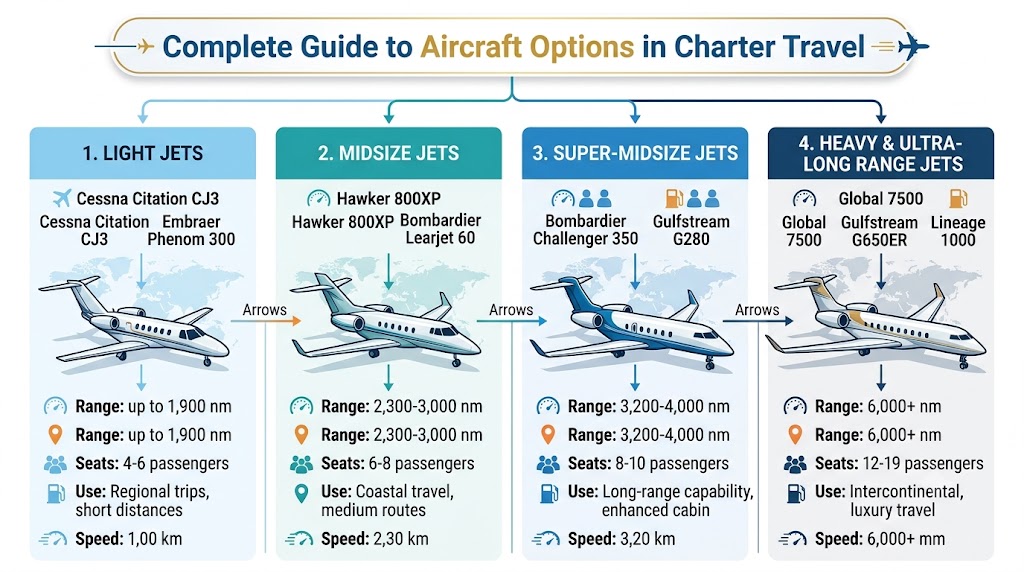
4. Light Jets
Light jets are one of the most common categories to consider for short and medium regional charter missions.
They generally offer a stronger combination of:
- Speed
- Passenger capacity
- Cabin comfort
- Airport flexibility
- Operating efficiency
They are particularly useful when the trip is too long to make a turboprop attractive but does not justify a larger aircraft.
Typical missions
- Regional corporate travel
- Short business trips
- Small family groups
- Multi-city itineraries
- Time-sensitive day trips
Advantages
- Faster than turboprops
- Comfortable for short flights
- Useful access to many general-aviation airports
- Suitable for smaller groups
Limitations
- Cabin size can be restrictive on longer flights
- Baggage capacity varies considerably
- Limited sleeping arrangements
- Some models have restricted range when heavily loaded
Important consideration
Passenger count should never be evaluated separately from luggage.
An aircraft may technically accommodate a particular number of passengers while becoming impractical once every passenger brings substantial baggage.
5. Midsize Jets
Midsize jets become attractive when the mission requires more cabin space, longer range, or additional onboard functionality.
They can be particularly suitable for:
- Longer domestic routes
- Regional international travel
- Business teams
- Families traveling with significant luggage
- Trips where passengers want more space to work or relax
What changes from a light jet?
The difference is not simply additional seats.
A midsize aircraft may provide:
- More cabin volume
- Larger baggage capacity
- Greater range
- More comfortable seating
- Better suitability for longer flights
- Additional cabin amenities
For passengers spending several hours onboard, cabin ergonomics can become more important than simply minimizing the charter price.
6. Super-Midsize Jets
Super-midsize aircraft sit between conventional midsize jets and larger long-range business jets.
They are often considered when the mission requires a combination of:
- Long range
- Larger cabin
- Higher passenger capacity
- International capability
- Comfortable nonstop travel
These aircraft can be particularly useful for travelers who want substantial cabin space without moving all the way into the largest business-jet categories.
Typical use cases
- Long domestic routes
- Transcontinental travel
- International regional travel
- Executive group travel
- Longer business missions
- Family travel where luggage volume is significant
Trade-off
The aircraft costs more to operate than a smaller jet, so using one for a short flight with only a few passengers can represent unnecessary capacity.
7. Large-Cabin Business Jets
Large-cabin aircraft are designed around long-distance travel, passenger comfort, and onboard functionality.
They become relevant when the mission involves:
- Larger groups
- Long nonstop sectors
- Extensive baggage
- Executive work requirements
- Sleeping arrangements
- More sophisticated cabin configurations
The value of these aircraft is not merely additional seating.
For long flights, the cabin itself becomes part of the transportation solution.
Passengers may need:
- Dedicated work areas
- More privacy
- Larger lavatories
- Sleeping configurations
- Multiple cabin zones
- Better separation between working and resting passengers
When does a large cabin make sense?
A large aircraft can be justified when the mission requires the combination of range, payload, passenger capacity, and cabin functionality.
It is less compelling when a smaller aircraft can complete the same mission comfortably and efficiently.
8. Ultra-Long-Range Jets
Ultra-long-range aircraft are designed for missions where nonstop distance is a major requirement.
They are relevant for:
- Long international journeys
- Intercontinental business travel
- Large executive groups
- Trips where avoiding intermediate stops has substantial value
- Missions requiring extensive onboard workspace and rest facilities
The value proposition
The key benefit is not simply luxury.
For a long international mission, avoiding an intermediate stop can reduce:
- Total travel time
- Airport transfers
- Passenger disruption
- Schedule uncertainty
- Additional handling requirements
The aircraft’s range, however, must always be considered alongside passenger count, baggage, weather, routing, airport conditions, and operational requirements. Published range figures are not guarantees for every real-world mission.
9. Helicopters as a Charter Option
Helicopters are fundamentally different from fixed-wing charter aircraft but can be extremely useful for specific missions.
They can connect passengers to locations where conventional runway access is inconvenient.
Possible applications include:
- Short regional transfers
- Airport-to-city transportation
- Island access
- Resort transfers
- Remote locations
- Sightseeing
- Connecting two points where surface transportation would consume significant time
The strongest helicopter use cases often involve first-mile or last-mile transportation, rather than replacing a long-distance jet.
Important limitations
Helicopters generally have:
- Shorter range
- Lower cruise speeds
- Smaller cabins
- More limited baggage capacity
Weather, landing-site suitability, permissions, and local operating restrictions can also be critical.
Aircraft Category Comparison
| Aircraft Type | Typical Mission Profile | Cabin Space | Range Potential | Airport Flexibility | Best-Suited Scenario |
|---|---|---|---|---|---|
| Piston | Short regional trips | Small | Limited | High in suitable locations | Small groups and short missions |
| Turboprop | Regional travel | Small to moderate | Moderate | Strong | Short routes and smaller airports |
| Very Light Jet | Short business trips | Small | Short to moderate | Strong | Small groups prioritizing jet speed |
| Light Jet | Short/medium routes | Small to moderate | Moderate | Strong | Business and leisure travel |
| Midsize Jet | Medium/longer routes | Moderate | Moderate to long | Good | Longer trips with added comfort |
| Super-Midsize Jet | Long regional/international | Large | Long | Good | Long nonstop missions |
| Large-Cabin Jet | Long-haul travel | Large | Long | More limited than smaller aircraft | Large groups and premium long-distance travel |
| Ultra-Long-Range Jet | Intercontinental travel | Very large | Very long | More limited | Long international nonstop missions |
| Helicopter | Short point-to-point sectors | Small | Short | Landing-site dependent | Remote or airport-transfer missions |
These categories are broad industry descriptions rather than universal regulatory classifications. Actual capabilities vary significantly by aircraft model, configuration, operator, payload, route, and operating conditions.
Passenger Count Is Only the Starting Point
One of the most common charter-planning mistakes is choosing aircraft based solely on the number of passengers.
Suppose a group has eight travelers.
Eight seats may appear sufficient, but the actual requirements could include:
- Eight full-size passengers
- Multiple suitcases
- Sporting equipment
- Business equipment
- Child seats
- Special medical equipment
- Additional cabin-space requirements
The aircraft that technically seats eight may therefore be less practical than another aircraft with a different cabin and baggage configuration.
NBAA specifically cautions that an aircraft advertised with a particular passenger capacity does not necessarily provide that many full-size, comfortable seats.
Better approach
Evaluate:
Passengers + baggage + cabin requirements + range + airport + operational conditions
rather than passenger count alone.
Range Does Not Mean “Fly This Distance”
Aircraft range figures should be treated as planning information rather than simple promises.
Real-world range can be affected by:
- Passenger load
- Baggage
- Fuel requirements
- Weather
- Winds
- Routing
- Alternate-airport requirements
- Air-traffic restrictions
- Airport elevation
- Temperature
- Reserve requirements
A route that appears to fit within an aircraft’s published maximum range may therefore require careful operational evaluation.
This is particularly important for international or remote destinations.
Airport Compatibility Can Change the Best Choice
Airport selection is one of the most underestimated factors in charter planning.
A larger aircraft may provide more cabin comfort, but if it must use a distant major airport while a smaller aircraft can use an airport closer to the final destination, the smaller aircraft may reduce total journey time.
The relevant calculation is not simply:
Flight time
It is:
Total door-to-door journey time
That includes:
- Ground transportation to departure airport
- Airport processing
- Aircraft boarding
- Flight time
- Arrival procedures
- Ground transportation to destination
General aviation airports can provide useful access to communities without convenient scheduled airline service, and smaller aircraft may be particularly suited to these facilities.
Cabin Comfort: Look Beyond Seat Count
For longer flights, cabin dimensions become increasingly important.
Ask about:
- Cabin height
- Cabin width
- Seat configuration
- Seat pitch
- Lavatory configuration
- Cabin zones
- Work tables
- Sleeping arrangements
- Noise environment
- Baggage accessibility
A nominal passenger capacity does not tell the entire story.
For a two-hour flight, a compact cabin may be perfectly acceptable. For a much longer journey, the same cabin could become uncomfortable.
Baggage Planning
Baggage is frequently underestimated in charter planning.
Consider:
Standard luggage
Suitcases, carry-on bags, and personal items.
Oversized luggage
Golf equipment, bicycles, musical instruments, sporting equipment, or specialist equipment may require additional planning.
High-volume baggage
A group traveling for an extended trip may carry significantly more luggage than the passenger count suggests.
Special items
Certain equipment may have handling, packaging, loading, or carriage restrictions.
The charter provider should confirm both volume and weight limitations, rather than relying solely on a generic baggage allowance.
Single-Leg vs. Multi-Leg Charter
Aircraft selection can change dramatically when the itinerary includes multiple stops.
For a simple:
City A → City B
mission, aircraft positioning may be relatively straightforward.
For:
City A → City B → City C → City D → City A
the operator must consider:
- Aircraft positioning
- Crew duty limitations
- Fuel planning
- Overnight parking
- Airport operating hours
- International permissions
- Maintenance requirements
- Passenger schedule
- Potential repositioning costs
A particular aircraft can be ideal for one leg but less suitable for the complete itinerary.
The aircraft should therefore be evaluated against the whole mission, not merely the longest flight segment.
Charter Aircraft Selection Decision Framework
A practical selection process can follow seven stages.
Step 1: Define the Mission
Record:
- Departure
- Destination
- Travel dates
- Passenger count
- Baggage
- Number of legs
- Preferred airports
- Desired departure time
Step 2: Establish Non-Negotiables
Identify requirements such as:
- Nonstop travel
- Minimum cabin size
- Specific airport
- Sleeping capability
- Large baggage volume
- International capability
Step 3: Determine the Aircraft Envelope
Eliminate aircraft that cannot meet:
- Passenger requirements
- Payload requirements
- Range requirements
- Airport requirements
- Operational requirements
Step 4: Compare Remaining Options
Compare:
- Total charter cost
- Flight duration
- Cabin comfort
- Baggage capacity
- Airport convenience
- Schedule
- Aircraft positioning
Step 5: Review the Operator
Aircraft selection is only part of charter quality.
The operating company, crew, maintenance program, regulatory authorization, and operational practices matter as well.
For U.S. charter operations, the FAA maintains a searchable list of certificated Part 135 operators and the aircraft authorized for charter. The FAA states that the database is updated weekly.
Step 6: Validate the Actual Aircraft
Do not assume that a quote for an aircraft category guarantees a particular model.
Ask:
- What aircraft model is proposed?
- Is the aircraft confirmed?
- What is the actual cabin configuration?
- What is the baggage capacity?
- What is the actual passenger configuration?
- Is the aircraft subject to substitution?
Step 7: Confirm the Complete Trip
Before finalizing, verify:
- Departure airport
- Arrival airport
- Aircraft
- Passenger count
- Baggage
- Schedule
- Operator
- Included services
- Additional charges
- Cancellation terms
- Aircraft substitution provisions
How to Compare Charter Quotes Properly
The lowest quoted aircraft rate does not automatically represent the lowest total travel cost.
Compare quotes using a consistent framework.
| Factor | Questions to Ask |
|---|---|
| Aircraft | What exact model is being proposed? |
| Operator | Who is actually operating the flight? |
| Capacity | How many passengers can comfortably travel? |
| Baggage | Can all luggage be accommodated? |
| Airport | Are the requested airports confirmed? |
| Schedule | Are departure and arrival times realistic? |
| Positioning | Are repositioning charges included? |
| Ground services | What handling or airport fees apply? |
| Catering | What is included? |
| Taxes/fees | Which charges are additional? |
| Aircraft substitution | What happens if the proposed aircraft changes? |
| Cancellation | What are the financial consequences? |
This prevents a common mistake: comparing a comprehensive quote against a quote that excludes several important operational costs.
Safety and Operator Verification
Aircraft category alone should never be treated as a proxy for operational quality.
The charter provider should be evaluated separately from the aircraft itself.
For U.S. operations, the FAA provides resources for verifying charter authorization and identifying aircraft authorized for charter under applicable regulations.
International charter operations are governed by the rules applicable to the relevant jurisdictions and operator. For example, EASA’s commercial air transport framework explicitly addresses both scheduled and charter operations.
Verification questions
Ask:
- Who is the actual operating carrier?
- Is the operator authorized for the requested charter operation?
- Which aircraft registration is planned?
- Is the aircraft operated by the quoted company or another operator?
- What happens if the aircraft becomes unavailable?
- Who is responsible for operational communication?
- What documentation is provided before departure?
A broker may arrange transportation without being the aircraft operator. NBAA’s charter-brokering guidance specifically distinguishes the broker’s role from the Part 135 operator providing the transportation.
Common Aircraft Selection Mistakes
Choosing the Largest Aircraft
More aircraft does not automatically mean better travel.
An unnecessarily large aircraft can increase cost and may offer little practical benefit on a short flight with a small passenger group.
Choosing Based Only on Price
The cheapest quote may involve:
- Longer travel time
- Less convenient airports
- Less cabin space
- Additional positioning
- More restrictive baggage arrangements
Ignoring Baggage
This is particularly problematic for family vacations, sporting trips, and extended journeys.
Assuming Passenger Capacity Equals Comfort
Seat count is not the same thing as usable cabin space.
Ignoring Airport Location
A larger aircraft at a distant airport may create more ground transportation time than a smaller aircraft using a convenient general-aviation airport.
Assuming Every Aircraft in a Category Is Equivalent
Two light jets can have materially different:
- Cabins
- Range
- Baggage capacity
- Performance
- Seating configurations
- Lavatories
Focusing Only on Flight Time
Total travel time is more useful than airborne time alone.
A Practical Aircraft Selection Matrix
| Priority | Aircraft Characteristics to Emphasize |
|---|---|
| Lowest practical operating cost | Turboprop or smaller aircraft where mission permits |
| Short regional trip | Turboprop, very light jet, or light jet |
| Small passenger group | Very light or light jet |
| More cabin comfort | Midsize or larger jet |
| Long nonstop domestic trip | Midsize or super-midsize jet |
| International travel | Aircraft with appropriate range and international capability |
| Large passenger group | Large-cabin aircraft, subject to actual configuration |
| Extensive baggage | Aircraft with adequate usable baggage volume and payload |
| Remote destination | Aircraft compatible with destination airport |
| Airport-to-remote-location transfer | Helicopter where legally and operationally suitable |
| Long international mission | Large-cabin or ultra-long-range aircraft |
This is a decision framework, not a universal aircraft prescription. Actual aircraft suitability must be confirmed for the specific route and operating conditions.
Questions to Ask Before Booking
Aircraft
- What exact aircraft model will operate the flight?
- Is the aircraft confirmed?
- What is the seating configuration?
- What is the usable baggage capacity?
- Is there a lavatory?
- What cabin configuration should passengers expect?
Route
- Can the aircraft operate nonstop?
- Are the requested airports suitable?
- Are alternate airports required?
- Could weather or airport restrictions affect the plan?
Operator
- Who is the actual operator?
- Is the operator authorized for charter?
- What aircraft is listed under the operator’s authorization where applicable?
Cost
- Is the quoted price all-inclusive?
- Are repositioning costs included?
- Are airport and handling charges included?
- Are taxes included?
- What services incur additional charges?
Schedule
- What is the planned departure time?
- What is the expected flight duration?
- How much positioning is required?
- What happens if the aircraft becomes unavailable?
Passenger Requirements
- Can all baggage be carried?
- Can special equipment be accommodated?
- Are catering requirements supported?
- Are there mobility or accessibility considerations?
When a Smaller Aircraft Is the Better Operational Choice
A smaller aircraft can be advantageous when:
- Passenger numbers are low
- The route is short
- The destination has a suitable smaller airport
- Cabin requirements are modest
- Baggage volume is limited
- Schedule flexibility is high
The benefit may come from more than the aircraft itself.
Using a convenient airport can eliminate substantial ground transportation time, making a smaller aircraft competitive from a total-trip perspective.
When a Larger Aircraft Becomes Justified
A larger aircraft becomes increasingly relevant when several requirements occur simultaneously:
- Long flight duration
- More passengers
- Significant baggage
- Nonstop requirement
- International travel
- Sleeping arrangements
- Dedicated workspace
- Longer time onboard
- Multiple demanding flight segments
The key is combined mission complexity.
One requirement alone may not justify a larger aircraft. Several requirements together can.
Charter Aircraft and Operational Reality
A charter aircraft is not an isolated product. It is part of an operating system involving:
Aircraft → Crew → Operator → Airport → Maintenance → Flight planning → Regulatory compliance → Ground handling → Passenger services
A good aircraft choice can still produce a poor travel experience if the airport is inconvenient, the aircraft is substituted, baggage is inadequately planned, or the itinerary does not account for operational constraints.
This is why experienced charter planning focuses on the complete mission.
Final Charter Aircraft Checklist
Before confirming an aircraft, verify:
- Passenger count confirmed
- Baggage volume and weight confirmed
- Exact aircraft model identified
- Aircraft configuration reviewed
- Range and nonstop requirements validated
- Departure airport confirmed
- Arrival airport confirmed
- Alternate airport considerations understood
- Operator identified
- Charter authorization verified where applicable
- Flight schedule confirmed
- Positioning requirements understood
- Airport and handling charges reviewed
- Catering requirements confirmed
- Special baggage requirements confirmed
- Aircraft substitution policy understood
- Cancellation terms reviewed
- International documentation requirements confirmed where applicable
FAQs
Q1. What is the best aircraft for charter travel?
There is no single aircraft that is best for every charter mission. The appropriate choice depends on passenger count, route, baggage, airport access, range, cabin requirements, schedule, and operating conditions.
Q2. Is a turboprop suitable for charter travel?
Yes. Turboprops can be highly practical for regional missions where operating economics and airport access are important. Their principal trade-off against jets is generally lower speed.
Q3. When should I choose a light jet?
A light jet can be appropriate for smaller groups traveling relatively short or medium distances when speed and private-jet convenience are more important than having a large cabin.
Q4. When is a midsize jet more appropriate?
A midsize jet becomes attractive when passengers need more cabin space, baggage capacity, range, or comfort than a smaller jet can reasonably provide.
Q5. Does a larger aircraft always have more range?
Not necessarily. Aircraft performance varies significantly by model, configuration, payload, weather, routing, and operating conditions. Aircraft selection should be based on the actual mission rather than category name alone.
Q6. Can charter aircraft use smaller airports?
Many smaller aircraft can access general-aviation airports that may not be practical for larger aircraft, subject to runway, performance, airport, and regulatory requirements.
Q7. Is passenger capacity enough to choose an aircraft?
No. Passenger capacity should be considered together with cabin dimensions, baggage capacity, payload, range, and the specific configuration of the aircraft.
Q8. How should I compare two charter quotes?
Compare the exact aircraft, operator, airports, schedule, baggage capability, positioning, included services, taxes and fees, cancellation terms, and substitution provisions rather than comparing only the headline price.
Q9. Should I verify the charter operator?
Yes. The aircraft and the operator should be evaluated separately. In the United States, the FAA provides tools for checking certificated Part 135 operators and aircraft authorized for charter.
Q10. Can a helicopter be part of a charter itinerary?
Yes. Helicopters can be useful for short sectors, airport transfers, remote destinations, and locations where conventional runway access is inconvenient, subject to applicable operational and landing requirements.
Conclusion
Choosing an aircraft for charter travel starts with the mission, not the aircraft category. Passenger numbers, baggage, route distance, airport access, cabin requirements, schedule, and operational constraints should all be evaluated together. Smaller aircraft can provide useful airport flexibility and efficient regional transportation, while larger jets become increasingly relevant as range, passenger capacity, baggage, and cabin requirements grow. The exact aircraft model and actual operator also matter because aircraft within the same category can differ substantially. A well-planned charter therefore evaluates the entire journey—from departure airport to final destination—rather than treating the aircraft as a standalone product.

