
Introduction
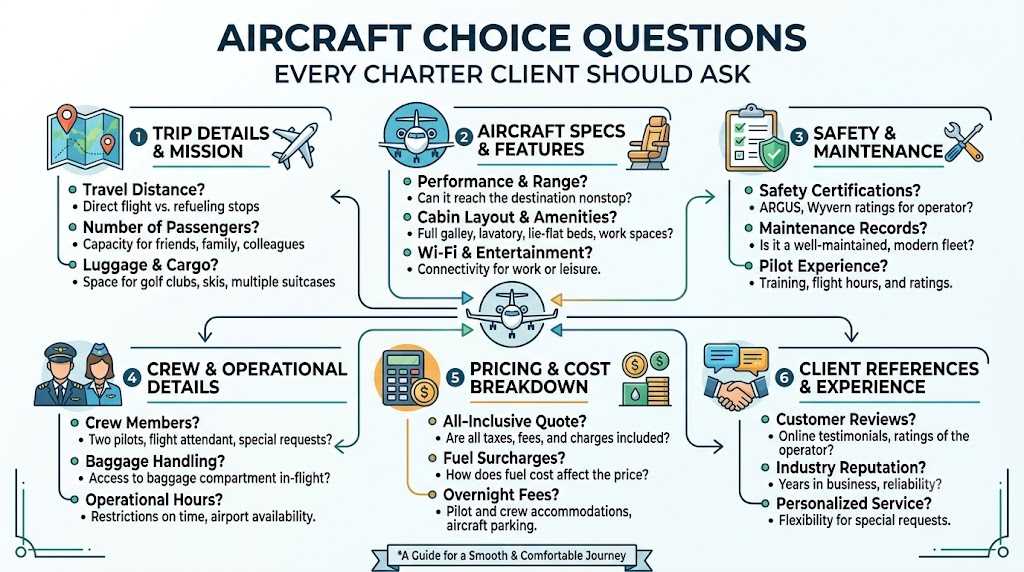
Choosing a charter aircraft is not simply a matter of selecting the largest cabin, newest interior, or lowest quoted price. The right aircraft is the one whose capability, configuration, operating limitations, airport compatibility, passenger capacity, baggage capacity, and mission profile match the actual trip.
A professional charter client should therefore ask questions that uncover what the aircraft can realistically deliver—not just what its marketing specification suggests.
Aircraft performance can change significantly with passenger count, baggage, fuel requirements, weather, airport conditions, and routing. For example, an aircraft advertised with a particular range may not achieve that mission profile with a full passenger load and luggage without a fuel stop.
Why Aircraft Selection Requires More Than Comparing Prices
Two aircraft may appear similar on paper but behave very differently for a particular mission.
The meaningful comparison includes:
- Passenger requirements
- Baggage requirements
- Required range
- Airport and runway characteristics
- Expected weather
- Flight time
- Cabin configuration
- Seating arrangement
- Lavatory requirements
- Accessibility needs
- Connectivity requirements
- Crew requirements
- International operating capability
- Aircraft availability
- Total trip cost
- Operational flexibility
The objective is not to identify the aircraft with the most impressive specifications.
The objective is to identify an aircraft that can comfortably and realistically perform the requested mission under the expected conditions.
1. Questions About the Aircraft Itself
Start by establishing exactly what aircraft is being proposed.
Ask:
- What aircraft make and model will operate my flight?
- What is the specific aircraft registration or tail number, if available?
- Is this the aircraft actually expected to operate the trip, or is it only a representative aircraft?
- What is the aircraft’s passenger seating configuration?
- How many seats are normally available in this configuration?
- Does the proposed aircraft differ from the aircraft shown in your marketing materials?
- Is the aircraft operated directly by the charter company or sourced from another operator?
These questions prevent a common misunderstanding: assuming that a quote describing an aircraft category guarantees a particular cabin, configuration, or individual aircraft.
NBAA’s charter request-for-proposal guidance specifically recommends identifying the aircraft make, model and, when available, tail number.
2. Questions About Passenger Capacity
Never treat the published maximum seating figure as the same thing as the ideal passenger configuration for your trip.
Ask:
- How many passengers can the aircraft accommodate for this specific mission?
- Is the quoted passenger capacity based on the normal cabin configuration?
- Will all passengers have usable seats throughout the flight?
- Does seating configuration reduce usable baggage capacity?
- Are any seats positioned differently from the standard layout?
- Can the cabin accommodate the passenger mix comfortably?
- Are there restrictions affecting child passengers or special passenger requirements?
- Does the aircraft have an appropriate lavatory for the expected flight duration?
Why this matters
A charter aircraft may technically have enough seats while still being a poor practical fit.
For example, a group may have eight passengers but unusually large luggage requirements. The aircraft’s nominal seating capacity may therefore tell you very little about whether the aircraft is suitable for the complete mission.
3. Questions About Baggage Capacity
Baggage is one of the easiest aircraft-selection issues to overlook.
Ask:
- What is the usable baggage capacity?
- Is that capacity based on weight, volume, or both?
- Where is the baggage stored?
- Can every passenger bring the luggage they have described?
- Are there restrictions on oversized items?
- Can sports equipment or other special baggage be accommodated?
- Will baggage limitations change because of fuel requirements?
- Will all baggage travel on the same aircraft?
Important distinction
Ask about usable baggage capacity for your actual trip, rather than simply asking for the aircraft’s published baggage volume.
Payload and range are interconnected. An aircraft may achieve a particular range with a lighter payload but require a fuel stop when carrying more passengers and baggage.
4. Questions About Range
Range should always be discussed in relation to the actual passenger and baggage load.
Ask:
- What is the expected nonstop range for my specific itinerary?
- Does the quoted range assume a particular passenger or baggage load?
- Will the aircraft require a fuel stop?
- What operational assumptions are being used for the range calculation?
- How much flexibility exists if winds or weather change?
- Is the aircraft being selected because it can complete the trip nonstop, or because a fuel stop is acceptable?
- If a fuel stop becomes necessary, how does that affect the schedule and price?
A better question
Instead of asking:
“What is this aircraft’s maximum range?”
ask:
“Can this aircraft complete my planned mission nonstop with all passengers and baggage under realistic operating conditions?”
That question is much more useful.
5. Questions About Airports and Runway Compatibility
Aircraft selection cannot be separated from airport selection.
Ask:
- Can this aircraft operate from my preferred departure airport?
- Can it operate from the destination airport?
- Are there runway-length considerations?
- Are there airport-specific operating restrictions?
- Are there elevation, temperature, or weather considerations?
- Could aircraft performance limitations require an alternate airport?
- If the preferred airport becomes unavailable, what alternatives are practical?
An aircraft that is excellent for long-distance travel may not provide the same airport flexibility as a smaller aircraft.
The shortest route is not always the most efficient route if the aircraft cannot practically use the desired airports.
6. Questions About Flight Time
Do not evaluate aircraft only by maximum speed.
Ask:
- What is the estimated nonstop flight time?
- How much time is expected on the ground?
- Would another aircraft meaningfully reduce total travel time?
- Would a faster aircraft require a less convenient airport?
- Would a slower aircraft avoid a fuel stop?
- Is the quoted travel time realistic for the planned routing?
The relevant metric is often door-to-door travel time, not merely airborne time.
An aircraft that flies faster but requires a less convenient airport or additional ground transportation may not produce the expected overall time savings.
7. Questions About Cabin Configuration
Cabin specifications deserve closer attention than marketing photographs.
Ask:
- What is the exact seating layout?
- Are seats arranged in the configuration shown in the quote?
- Are seats individually adjustable?
- Is there a cabin table or work area?
- Is there a separate lavatory?
- How much cabin space is available?
- Are there restrictions on cabin use during different phases of flight?
- Does the cabin configuration match the needs of the passengers?
For business travel, also consider:
- Ability to work
- Privacy
- Power availability
- Connectivity
- Meeting requirements
- Noise environment
- Seating orientation
For family or leisure travel, priorities may instead include:
- Cabin accessibility
- Luggage space
- Lavatory availability
- Seating flexibility
- Entertainment
- Ease of boarding
8. Questions About Aircraft Age and Refurbishment
Aircraft age alone should not determine the decision, but it is reasonable to understand the aircraft’s history and configuration.
Ask:
- When was the aircraft manufactured?
- When was its interior last refurbished?
- Has the aircraft received significant avionics upgrades?
- When was the cabin last updated?
- Are the photographs current?
- Is the aircraft configuration consistent with the photographs?
- Has major maintenance or refurbishment recently affected its availability?
The important point is to distinguish aircraft age from current condition, maintenance status, equipment, configuration, and operator practices.
NBAA’s charter consumer materials specifically include questions about aircraft manufacturing dates and major refurbishments when screening charter providers.
9. Questions About Maintenance
Passengers generally do not need to inspect maintenance records themselves, but they should understand who is responsible for maintaining the aircraft and whether the aircraft is authorized for the proposed charter operation.
Ask:
- Who operates and maintains the aircraft?
- Is the aircraft authorized for the proposed charter operation?
- Who is responsible for maintenance?
- Are there any known maintenance considerations that could affect the trip?
- What happens if the aircraft becomes unavailable because of maintenance?
- What replacement-aircraft policy applies?
For U.S. charter operations, the FAA maintains information that can be used to verify whether an operator is certificated for charter and which aircraft are authorized for charter. The FAA says this information is updated weekly.
10. Questions About the Charter Operator
Aircraft selection and operator selection are closely connected.
Ask:
- Who is the actual operating carrier?
- What certificate authorizes the charter operation?
- Is the aircraft listed under that operator’s charter authority?
- Who has operational control of the flight?
- Is a broker involved?
- If a broker is involved, what is its role?
- Who should I contact if something changes before departure?
In the United States, on-demand charter operations are commonly conducted under FAA Part 135, which establishes requirements relating to areas such as certification, aircraft, maintenance, training, insurance, and security.
The FAA also specifically advises consumers to verify the legitimacy of the operator and the aircraft’s authorization for charter use.
11. Questions About Crew and Aircraft Compatibility
The aircraft itself is only one part of the operation.
Ask:
- Who will operate the flight?
- What experience do the crewmembers have with this aircraft type?
- What happens if the originally assigned crew changes?
- How will I be notified about significant changes?
- Are there operational restrictions that could affect the itinerary?
NBAA’s charter RFP guidance includes questions concerning crew experience, aircraft-specific experience, training, and policies governing substitute crewmembers.
The goal is not to demand unnecessary personal information from crew members. It is to understand whether the proposed operation has a credible crew plan.
12. Questions About Weather and Operational Flexibility
Weather can change an otherwise straightforward charter plan.
Ask:
- What happens if weather affects the planned departure?
- How are alternate airports handled?
- What happens if the aircraft cannot land at the planned destination?
- How are delays communicated?
- Can the aircraft be substituted if operational conditions change?
- What happens if the trip has to be delayed or rescheduled?
A professional charter provider should be able to explain the process without promising that weather-related disruption can always be avoided.
13. Questions About Aircraft Substitution
Aircraft substitution deserves explicit attention before payment.
Ask:
- Can the operator substitute another aircraft?
- Under what circumstances?
- Will the replacement aircraft be the same model?
- If not, what minimum standards apply?
- What happens if the replacement has fewer seats?
- What happens if it has less baggage capacity?
- What happens if the replacement requires a fuel stop?
- Will the price change?
- When will I be informed?
A replacement aircraft should be evaluated against the mission requirements, not merely whether it belongs to a similar marketing category.
14. Questions About International Operations
For international travel, ask additional questions.
- Is the aircraft authorized for the required international operation?
- Can it operate to and from the specific countries involved?
- Are there customs and immigration considerations?
- Are additional permits required?
- Are there restrictions affecting the aircraft?
- Does the operator have experience with the proposed international routing?
- What happens if an international operating authorization changes?
NBAA’s charter guidance identifies international operations as an important area for consumer screening.
International charter planning can involve requirements from multiple authorities, so the client should establish who is responsible for handling the relevant operational arrangements.
15. Questions About Special Passenger Requirements
Aircraft choice may change significantly when passengers have special requirements.
Ask:
- Can the aircraft accommodate mobility limitations?
- Are there boarding considerations?
- Can required medical or mobility equipment be accommodated where permitted?
- Are there accessibility limitations?
- Is the lavatory configuration appropriate?
- Are there restrictions that passengers should know before booking?
Do not assume that a particular aircraft category automatically provides the accessibility features a passenger needs.
The specific aircraft configuration matters.
16. Questions About Connectivity and Work Requirements
For business travel, cabin connectivity can be a major part of the aircraft-selection decision.
Ask:
- Is Wi-Fi available?
- Is it operationally available throughout the planned route?
- What type of connectivity is provided?
- Are there limitations on bandwidth or availability?
- Are power outlets available?
- Are charging options available at each seat?
- Is the cabin configured for work?
- Can passengers comfortably conduct meetings or work during the flight?
Avoid treating “Wi-Fi available” as equivalent to “reliable business-grade connectivity.”
Ask what is actually installed and what level of service can reasonably be expected.
17. Questions About Safety and Regulatory Status
Safety questions should focus on verifiable operational information, not marketing claims.
Ask:
- Who is the certificated operator?
- What authority permits the operator to conduct the charter?
- Is the aircraft authorized for the proposed operation?
- Who has operational control?
- What happens if the aircraft becomes unavailable?
- What passenger briefing will be provided?
- What safety information will passengers receive?
The FAA states that legal air charter operations require appropriate pilot certification, training, maintenance procedures, and operating rules.
The FAA also provides guidance concerning passenger safety briefings and briefing cards for Part 135 operations.
18. Questions About Insurance
Insurance is easy to ignore until something goes wrong.
Ask:
- What aviation insurance coverage does the operator maintain?
- Is the required coverage appropriate for the charter operation?
- Are there contractual limitations passengers should understand?
- Does the charter agreement contain specific liability provisions?
- Who should explain any insurance-related contractual language?
NBAA’s charter consumer materials identify aviation insurance as one of the areas consumers should investigate when evaluating charter providers.
For significant corporate or international travel, legal or risk-management review may be appropriate.
19. Questions About the Total Price
The aircraft’s hourly rate is only one component of the final cost.
Ask for a complete estimate covering:
| Cost Item | Question to Ask |
|---|---|
| Aircraft time | What is the applicable rate? |
| Crew | Are crew expenses included? |
| Landing fees | Are they included or additional? |
| Parking | Are overnight or parking charges included? |
| Catering | What is included? |
| Ground transportation | Is it included? |
| Fuel | How is fuel treated in the quote? |
| Taxes | Which taxes apply? |
| International charges | Are additional charges expected? |
| Positioning | Are repositioning legs included? |
| Cancellation | What fees apply? |
| Changes | What happens if the itinerary changes? |
NBAA’s charter RFP guidance specifically recommends asking about additional costs, cancellation policies, refund terms, and the total estimated price including applicable taxes and fees.
20. Questions About Cancellation and Changes
Before committing, ask:
- What is the cancellation deadline?
- What happens if the departure time changes?
- Can the destination be changed?
- How are additional flight hours charged?
- What happens if passenger numbers change?
- What happens if baggage requirements change?
- What happens if the aircraft must be substituted?
- What happens if the operator cancels the trip?
A flexible itinerary may justify a different aircraft or contract structure than a fixed one.
21. Questions About Broker Relationships
If a broker is involved, establish exactly who is selling and who is operating the flight.
Ask:
- Are you the aircraft operator or a broker?
- Which company will actually operate my flight?
- What is your relationship with that operator?
- How are you compensated?
- Are you acting on my behalf, the operator’s behalf, or in another capacity?
- Who has operational control?
- Who handles problems during the trip?
NBAA’s RFP guidance specifically recommends asking brokers about compensation, agency relationships, and their role in arranging the flight.
This distinction matters because the person arranging the charter is not necessarily the company operating the aircraft.
22. The 20 Essential Aircraft-Choice Questions
For a practical pre-booking conversation, start with these questions:
- What exact aircraft make and model is proposed?
- What aircraft registration will operate the flight, if available?
- How many passengers can it realistically carry for this mission?
- How much baggage can it accommodate with our passenger load?
- Can it complete the route nonstop under realistic operating conditions?
- Will a fuel stop be required?
- Which airports can it practically use for this itinerary?
- What is the expected total flight time?
- What is the exact cabin configuration?
- Does it have the lavatory and cabin features we require?
- What connectivity and power options are available?
- When was the aircraft interior last refurbished?
- Who operates and maintains the aircraft?
- Is the aircraft authorized for the proposed charter operation?
- Who has operational control of the flight?
- What happens if the aircraft becomes unavailable?
- What aircraft-substitution policy applies?
- What additional costs are excluded from the quoted price?
- What cancellation and itinerary-change terms apply?
- Can all material promises about the aircraft and service be included in the written quote or contract?
Aircraft Selection Decision Framework
A useful way to compare charter proposals is to evaluate the aircraft against the actual mission rather than comparing aircraft labels.
| Decision Area | Key Question | Why It Matters |
|---|---|---|
| Passenger fit | Can everyone be accommodated appropriately? | Avoids capacity problems |
| Baggage | Can all luggage travel as planned? | Prevents payload surprises |
| Range | Can the aircraft complete the route as required? | Determines fuel-stop risk |
| Airport access | Can it use preferred airports? | Affects ground travel |
| Cabin | Does the configuration meet passenger needs? | Determines comfort and productivity |
| Connectivity | Can passengers work if required? | Important for business trips |
| Lavatory | Is the configuration appropriate? | Relevant on longer flights |
| Aircraft availability | Is the aircraft firmly assigned? | Reduces substitution uncertainty |
| Operator | Who actually operates it? | Establishes accountability |
| Regulatory status | Is the aircraft authorized for the operation? | Fundamental compliance consideration |
| Substitution | What happens if the aircraft changes? | Protects the original mission requirements |
| Cost | What is the complete trip price? | Prevents misleading comparisons |
| Flexibility | How are changes handled? | Important for uncertain schedules |
Common Aircraft-Choice Mistakes
1. Choosing Based Only on Aircraft Size
A larger aircraft is not automatically more suitable.
It may introduce higher costs or provide capabilities the mission does not require.
2. Treating Published Range as Guaranteed Trip Range
Published performance figures are not a substitute for a mission-specific assessment.
Passenger load, baggage, routing, weather, and operating requirements can affect the practical mission.
3. Ignoring Baggage
Passenger capacity without baggage analysis can produce an incomplete aircraft-selection decision.
4. Assuming Photographs Represent the Actual Aircraft
Marketing photographs may represent an aircraft type rather than the specific aircraft assigned to the trip.
Ask for the actual configuration.
5. Comparing Only Hourly Rates
An apparently inexpensive aircraft may require additional positioning, fuel stops, airport charges, or other costs.
Compare the complete trip economics.
6. Failing to Ask About Substitution
A quote is much easier to evaluate when the client understands what happens if the proposed aircraft becomes unavailable.
7. Assuming the Broker Is the Operator
Always identify the actual operating carrier.
8. Treating Safety Claims as Verification
Statements such as “excellent safety record” should not replace verification of the operator’s authorization and relevant operational information.
Red Flags That Deserve Additional Questions
Be cautious when a provider:
- Avoids identifying the actual operator
- Will not clearly identify the proposed aircraft
- Cannot explain who has operational control
- Is evasive about charter authorization
- Cannot explain aircraft substitution
- Provides an unusually vague quote
- Gives a price without explaining major assumptions
- Refuses reasonable questions about the operation
- Changes the aircraft description repeatedly without explanation
- Makes promises that appear inconsistent with aircraft capability
The FAA specifically identifies evasiveness, failure to confirm authorization, and arrangements that improperly shift operational control as warning signs for consumers.
A Practical Charter Aircraft Comparison Worksheet
Before making a booking decision, record the same information for every proposal.
| Requirement | Charter Option A | Charter Option B | Charter Option C |
|---|---|---|---|
| Aircraft model | |||
| Aircraft registration | |||
| Passenger capacity | |||
| Baggage capacity | |||
| Nonstop capability | |||
| Fuel stop required | |||
| Departure airport | |||
| Arrival airport | |||
| Estimated flight time | |||
| Cabin configuration | |||
| Lavatory | |||
| Wi-Fi/connectivity | |||
| Power availability | |||
| Operator | |||
| Charter authorization verified | |||
| Substitution policy | |||
| Total estimated cost | |||
| Cancellation terms | |||
| Special requirements |
This approach forces the comparison to remain mission-focused rather than marketing-focused.
Final Pre-Booking Checklist
Before confirming the charter, verify:
Aircraft
- Exact aircraft model identified
- Actual aircraft or registration identified where available
- Passenger capacity confirmed
- Baggage capacity confirmed
- Cabin configuration confirmed
- Lavatory requirements confirmed
- Connectivity requirements confirmed
Mission
- Departure airport confirmed
- Destination airport confirmed
- Nonstop capability assessed
- Fuel-stop requirements understood
- Expected flight time confirmed
- Weather-related contingency understood
Operator
- Actual operating company identified
- Appropriate charter authorization verified
- Operational control understood
- Broker relationship clarified if applicable
- Aircraft substitution policy understood
Commercial Terms
- Total estimated price received
- Additional fees identified
- Cancellation terms reviewed
- Change policy reviewed
- Refund terms understood
- Material aircraft commitments documented
Final Recommendation
The most useful aircraft-choice question is not “Which aircraft is the most impressive?” It is “Which aircraft can reliably meet the requirements of this specific mission?”
Start with passengers, baggage, airports, range and schedule. Then examine cabin configuration, operator authorization, substitution arrangements, connectivity and total cost.
For U.S. charter travel, verify the actual operator and aircraft through appropriate FAA resources rather than relying solely on a broker’s description. The FAA provides tools for checking Part 135 charter authorization and aircraft listings.
A well-chosen charter aircraft is therefore the one whose real-world capability matches the complete trip requirement, with its important assumptions and contractual terms clearly understood before booking.
FAQs
Q1. What is the most important question to ask about a charter aircraft?
Ask whether the proposed aircraft can perform your specific mission with all passengers and baggage, including the planned route and airport requirements.
Q2. Should I ask for the aircraft registration?
Yes, when available. The registration can help distinguish the actual aircraft from a generic aircraft type or marketing photograph.
Q3. Is maximum passenger capacity enough to determine whether an aircraft is suitable?
No. Passenger count should be considered together with baggage, range, fuel requirements, cabin configuration and airport performance.
Q4. Should I ask whether the flight will be nonstop?
Yes. Confirm whether the aircraft can realistically complete the planned route without a fuel stop for the expected passenger and baggage load.
Q5. Does an aircraft’s age determine whether it is a good charter choice?
No. Age is only one factor. Configuration, maintenance, equipment, operator practices and mission suitability also matter.
Q6. What should I ask if a broker is arranging my charter?
Ask who the actual operating carrier is, who has operational control, what role the broker plays and how the broker is compensated.
Q7. Why should I ask about aircraft substitution?
Because the aircraft described during booking may become unavailable. You should understand what replacement standards apply and whether the replacement can still meet your mission requirements.
Q8. Should I compare charter aircraft by hourly price?
Not by itself. Compare the total trip cost, including positioning, fuel stops, airport charges, crew costs, taxes, catering and other applicable fees.
Q9. What should I ask about baggage?
Ask for the usable baggage capacity for your actual passenger load, including any oversized or special items you intend to carry.
Q10. What should I verify before paying for a U.S. charter?
Verify the actual charter operator, the aircraft’s authorization for the operation, the operational-control arrangement and the material terms of the charter agreement. The FAA specifically recommends consumers verify that the operator and aircraft are authorized for charter use.
Conclusion
Selecting a charter aircraft requires more than comparing aircraft size or advertised hourly rates.
The real evaluation begins with passengers, baggage, range, airports, schedule and cabin requirements.
Clients should also establish who operates the aircraft, who has operational control and what happens if the aircraft is substituted.
Total trip cost, cancellation terms and operational limitations should be understood before committing.
A structured set of questions turns aircraft selection from a marketing comparison into a practical mission-planning decision.

