
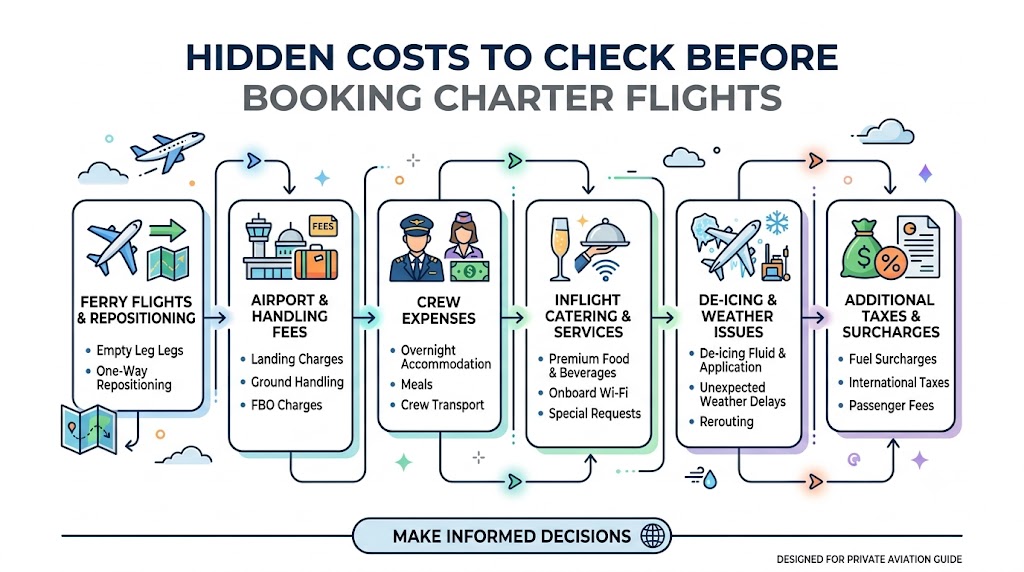
Introduction
Charter flights can offer flexibility, privacy, convenient departure times, and access to airports that may be impractical for scheduled airline travel. However, the first price presented by a charter operator does not always represent the final amount a traveler will pay.
A charter quote can be affected by repositioning, airport charges, crew expenses, overnight requirements, taxes, catering, ground transportation, de-icing, waiting time, and changes to the itinerary. Some of these costs may be included in the initial proposal, while others may appear later as additional charges.
The safest approach is to evaluate a charter flight as a complete travel package rather than simply an aircraft rental. Before paying a deposit, travelers should understand what the quoted price includes, what is excluded, which charges are fixed, and which costs can change.
Why the Advertised Charter Price Can Be Misleading
A charter flight involves more than the aircraft and the flight crew.
The operator may need to position the aircraft before the trip, arrange airport handling, pay landing or parking fees, accommodate the crew, and potentially reposition the aircraft again after the passengers arrive.
A simplified cost structure can look like this:
Total Trip Cost = Aircraft Charter + Positioning + Airport Fees + Crew Costs + Taxes + Passenger Services + Ground Services + Additional Charges
Not every trip contains every component, but the structure illustrates why two apparently similar charter quotes can produce different final prices.
A low initial quote is not necessarily the lowest total cost.
The more useful question is:
What will I actually pay from departure planning through completion of the charter?
1. Aircraft Repositioning Charges
One of the most important costs to investigate is aircraft repositioning.
The aircraft may not be located at your departure airport when you book it. If the operator needs to fly the aircraft to your pickup location, that positioning flight creates additional costs.
Depending on the operator and pricing structure, repositioning may involve:
- Aircraft flight time
- Fuel
- Crew time
- Airport charges
- Navigation or handling fees
- Parking
- Additional positioning after the passenger trip
Some operators incorporate positioning into the quoted charter price, while others may list it separately.
Questions to Ask
Before accepting a quote, ask:
- Is the aircraft already based at the departure airport?
- Is repositioning included?
- Is the return repositioning included?
- Are repositioning costs subject to change?
- What happens if the aircraft’s previous assignment changes?
This can make a significant difference when comparing charter proposals.
2. Empty-Leg Pricing and Its Limitations
An empty leg is a flight where an aircraft is repositioning without passengers on the relevant segment.
Empty-leg opportunities can sometimes be priced differently from traditional charter arrangements. However, travelers should understand that these flights may have less flexibility.
Potential limitations include:
- Fixed departure times
- Limited route flexibility
- Schedule changes
- Availability depending on another customer’s itinerary
- Limited ability to modify the trip
- Different cancellation conditions
An attractive empty-leg price should therefore be evaluated alongside the operational restrictions.
If your schedule is critical, a slightly higher conventional charter arrangement may provide greater certainty.
3. Landing Fees
Landing fees are often overlooked because travelers naturally focus on aircraft and hourly charter rates.
Airports can charge operators for landing based on factors such as:
- Aircraft weight
- Airport category
- Time of operation
- Local airport policies
- International or domestic operations
- Special operating requirements
Some quotes include landing charges. Others may pass them through separately.
Ask Specifically
“Are all departure and arrival airport landing fees included in the quoted price?”
Do not assume that the answer is yes.
4. Airport Handling and FBO Charges
Private aircraft frequently use Fixed-Base Operators (FBOs) or other ground-handling facilities.
Handling charges can cover services such as:
- Passenger processing
- Aircraft handling
- Ground support
- Baggage assistance
- Ramp services
- Crew facilities
- Transportation coordination
- Aircraft servicing
Some airports have multiple handling providers, and pricing can vary.
A quote that excludes handling charges may look cheaper initially while producing a higher final bill.
5. Parking and Overnight Aircraft Charges
If the aircraft remains at an airport after your arrival or before your departure, parking charges may apply.
This becomes especially relevant when:
- Your itinerary spans multiple days
- The aircraft remains overnight
- The airport has limited parking capacity
- The aircraft cannot immediately reposition
- The crew must remain with the aircraft
Ask whether aircraft parking is included for the expected duration of the trip.
Also ask what happens if the aircraft must remain longer than originally planned.
6. Crew Accommodation and Expenses
Multi-day trips can generate additional crew-related expenses.
Depending on the arrangement, the charter price may or may not include:
- Hotel accommodation
- Meals
- Ground transportation
- Crew expenses
- Additional duty-related costs
These expenses become particularly relevant when passengers expect the aircraft to remain available at the destination for an extended period.
Important Question
“Are crew accommodation, meals, transportation, and associated expenses included for the entire itinerary?”
A written answer is preferable to an informal verbal assurance.
7. Crew Duty and Waiting-Time Charges
Flight crews operate under duty-time and rest requirements. A passenger’s preferred schedule cannot always be accommodated simply by extending the crew’s working day.
If you want the aircraft and crew to remain available for several hours or days, additional costs may arise.
Potential charges can involve:
- Extended waiting
- Crew rest requirements
- Additional crew members
- Overnight stays
- Schedule extensions
- Crew repositioning
This is particularly important for business trips where the return flight time is uncertain.
8. Fuel Surcharges and Fuel-Related Adjustments
Fuel is a major operating cost, and some charter arrangements may contain provisions for fuel-price adjustments.
A traveler should determine whether the quote:
- Includes fuel completely
- Includes a fuel surcharge
- Uses a variable fuel adjustment
- Is based on a particular fuel assumption
- Allows additional fuel charges under certain circumstances
If the quote says “fuel included,” clarify whether that means all fuel required for the agreed itinerary or only fuel calculated under specific assumptions.
9. De-Icing and Weather-Related Charges
Cold-weather operations can introduce additional expenses.
Depending on airport conditions and aircraft requirements, de-icing or anti-icing services may be necessary.
These charges may not be known when the initial quote is prepared.
Possible weather-related costs include:
- Aircraft de-icing
- Anti-icing treatment
- Additional ground handling
- Extended airport time
- Diversion-related expenses
- Additional fuel requirements
Travelers should ask how weather-related operational charges are handled.
10. Catering Costs
Catering is another area where assumptions can create unexpected charges.
A basic charter quote may include only limited refreshments, while passengers may expect a full meal service.
Additional catering can include:
- Meals
- Special dietary requirements
- Premium beverages
- Customized menus
- Additional snacks
- Special service arrangements
If catering matters to your trip, request the catering specification in writing.
Instead of asking only:
“Is catering included?”
ask:
“What specific catering service is included for each passenger, and what items generate additional charges?”
11. Special Catering and Dietary Requirements
Special meals can require additional planning.
Examples include:
- Vegetarian meals
- Vegan meals
- Allergy-sensitive meals
- Religious dietary requirements
- Child-friendly meals
- Specific regional cuisine
Not every aircraft or catering facility can provide every request.
If you require specialized catering, mention it before finalizing the booking rather than assuming it can be arranged later without additional cost.
12. Ground Transportation
The charter flight itself may not include transportation between the airport and your final destination.
Potential additional services include:
- Private car transfers
- Chauffeur service
- Hotel transportation
- Multiple vehicle arrangements
- Long-distance ground transfers
- Special-access transportation
If ground transportation is needed, request it as a separate line item or confirm that it is included.
This makes the total travel budget much easier to calculate.
13. Passenger Handling and VIP Services
Some private terminals and FBOs provide premium passenger services.
Depending on the location and service level, these may involve additional charges for:
- VIP handling
- Concierge services
- Special security arrangements
- Baggage assistance
- Private meeting facilities
- Passenger lounges
- Special immigration or customs coordination
Do not assume that every service available at a private aviation facility is included in the aircraft charter price.
14. International Handling Charges
International charter flights can involve additional administrative and operational requirements.
Possible costs include:
- International handling
- Customs coordination
- Immigration processing
- Overflight permits
- Landing permissions
- Ground handling
- International airport fees
- Documentation support
The exact requirements depend on the countries, airports, aircraft, operator, and routing involved.
For international travel, ask the operator to provide a clear breakdown of all anticipated government and airport-related charges.
15. Overflight and Permit Costs
Certain international routes may require operational permits or overflight permissions.
These may involve additional administrative expenses.
The traveler should ask:
- Are all required permits included?
- Are overflight charges included?
- Who is responsible for obtaining permissions?
- What happens if the planned route changes?
- Could additional permit costs arise because of a schedule change?
This is particularly important for complex international itineraries.
16. Taxes and Government Charges
Taxes can significantly affect the final invoice.
Depending on the jurisdiction and itinerary, additional taxes or government-imposed charges may apply.
The quote should clearly state whether the displayed price is:
- Before tax
- Tax-inclusive
- Subject to additional government charges
- Based on estimated taxes
A quote that does not clearly identify its tax treatment is difficult to compare with another proposal.
17. International Passenger Taxes and Fees
International travel may introduce passenger-related taxes and fees.
These can vary according to:
- Departure location
- Arrival location
- Passenger status
- Type of operation
- International routing
- Applicable government rules
The charter provider should identify applicable charges as early as practical.
18. Baggage and Special Equipment
Private aviation generally offers greater flexibility than scheduled airlines, but aircraft limitations still matter.
Additional considerations can include:
- Oversized baggage
- Sporting equipment
- Musical instruments
- Special cargo
- Additional luggage
- Specialized equipment
The key issue is not only whether an item can physically fit inside the aircraft.
The aircraft must also remain within its operational limitations for weight, balance, storage, and loading.
Ask the operator to confirm unusual baggage requirements before booking.
19. Pet Transportation
Traveling with pets may require additional arrangements.
Potential considerations include:
- Pet handling
- Documentation
- International animal-entry requirements
- Special cleaning
- Ground transportation
- Additional handling procedures
For international travel, animal-entry requirements can be particularly important because they may affect the entire itinerary.
Pet travel should therefore be discussed before the charter contract is finalized.
20. Security Services
Additional security arrangements may be requested for certain passengers, destinations, or events.
Potential services include:
- Security personnel
- Secure ground transportation
- Additional screening
- Special airport arrangements
- Destination security coordination
These services are generally separate from the aircraft itself unless explicitly included in the charter agreement.
21. Schedule Changes
One of the most important areas to examine is the cost of changing your itinerary.
Ask what happens if you want to:
- Move the departure time
- Change the destination
- Add a stop
- Extend the stay
- Return earlier
- Return later
- Change the passenger list
A schedule modification can affect aircraft availability, crew duty limits, permits, airport charges, and positioning.
The original quote may therefore no longer apply.
22. Cancellation Charges
Never book a charter without understanding the cancellation policy.
Cancellation costs may depend on how far in advance you cancel.
The agreement may specify different charges for cancellation:
- Shortly after booking
- Several days before departure
- Within a specified notice period
- After the aircraft has repositioned
- After permits or special services have been arranged
Some third-party services may also have their own non-refundable charges.
What to Check
Look for:
- Deposit rules
- Refund conditions
- Cancellation deadlines
- Non-refundable expenses
- Repositioning costs
- Administrative fees
- Weather-related cancellation provisions
23. Date and Time Changes
Changing the travel date can be more complicated than simply changing a reservation with a scheduled airline.
The aircraft may have been committed to another customer.
A date change could therefore trigger:
- Repricing
- Aircraft substitution
- New positioning requirements
- Additional airport charges
- New permits
- Cancellation of existing arrangements
Ask whether the contract allows date changes and how the revised price will be calculated.
24. Diversion and Operational Changes
A charter operator may need to change the planned operation because of:
- Weather
- Airport restrictions
- Aircraft limitations
- Air traffic restrictions
- Operational requirements
- Security considerations
- Runway limitations
A diversion or operational change can create additional costs.
Ask the operator how unexpected operational expenses are allocated.
This is more useful than simply asking whether the operator guarantees the original route.
25. Aircraft Substitution
Aircraft availability can change.
If the originally proposed aircraft becomes unavailable, the operator may provide another aircraft.
Before booking, understand:
- Whether substitution is permitted
- Whether the replacement aircraft must meet specific requirements
- What happens if the replacement aircraft is smaller
- Whether passenger capacity changes
- Whether baggage capacity changes
- Whether the price changes
The contract should establish the basic rules rather than leaving the issue entirely open.
26. Minimum Flight-Time Charges
Some charter arrangements have minimum billable flight-time requirements.
For example, an aircraft may operate a relatively short flight but still be subject to a minimum number of billable hours.
This means:
Actual Flight Time ≠ Always Billable Flight Time
Ask whether the quote is based on:
- Actual flight time
- Minimum flight hours
- Block hours
- Round-trip utilization
- Daily minimums
This is an important comparison point when evaluating aircraft options.
27. Daily Aircraft Minimums
For multi-day charters, operators may apply minimum daily utilization.
This means the aircraft may incur a minimum charge even if it flies relatively little on a particular day.
A trip involving several short segments can therefore have a different cost structure from a simple nonstop journey.
Always ask how daily minimums are calculated.
28. Extra Stops
Adding a stop can appear simple, but it can affect several components of the trip.
An additional stop can introduce:
- Landing fees
- Handling fees
- Parking
- Crew time
- Additional flight time
- Fuel
- Passenger handling
- Permit requirements
Before adding a stop, request a revised all-in estimate.
29. Airport Operating Restrictions
Not every airport is equally convenient for private aviation.
Some airports have:
- Limited operating hours
- Curfews
- Noise restrictions
- Runway restrictions
- Aircraft-size limitations
- Special handling requirements
If your schedule falls outside normal operating hours, additional arrangements may be necessary.
In some cases, an alternate airport may be required.
30. Ground Delay and Waiting Costs
Passengers sometimes assume the aircraft will simply wait indefinitely.
That is not always how charter pricing works.
Extended waiting can affect:
- Crew duty limits
- Airport parking
- Handling
- Aircraft scheduling
- Subsequent charter assignments
If your meeting, event, or ground transportation schedule is uncertain, discuss the maximum expected waiting period with the operator before booking.
31. Aircraft Cleaning and Special Services
Standard aircraft cleaning may be included, but unusual requirements can create additional charges.
Examples may include:
- Extensive cleaning
- Special sanitation
- Pet-related cleaning
- Food or beverage cleanup
- Special cabin preparation
These charges are usually avoidable surprises when expectations are clarified in advance.
32. Communication and Connectivity Charges
Depending on the aircraft, connectivity may be available through:
- Wi-Fi
- Satellite communications
- Cellular systems
- Aircraft-specific connectivity services
The availability and pricing model can differ considerably.
If connectivity is important for business travel, confirm:
- Whether Wi-Fi is included
- Whether usage is limited
- Whether premium connectivity costs extra
- Whether the aircraft actually has the required system
33. Special Onboard Requests
Personalized requests can increase the total price.
Examples include:
- Special cabin setup
- Additional refreshments
- Flowers or gifts
- Event-related arrangements
- Customized passenger services
- Special equipment
These services should be listed separately in the quote so that you can distinguish optional extras from mandatory operating costs.
34. Broker Fees and Commission Structures
When working through a charter broker, understand how the broker is compensated.
The customer should know whether the quoted price includes:
- Broker service fees
- Commission
- Administrative charges
- Payment-processing costs
- Third-party service fees
A transparent quote should make it reasonably clear what you are paying for the aircraft and what represents other services.
35. Payment Processing and Currency Charges
International charter bookings can involve currency conversion.
Potential additional costs include:
- Foreign-exchange charges
- Bank transfer fees
- Credit-card processing fees
- International transaction charges
- Currency conversion differences
If the quote is provided in a currency different from the one you will use for payment, clarify the payment currency and applicable conversion terms.
36. Deposit Requirements
A charter company may require a deposit before confirming the aircraft.
The deposit may be:
- Partially refundable
- Fully refundable under certain conditions
- Non-refundable after a specified point
- Applied against the final invoice
Understand exactly what happens to the deposit if you cancel or modify the trip.
37. Invoice Reconciliation
A professional charter transaction should allow you to reconcile the final invoice against the agreed quotation.
Look for a clear breakdown of:
| Cost Category | What to Confirm |
|---|---|
| Aircraft charter | Agreed aircraft and pricing basis |
| Positioning | Included or billed separately |
| Landing fees | Included or pass-through |
| Handling | Departure and arrival handling |
| Parking | Expected duration and rates |
| Crew | Accommodation and expenses |
| Fuel | Included or adjustable |
| Catering | Exact included service |
| Ground transport | Included or separate |
| Taxes | Applicable taxes and fees |
| Permits | Included or separately billed |
| Changes | Repricing rules |
| Cancellation | Deposit and refund conditions |
| Special services | Optional and mandatory extras |
A detailed invoice is much easier to audit when the original quote was equally detailed.
How to Compare Two Charter Quotes Properly
Comparing only the headline price is a common mistake.
Instead, normalize both quotes into the same categories.
Example
Suppose:
Charter A
- Lower aircraft price
- Positioning excluded
- Handling excluded
- Catering limited
- Crew expenses billed separately
Charter B
- Higher aircraft price
- Positioning included
- Handling included
- Standard catering included
- Crew expenses included
Charter A may initially appear cheaper, but the final comparison cannot be made until the same cost categories are included in both calculations.
Use an All-In Comparison
| Category | Charter A | Charter B |
|---|---|---|
| Aircraft | Included | Included |
| Positioning | Additional | Included |
| Airport fees | Additional | Included |
| Handling | Additional | Included |
| Crew expenses | Additional | Included |
| Catering | Limited | Included |
| Ground transport | Additional | Additional |
| Taxes | Confirm | Confirm |
| Change fees | Confirm | Confirm |
| Cancellation | Confirm | Confirm |
| Estimated total | Calculate | Calculate |
The goal is not to find the lowest advertised number.
The goal is to identify the most accurate total trip cost for the same service level.
A Practical Charter Cost-Checking Workflow
Step 1: Define the Exact Itinerary
Specify:
- Departure airport
- Arrival airport
- Travel date
- Preferred departure time
- Number of passengers
- Baggage requirements
- Return date
- Return time
- Additional stops
- Special passenger requirements
The more precise the itinerary, the more meaningful the quote becomes.
Step 2: Request a Written Quote
Avoid relying only on a phone conversation.
Request a written proposal that identifies:
- Aircraft
- Route
- Pricing basis
- Included services
- Excluded services
- Taxes
- Fees
- Cancellation terms
- Change terms
Step 3: Ask for an “All-In” Price
Use clear language:
“Please provide the estimated all-in price for the complete itinerary, including applicable taxes, positioning, airport fees, handling, crew expenses, and mandatory charges.”
This does not guarantee that every future variable cost can be predicted, but it creates a much clearer baseline.
Step 4: Identify Variable Costs
Ask which costs can change before or during the trip.
Typical variables may include:
- Fuel-related adjustments
- Weather-related services
- Additional waiting
- Extra stops
- Schedule changes
- Airport changes
- Additional passenger services
Step 5: Read the Contract Before Paying
The quotation and the charter agreement should be consistent.
Pay particular attention to:
- Cancellation
- Refunds
- Deposits
- Changes
- Aircraft substitution
- Delays
- Diversions
- Additional expenses
- Liability
- Passenger requirements
Step 6: Keep a Cost Buffer
Even after receiving an all-in estimate, it can be sensible to maintain some budget flexibility for legitimate operational changes.
The appropriate buffer depends on the complexity of the itinerary.
A straightforward domestic trip with a fixed schedule may have fewer variables than a multi-country itinerary involving permits, multiple stops, and overnight aircraft parking.
Questions to Ask Before Booking
Use this checklist with the charter operator or broker:
Aircraft and Flight
- What aircraft is being proposed?
- Is the aircraft confirmed?
- Is aircraft positioning included?
- Are minimum flight hours applicable?
- Are daily minimums applicable?
Airports
- Are landing fees included?
- Are handling fees included?
- Is parking included?
- Are airport operating-hour restrictions relevant?
Crew
- Are crew accommodation and meals included?
- Are crew transportation costs included?
- Could extended waiting create additional charges?
Passenger Services
- What catering is included?
- Are special meals extra?
- Is Wi-Fi included?
- Are ground transfers included?
- Are pets or special baggage subject to additional charges?
International Operations
- Are permits included?
- Are customs and immigration handling charges included?
- Are overflight costs included?
- Are international taxes included?
Changes and Cancellation
- What is the cancellation policy?
- How much of the deposit is refundable?
- What does changing the departure time cost?
- What happens if the travel date changes?
- What happens if the destination changes?
Final Invoice
- Which charges are estimates?
- Which charges are fixed?
- Which charges are pass-through expenses?
- What circumstances can increase the final invoice?
Common Mistakes Travelers Make
Mistake 1: Comparing Only the Hourly Rate
An hourly rate does not necessarily represent the total cost of the trip.
Positioning, minimum hours, airport fees, and crew expenses can materially change the final amount.
Mistake 2: Assuming “Private” Means “All-Inclusive”
Private aviation does not automatically mean that every passenger service is included.
Always verify inclusions.
Mistake 3: Ignoring the Return Journey
A round trip can involve different aircraft positioning requirements and crew arrangements.
Review the entire itinerary rather than evaluating each flight segment independently.
Mistake 4: Not Discussing Schedule Flexibility
If your return time is uncertain, discuss the consequences before booking.
Waiting and schedule changes can affect aircraft and crew availability.
Mistake 5: Treating a Verbal Estimate as a Final Price
A verbal estimate may not include every cost category.
Request a written quotation.
Mistake 6: Not Reading Cancellation Terms
A low deposit does not necessarily mean a low cancellation risk.
The contract determines what happens when plans change.
Mistake 7: Forgetting Special Requirements
Pets, oversized baggage, special meals, additional passengers, and unusual destinations should be disclosed early.
Late requests can create operational and financial complications.
When a Higher Charter Quote May Actually Represent Better Value
Price should be evaluated alongside the service being purchased.
A higher quote may include services that another operator excludes, such as:
- Aircraft positioning
- Airport handling
- Catering
- Crew expenses
- Ground coordination
- More flexible scheduling
- Additional operational support
This does not automatically make the higher quote preferable. It means the two quotes should be compared on an equivalent basis.
The right comparison is:
Total Cost + Included Services + Flexibility + Operational Terms
rather than:
Headline Price Alone
A Simple Charter Flight Cost Formula
For budgeting purposes, travelers can use a basic framework:
Estimated Total = Base Charter Cost + Positioning + Airport Charges + Crew Expenses + Taxes + Passenger Services + Ground Services + Optional Services
Then identify variable components:
Potential Final Cost = Estimated Total + Variable Operational Charges
The purpose of this formula is not to predict every invoice precisely. It is to prevent important categories from being forgotten during the comparison process.
Decision Framework Before Paying a Deposit
Before confirming the charter, ask five questions:
1. Do I know the complete itinerary?
If not, the quote may change.
2. Do I understand what is included?
If not, request clarification.
3. Do I know which costs are variable?
If not, identify them.
4. Do I understand cancellation and modification rules?
If not, do not rely on assumptions.
5. Can I reconcile the final invoice with the quotation?
If not, request a clearer cost breakdown.
Final Charter Booking Checklist
Before paying a deposit, verify:
- Aircraft type confirmed
- Aircraft availability confirmed
- Departure airport confirmed
- Arrival airport confirmed
- Passenger count confirmed
- Baggage requirements provided
- Positioning charges understood
- Landing fees understood
- Handling charges understood
- Parking charges understood
- Crew expenses understood
- Fuel pricing understood
- Catering requirements confirmed
- Ground transportation confirmed
- International permits checked where applicable
- Taxes identified
- Minimum flight-time requirements understood
- Schedule-change rules understood
- Cancellation policy reviewed
- Deposit terms understood
- Aircraft-substitution terms reviewed
- Potential variable charges identified
- Written quotation received
- Charter agreement reviewed
- Final estimated cost understood
FAQs
Q1. What is the most commonly overlooked cost when booking a charter flight?
Aircraft positioning is one of the important costs to check because the aircraft may need to travel to the passenger’s departure airport before the charter begins.
Q2. Are airport landing fees always included in a charter quote?
No. Their treatment varies by operator, airport, and quotation structure. Confirm whether departure and arrival airport charges are included.
Q3. Can crew accommodation increase the cost of a charter?
Yes. Multi-day trips may require hotel accommodation, meals, transportation, or other crew-related expenses unless these are already included in the agreed price.
Q4. Does an empty-leg flight always provide the lowest overall cost?
Not necessarily. Empty-leg flights can have schedule and routing limitations. A lower base price may come with less flexibility.
Q5. Are catering services normally included?
Basic catering may be included depending on the charter arrangement, but premium meals, special requests, or customized catering may cost extra.
Q6. Can changing the departure time increase the charter price?
Yes. A schedule change can affect aircraft availability, crew duty requirements, airport charges, permits, and positioning.
Q7. Should travelers ask for an all-inclusive charter price?
Yes. Asking for an estimated all-in price makes it easier to identify charges that might otherwise be excluded from the headline quote.
Q8. What should travelers check in the cancellation policy?
Review deposit terms, refund conditions, cancellation deadlines, non-refundable expenses, and charges that may apply after aircraft positioning or special arrangements have been made.
Q9. Can international charter flights have additional fees?
Yes. International operations may involve permits, overflight charges, customs or immigration handling, airport fees, and applicable taxes.
Q10. What is the best way to compare two charter flight quotes?
Compare them using the same categories: aircraft cost, positioning, airport fees, handling, crew expenses, taxes, passenger services, cancellation terms, schedule flexibility, and other mandatory charges.
Conclusion
The biggest mistake when booking a charter flight is treating the advertised aircraft price as the final travel cost. Positioning, airport handling, crew expenses, taxes, catering, parking, schedule changes, and special services can all affect the final invoice. The safest approach is to request a detailed written quote and separate included, excluded, fixed, and variable costs before paying a deposit. Comparing charter options on an all-in basis provides a much clearer picture of what each proposal actually offers. A well-understood contract and cost breakdown can also prevent unpleasant surprises when the trip changes or unexpected operational requirements arise.

