
Introduction
Private ground transport is often treated as the final, simple step of a charter journey: land, collect luggage, get into a vehicle, and continue to the destination. In practice, it can be one of the least predictable parts of the itinerary.
A charter traveler may be moving between an airport, private terminal, hotel, residence, business meeting, marina, event venue, or secondary airport. Timing can change because of weather, aircraft operations, baggage handling, security procedures, traffic, or changes to the passenger itinerary. Ground transportation therefore needs to be planned as part of the complete journey rather than arranged as an afterthought.
A good ground-transport checklist confirms who is traveling, where they are going, what vehicle is appropriate, who is meeting them, how timing will be coordinated, and what happens if the original plan changes.
Why Ground Transport Planning Matters
The quality of private transportation is not determined only by the vehicle.
A professionally managed transfer should provide:
- Correct pickup and drop-off locations
- Reliable timing coordination
- Appropriate vehicle capacity
- Clear passenger identification
- Sufficient luggage capacity
- Professional driver arrangements
- Communication between the transport provider and charter operator
- A contingency plan for delays
- Appropriate privacy and security
- Clear billing and cancellation terms
A vehicle arriving at the wrong terminal can create more disruption than a slightly longer drive. Likewise, a luxury vehicle may be unsuitable if it cannot accommodate the passenger group and luggage comfortably.
The objective is therefore reliable door-to-door movement, not simply booking an expensive vehicle.
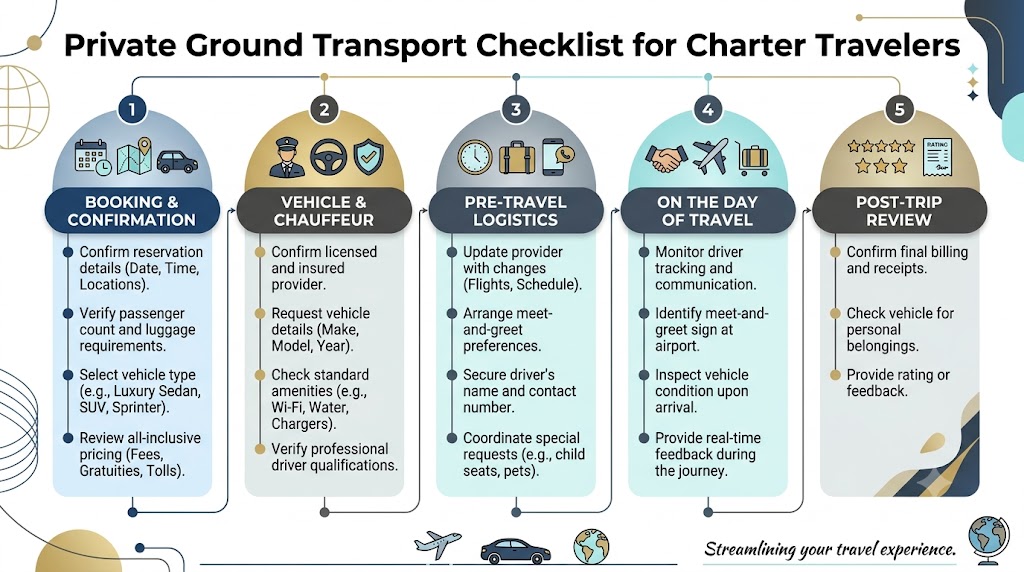
Private Ground Transport Checklist
1. Confirm the Complete Itinerary
Before arranging transportation, establish the complete journey.
Confirm:
- Departure location
- Arrival location
- Airport or private terminal
- Pickup address
- Final destination
- Intermediate stops
- Date of travel
- Estimated arrival time
- Estimated departure time
- Passenger count
- Number of vehicles required
- Special transportation requirements
Do not rely solely on an airport name.
Large airports can have multiple terminals, fixed-base operators, private aviation facilities, and separate access roads. The transport provider should know the specific pickup point, not merely the airport’s general name.
2. Verify Passenger Details
The transportation provider should have the information necessary to execute the transfer without unnecessary communication delays.
Confirm:
| Requirement | Details to Verify |
|---|---|
| Passenger count | Total number of travelers |
| Names | As required by the provider |
| Contact person | Primary passenger or trip coordinator |
| Contact method | Phone or other agreed communication channel |
| Children | Age and applicable seating requirements |
| Mobility needs | Wheelchair, walking assistance, etc. |
| Special needs | Any relevant accessibility requirements |
| Pets | Whether animals are traveling |
| Luggage | Approximate number and type of bags |
Only provide personal information that is actually necessary for the transportation arrangement.
3. Check Luggage Capacity
This is one of the most frequently overlooked considerations.
A vehicle can technically accommodate the passenger count while still being unsuitable for the luggage.
Consider:
- Checked luggage
- Carry-on bags
- Garment bags
- Golf equipment
- Skis or other sports equipment
- Musical instruments
- Child equipment
- Business equipment
- Oversized cases
- Fragile items
Example
Four passengers with four standard suitcases may fit comfortably in a large sedan.
Four passengers traveling with several suitcases, garment bags, and sporting equipment may require an SUV or larger vehicle.
The correct question is not:
“How many passengers can the vehicle carry?”
It is:
“Can the vehicle carry the passengers and all luggage comfortably and safely?”
4. Select the Appropriate Vehicle
Vehicle selection should reflect the actual transportation requirement.
Common considerations
Sedan
Suitable for:
- Small passenger groups
- Limited luggage
- Individual transfers
- Executive travel
SUV
Useful when travelers require:
- Additional luggage space
- More passenger room
- Higher seating position
- Transportation on less predictable road conditions
Van or people mover
Often appropriate for:
- Larger groups
- Multiple pieces of luggage
- Families
- Corporate groups
- Group transfers
Specialized vehicle
May be required for:
- Accessibility needs
- Oversized equipment
- Special events
- Particular security arrangements
- Unusual destination access
Do not choose a vehicle solely because it appears more luxurious. Capacity, access, reliability, and suitability should come first.
5. Confirm the Exact Pickup Location
The pickup point should be documented precisely.
For airport transfers, confirm:
- Airport name
- Terminal
- Private aviation facility or FBO where applicable
- Arrival area
- Designated vehicle pickup zone
- Meeting point
- Driver waiting location
- Airport access restrictions
- Whether commercial vehicles require specific permissions
For hotels or residences, confirm:
- Property name
- Street address
- Entrance
- Lobby or designated pickup area
- Loading restrictions
- Security gate requirements
- Whether the vehicle can access the property directly
A vague instruction such as “pick us up at the airport” is insufficient for professional coordination.
6. Confirm Drop-Off Details
The same level of precision should be applied to the destination.
Confirm:
- Full destination address
- Correct entrance
- Terminal or building
- Loading zone
- Access restrictions
- Appointment or event timing
- Parking or waiting limitations
For large properties, campuses, resorts, venues, and business complexes, the correct entrance can matter considerably.
7. Build Timing Around the Entire Journey
Ground transportation should not be scheduled using only the published aircraft arrival time.
The traveler may need time for:
- Aircraft arrival
- Disembarkation
- Passenger movement
- Baggage collection
- Customs or immigration where applicable
- Movement through the terminal or facility
- Meeting the driver
- Loading luggage
- Departure from the airport
The correct buffer depends on the trip.
Important principle
Do not create an unrealistic schedule simply because the driving time looks short.
A 30-minute road journey does not necessarily mean the vehicle should be scheduled exactly 30 minutes after the aircraft’s expected arrival.
8. Coordinate Flight and Ground Transportation
For charter travelers, aircraft schedules can change.
Transportation planning should therefore consider:
- Aircraft departure changes
- Arrival changes
- Weather delays
- Air traffic restrictions
- Operational delays
- Early arrival
- Late arrival
- Destination changes
Where possible, the ground transportation provider should have an appropriate way to receive updated flight information or itinerary changes.
The goal is to reduce unnecessary waiting while ensuring the traveler does not arrive without transportation.
9. Establish a Driver Meeting Procedure
The passenger should know exactly how the driver will be identified.
Confirm:
- Driver name
- Company name
- Vehicle description
- Vehicle registration details where appropriate
- Meeting location
- Driver contact method
- Sign or name-board procedure if used
- Backup contact
- Waiting procedure
Avoid relying on a vague instruction such as:
“The driver will find you.”
A clear meeting protocol reduces confusion, especially at busy airports and unfamiliar locations.
10. Confirm Driver Communication
A reliable transfer requires communication between the relevant parties.
Depending on the trip, communication may involve:
- Passenger
- Trip coordinator
- Charter operator
- Flight crew or operations team
- Ground transportation company
- Driver
- Hotel or destination representative
Establish who has responsibility for communicating changes.
Without clear ownership, everyone may assume someone else is monitoring the itinerary.
11. Confirm Waiting and No-Show Policies
Before booking, understand what happens if the passenger is delayed.
Check:
- Included waiting time
- Additional waiting charges
- Grace period
- No-show definition
- Cancellation deadline
- Cancellation charges
- Early-arrival procedure
- Delayed-flight procedure
- Driver departure policy
This is particularly important for charter travel because the actual arrival time may differ from the original schedule.
12. Review Cancellation and Change Terms
Charter itineraries can change quickly.
Understand the provider’s policies for:
- Date changes
- Time changes
- Destination changes
- Vehicle changes
- Passenger-count changes
- Cancellation
- Delayed departure
- Aircraft substitution
- Route changes
A low initial transportation price may be less attractive if every itinerary change creates substantial additional charges.
13. Consider Road and Destination Conditions
The shortest route is not always the most reliable route.
Consider:
- Traffic patterns
- Road construction
- Weather
- Seasonal conditions
- Mountain roads
- Rural access
- Event traffic
- Road restrictions
- Toll roads
- Parking limitations
- Temporary closures
For time-sensitive travel, the transportation provider should understand the destination environment rather than relying only on estimated map travel time.
14. Check Special Passenger Requirements
Private transportation may need to accommodate specific requirements.
Examples include:
- Child passengers
- Elderly travelers
- Passengers with mobility limitations
- Wheelchair users
- Medical equipment
- Service animals
- Pets
- Oversized luggage
- Sensitive business equipment
Requirements should be communicated before the vehicle is dispatched.
Do not assume that every premium vehicle automatically supports every special requirement.
15. Consider Privacy and Security
Privacy can be especially important for charter travelers.
Depending on the trip, consider:
- Driver identification procedures
- Passenger information handling
- Pickup privacy
- Vehicle privacy
- Communication protocols
- Destination confidentiality
- Access control at private facilities
- Whether unnecessary passenger details are being shared
The principle should be minimum necessary information.
A transportation provider generally needs enough information to perform the transfer correctly. It does not automatically need every detail of the passenger’s itinerary.
16. Verify Vehicle and Driver Standards
Before using a provider, confirm the standards that matter for the journey.
Depending on location and service type, this can include:
- Proper commercial licensing
- Appropriate insurance
- Driver qualifications
- Vehicle maintenance
- Safety procedures
- Dispatch capability
- Emergency procedures
- Customer support
- Local operating permissions
Requirements vary by jurisdiction and service model, so travelers should verify the applicable local requirements rather than assuming one standard applies everywhere.
17. Plan for Delays
A good transportation plan assumes that something may change.
Create a simple contingency process:
If the flight is delayed:
Driver timing is updated according to the agreed procedure.
If the flight arrives early:
Confirm whether the driver can accommodate the earlier arrival.
If baggage takes longer:
Confirm whether waiting coverage applies.
If the pickup location changes:
Establish who communicates the new location.
If the vehicle becomes unavailable:
Confirm the provider’s backup process.
If the destination changes:
Know how additional mileage, time, and pricing are handled.
A contingency plan is valuable because it converts an unexpected event into a predefined procedure.
18. Consider Multiple Vehicles for Larger Groups
Large groups should not automatically be placed into the largest available vehicle.
Evaluate:
- Passenger distribution
- Luggage distribution
- Travel time
- Destination access
- Driver availability
- Loading efficiency
- Privacy requirements
- Cost
Sometimes two appropriately sized vehicles provide a smoother transfer than one oversized vehicle.
19. Confirm Payment and Billing
Before travel, clarify:
- Total quoted price
- Taxes and fees
- Tolls
- Parking
- Waiting charges
- Additional stops
- Additional mileage
- Driver gratuity policy
- Cancellation charges
- Payment method
- Currency
- Invoice requirements
Do not assume that every quote is all-inclusive.
A professional booking should make the commercial terms understandable before the journey begins.
20. Keep a Single Trip Information Sheet
For complex charter travel, maintain one consolidated transportation record.
A useful format is:
| Item | Details |
|---|---|
| Passenger | Name / group |
| Travel date | Confirmed date |
| Aircraft arrival | Expected time |
| Pickup | Exact location |
| Destination | Full address |
| Vehicle | Type and capacity |
| Driver | Name/contact |
| Provider | Transportation company |
| Luggage | Estimated quantity |
| Special requirements | Details |
| Waiting policy | Confirmed |
| Backup contact | Contact information |
| Change procedure | Agreed process |
| Payment | Confirmed terms |
This prevents important information from being scattered across emails, messages, and booking confirmations.
Ground Transportation Decision Framework
When selecting transportation, evaluate the following factors.
| Factor | Questions to Ask |
|---|---|
| Reliability | Can the provider handle itinerary changes? |
| Capacity | Can passengers and luggage fit comfortably? |
| Timing | Is there enough buffer for the complete arrival process? |
| Communication | Who handles schedule updates? |
| Location | Is the pickup point precise? |
| Driver | How will the passenger identify the driver? |
| Vehicle | Is it appropriate for the trip? |
| Safety | Are licensing, insurance, and maintenance requirements addressed? |
| Privacy | Is passenger information handled appropriately? |
| Flexibility | What happens when plans change? |
| Cost | What is included in the quoted price? |
| Backup | What happens if the assigned vehicle becomes unavailable? |
Common Ground Transport Mistakes
1. Booking Only by Passenger Count
Passenger capacity does not guarantee adequate luggage space.
Better approach: calculate passenger and luggage requirements together.
2. Using the Airport Arrival Time as the Pickup Time
Aircraft arrival is not necessarily the moment the passenger reaches the vehicle.
Better approach: account for disembarkation, baggage, customs where applicable, and movement to the pickup point.
3. Providing an Incomplete Address
Large airports, resorts, and commercial properties can have multiple entrances.
Better approach: document the exact pickup and drop-off point.
4. Assuming the Driver Will Know the Passenger
This creates unnecessary confusion.
Better approach: establish a clear identification and meeting procedure.
5. Ignoring Schedule Changes
A fixed vehicle reservation may not automatically adapt to an aircraft delay.
Better approach: confirm how flight changes are monitored and communicated.
6. Selecting a Vehicle Based Only on Appearance
A premium vehicle can still be operationally unsuitable.
Better approach: prioritize capacity, accessibility, luggage space, reliability, and destination access.
7. Ignoring Waiting Charges
Unexpected delays can create additional costs.
Better approach: review the waiting and cancellation policy before confirming the booking.
8. Sharing Too Much Passenger Information
More information is not automatically better.
Better approach: provide the transportation provider with the information required to perform the service and protect unnecessary personal details.
9. Having No Backup Contact
A passenger may struggle if the primary dispatcher becomes unreachable.
Better approach: retain an alternate contact or dispatch channel.
10. Treating Ground Transport as an Independent Booking
Aircraft, ground transport, hotels, and destination arrangements are interconnected.
Better approach: manage the transfer as one component of the overall itinerary.
Private Ground Transport Checklist Before Departure
Passenger
- Passenger count confirmed
- Passenger names provided where necessary
- Children or accessibility requirements identified
- Pets or service animals confirmed
- Special requirements communicated
Luggage
- Number of bags estimated
- Oversized items identified
- Special equipment identified
- Vehicle luggage capacity confirmed
Vehicle
- Vehicle type confirmed
- Passenger capacity confirmed
- Luggage capacity confirmed
- Vehicle requirements communicated
- Backup arrangement understood
Pickup
- Exact pickup location confirmed
- Terminal or private facility confirmed
- Meeting point documented
- Driver identification procedure confirmed
- Driver contact information available
Timing
- Aircraft schedule confirmed
- Ground-transfer timing established
- Appropriate buffer included
- Waiting policy reviewed
- Delay procedure confirmed
Destination
- Full destination address confirmed
- Correct entrance identified
- Access restrictions checked
- Drop-off requirements confirmed
Commercial Terms
- Price confirmed
- Taxes and fees understood
- Tolls and parking clarified
- Waiting charges understood
- Cancellation policy reviewed
- Payment method confirmed
Contingency
- Backup contact available
- Flight-change procedure understood
- Vehicle failure procedure understood
- Destination-change procedure understood
- Emergency communication method available
Day-of-Travel Verification
A short final check can prevent many avoidable problems.
Before the aircraft departs, verify:
- The passenger count has not changed.
- The destination remains correct.
- The vehicle assignment is confirmed.
- The driver is aware of the expected arrival.
- The pickup location is still valid.
- Special requirements have been acknowledged.
- The passenger has the driver’s identification details.
- The transportation provider has the correct contact information.
- Any itinerary changes have been communicated.
- The backup procedure remains available.
This final verification is particularly useful when several parties are coordinating the same journey.
What a Well-Planned Transfer Looks Like
A well-managed transfer should be simple from the passenger’s perspective.
The traveler should know:
Where am I going?
The destination is confirmed.
Where do I meet the driver?
The pickup location is specific.
How do I identify the vehicle?
The vehicle and driver details are available.
What happens if my flight is delayed?
The adjustment procedure is already established.
What happens if something changes?
There is a known communication channel.
The complexity should largely remain behind the scenes. The traveler should experience a straightforward transition from aircraft to vehicle to destination.
Final Recommendation
Private ground transportation should be planned as an integrated part of the charter itinerary, not as a last-minute car booking. The most important controls are accurate pickup information, appropriate vehicle capacity, realistic timing, clear driver identification, transparent commercial terms, and a defined contingency process. Passenger privacy and special requirements should be addressed before dispatch rather than at pickup. For complex itineraries, keeping one consolidated transportation sheet reduces communication gaps and conflicting instructions. The strongest ground-transport plan is ultimately the one that remains dependable when the original itinerary changes.

