
Introduction
Modern IT environments are no longer simple or predictable. With cloud-native systems, microservices, Kubernetes clusters, hybrid infrastructure, and distributed applications, IT operations teams face constant complexity. Traditional monitoring tools often generate too many alerts, making it difficult to identify real issues quickly.
This is where AIOps (Artificial Intelligence for IT Operations) transforms the game. AIOps combines artificial intelligence, machine learning, and big data analytics to automate IT operations tasks such as anomaly detection, event correlation, root cause analysis, and incident response. It enables organizations to move from reactive firefighting to proactive and predictive operations.
AIOps training and certification help professionals develop the skills needed to work in modern IT environments where automation and intelligence are essential. Platforms like AIOpsSchool.com focus on preparing learners for real-world AIOps adoption across DevOps, SRE, and cloud engineering roles.
What is AIOps?
AIOps refers to the use of AI and machine learning to enhance and automate IT operations. It processes large volumes of operational data such as logs, metrics, traces, and events to improve system reliability and performance.
Core capabilities of AIOps include:
- Real-time anomaly detection
- Intelligent alert correlation
- Root cause analysis automation
- Predictive insights for system failures
- Automated incident remediation
Instead of manually analyzing thousands of alerts, AIOps platforms identify patterns and highlight the most critical issues that require attention.
Why AIOps Matters in Modern IT Operations
IT operations have become increasingly complex due to:
- Cloud-native architecture adoption
- Microservices-based applications
- Container orchestration platforms like Kubernetes
- Distributed system dependencies
- High-speed CI/CD pipelines
Traditional monitoring tools struggle in this environment because they generate too much noise and lack contextual intelligence.
AIOps solves these challenges by:
- Reducing alert fatigue
- Increasing mean time to resolution (MTTR) efficiency
- Improving system uptime and reliability
- Enabling predictive maintenance
- Supporting automation-driven operations
In short, AIOps allows IT teams to do more with less effort while maintaining high service quality.
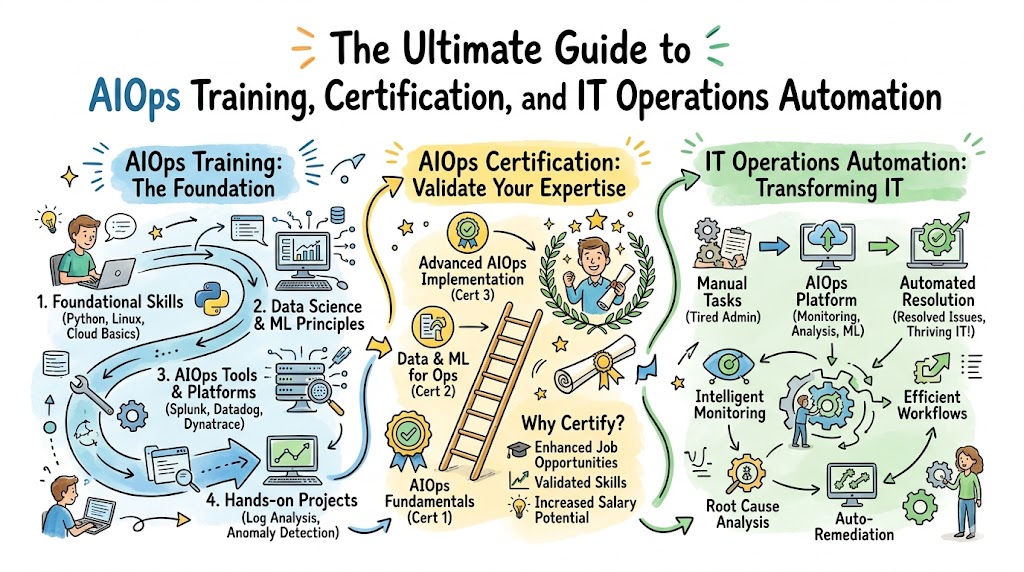
AIOps Training: What You Will Learn
A structured AIOps training program is designed to build both conceptual and practical skills.
Key learning areas include:
1. Foundations of AIOps
- Introduction to AI for IT operations
- Difference between DevOps, SRE, and AIOps
- Understanding IT operational data
2. Observability and Monitoring
- Metrics, logs, and traces
- Distributed system observability
- Monitoring tools and frameworks
3. Machine Learning in IT Operations
- Supervised vs unsupervised learning
- Anomaly detection models
- Pattern recognition in operational data
4. Event Correlation and Noise Reduction
- Alert grouping techniques
- Reducing duplicate alerts
- Intelligent incident grouping
5. Root Cause Analysis
- Dependency mapping
- Incident tracing
- Automated RCA workflows
6. Automation and Remediation
- Auto-healing systems
- Workflow automation
- Integration with DevOps pipelines
AIOps Certification: Why It is Important
AIOps certification validates your ability to work with AI-driven IT operations systems. It demonstrates that you understand both theoretical and practical aspects of intelligent operations.
Benefits of AIOps certification:
- Strong career advancement opportunities
- Higher salary potential in DevOps and SRE roles
- Industry recognition of AI and automation skills
- Better understanding of enterprise IT systems
- Eligibility for advanced cloud and platform engineering roles
Certification also helps organizations identify skilled professionals who can reduce operational costs and improve system performance.
Who Should Learn AIOps?
AIOps is relevant for multiple IT roles, including:
- DevOps Engineers
- Site Reliability Engineers (SREs)
- Cloud Engineers
- Platform Engineers
- IT Operations Managers
- Monitoring Engineers
- Data Engineers working with logs and metrics
Even beginners entering IT operations can benefit from AIOps training because it provides a strong foundation in modern system management.
Key Use Cases of AIOps in Enterprises
AIOps is widely used across industries to improve operational efficiency.
1. Incident Detection and Response
AIOps automatically detects system anomalies and triggers alerts before users are impacted.
2. Predictive Maintenance
Systems can predict potential failures before they occur, reducing downtime.
3. IT Service Management Optimization
AIOps improves ticket classification and prioritization in ITSM systems.
4. Cloud Resource Optimization
Helps in optimizing cloud usage and reducing unnecessary costs.
5. Security Event Analysis
Detects abnormal patterns that may indicate security threats.
AIOps Tools and Technology Ecosystem
AIOps platforms typically integrate with multiple monitoring and observability tools.
Common categories include:
- Infrastructure monitoring tools
- Log analytics systems
- Application performance monitoring (APM) tools
- Event management systems
- Automation and orchestration platforms
These tools work together to provide a unified view of system health and performance.
AIOps vs Traditional IT Operations
| Feature | Traditional IT Operations | AIOps |
|---|---|---|
| Alert Handling | Manual | Automated |
| Root Cause Analysis | Time-consuming | AI-driven |
| Monitoring | Reactive | Proactive |
| Incident Response | Human-driven | Semi/fully automated |
| Scalability | Limited | High |
AIOps significantly improves speed, accuracy, and scalability of IT operations.
Career Opportunities in AIOps
AIOps is creating new career paths across IT and cloud domains.
Popular roles include:
- AIOps Engineer
- DevOps Engineer with AI specialization
- SRE with automation expertise
- Cloud Operations Engineer
- IT Automation Specialist
Career benefits:
- High demand in enterprise IT
- Competitive salary packages
- Opportunities in cloud-native companies
- Growth into architecture and leadership roles
How to Choose the Right AIOps Training Program
When selecting an AIOps course or certification, consider:
- Depth of curriculum (theory + hands-on labs)
- Coverage of real-world use cases
- Exposure to AIOps tools and platforms
- Instructor experience in IT operations
- Alignment with DevOps and SRE practices
A good training program should not only teach concepts but also simulate real enterprise environments.
Future of AIOps in IT Operations
AIOps is expected to become a core component of IT infrastructure management. Future advancements will include:
- More autonomous self-healing systems
- Deeper integration with cloud-native platforms
- Advanced predictive analytics using AI models
- Increased automation in DevOps pipelines
- Stronger alignment with cybersecurity operations
As organizations continue adopting digital transformation strategies, AIOps will become essential for maintaining system reliability at scale.
Challenges in AIOps Adoption
Despite its advantages, organizations may face challenges such as:
- High initial implementation complexity
- Integration with legacy systems
- Data quality issues
- Skill gaps in AI and operations
- Cultural shift toward automation
Proper training and certification can help overcome these challenges effectively.
Conclusion
AIOps is reshaping the future of IT operations by combining artificial intelligence with automation and observability. It helps organizations manage complex systems efficiently while reducing downtime and operational costs. For professionals, AIOps training and certification open the door to high-growth careers in DevOps, SRE, and cloud engineering.

