
Introduction
Organizations constantly face intense operational drag while coordinating complex monetary exchanges across multiplying business units. Disconnected spreadsheets and manual bookkeeping routines routinely generate expensive calculation mistakes, sluggish reporting cycles, and frustrated clients. Adopting disciplined technological frameworks converts this chaotic cycle into a fast, dependable revenue engine. Advanced software platforms successfully bridge the critical gap between issuing a bill and securing settled funds. Grasping how these digital environments operate helps executives reclaim total command over their corporate financial health. Ultimately, shifting toward automated workflows establishes a resilient foundation for enduring business expansion.
Choosing the Right Payment Management Platform
Selecting ideal financial software requires evaluating current operational pain points and future scaling requirements. Decision-makers must look for platforms offering seamless gateway integrations, robust security, and intuitive user interfaces. Scalability remains critical to ensure the software grows alongside rising transaction volumes and expanding business units. Evaluating customer support quality and implementation timelines helps avoid unexpected disruptions during the transition phase. Ultimately, the right platform should feel like a natural extension of the existing finance team. Investing time in careful platform selection pays off exponentially through improved cash flow and efficiency. Choosing wisely sets the stage for uninterrupted business expansion and financial health.
How PayManagerPro Simplifies Modern Invoice and Payment Management
Navigating financial complexities becomes effortless when organizations adopt a comprehensive solution built for growth. PayManagerPro combines billing, multi-channel collections, automated matching, and tax compliance into a single interface. Finance teams eliminate manual spreadsheet tracking, drastically reducing administrative errors and accelerating monthly closures. The platform empowers businesses to issue branded tax documents and deploy instant checkout links seamlessly. Automated reconciliation tools match processor settlements instantly, ensuring balance sheets remain completely accurate. By centralizing operations, the platform delivers the real-time visibility required to scale business revenue confidently. Modern enterprises rely on this unified ecosystem to secure their financial future.
Best Practices for Successful Payment Management
Implementing new financial technology requires thoughtful planning and clear internal communication to achieve maximum adoption. Organizations should begin by auditing current invoicing bottlenecks and defining precise operational goals. Training staff thoroughly on platform features ensures that teams utilize every available automation tool effectively. Establishing clear maker-checker controls and approval workflows maintains internal financial security from day one. Furthermore, businesses should regularly review collection metrics and adjust automated reminder schedules based on customer behavior. Continuous process refinement maximizes the long-term value delivered by modern financial management systems. Following structured best practices guarantees a smooth and profitable digital transition.
Real-World Applications Across Industries
Different business sectors face unique billing challenges, yet all require efficient collection and reconciliation workflows. B2B service providers rely heavily on recurring billing schedules and milestone-based payment milestones. Wholesale distributors need robust tax compliance and multi-channel payment collection dashboards to manage large inventories. Software-as-a-service companies depend entirely on automated subscription renewals and instant gateway reconciliation to minimize churn. Regardless of specific industry verticals, streamlining financial operations yields immediate operational advantages for companies. Adapting flexible software to fit specific sector workflows ensures maximum return on technology investments. Versatile platforms bridge the gap between unique business models and standardized accounting.
Reporting and Analytics for Better Financial Decisions
Raw financial data becomes valuable only when transformed into actionable insights through structured reporting tools. Traditional spreadsheet reports take days to compile and grow outdated before leadership even reviews them. Advanced management platforms generate dynamic analytical dashboards displaying collection trends, ageing reports, and revenue forecasts. Finance teams schedule automated report deliveries directly to key stakeholders on a daily or weekly basis. These insights help executives identify top-performing product lines, problematic client accounts, and seasonal slumps. Making informed strategic decisions becomes remarkably straightforward when reliable data is readily available. Comprehensive analytics drive smarter budgeting and aggressive corporate growth.
Security and Compliance in Payment Management
Handling sensitive financial records and customer banking details demands the absolute highest standards of data protection. Security breaches destroy brand reputation instantly and result in severe regulatory fines and legal liabilities. Modern financial platforms utilize advanced encryption protocols and secure cloud infrastructure to safeguard all data. Role-based permissions guarantee that employees access only the specific information required for their daily duties. Additionally, comprehensive audit trails record every single user action, ensuring complete accountability across the board. Adhering to strict compliance standards protects both the enterprise and its valued customers from fraud. Uncompromising security is a non-negotiable requirement for digital financial management.
The Importance of Real-Time Payment Visibility
Waiting for end-of-month financial reports leaves business leaders flying blind during critical decision-making moments. Market conditions change rapidly, requiring instant access to accurate revenue metrics and cash positions. Utilizing real-time tracking tools ensures that executives view incoming and outgoing funds the exact second they occur. Immediate data visibility helps management spot emerging cash flow pinches before they threaten daily operations. Furthermore, customer service representatives answer client billing inquiries instantly without placing anyone on hold. Real-time clarity empowers organizations to pivot strategies quickly and capitalize on new market opportunities. Instant data access transforms passive accounting into an active corporate growth driver.
Building a Centralized Enterprise Payment Environment
Large organizations spanning multiple branches and business units struggle immensely with decentralized financial operations. Permitting individual departments to use separate billing tools creates dangerous data silos and severe compliance risks. Deploying a robust enterprise payment management platform brings organization-wide financial control back to central headquarters. Role-based access controls ensure that regional staff manage daily tasks while executives view overarching metrics. Secure application programming interfaces connect the central platform smoothly with existing enterprise resource planning software. This unified ecosystem scales effortlessly as the business expands into new markets and territories. Centralization remains the ultimate key to maintaining financial integrity across complex corporate structures.
Understanding Invoice-to-Cash Automation
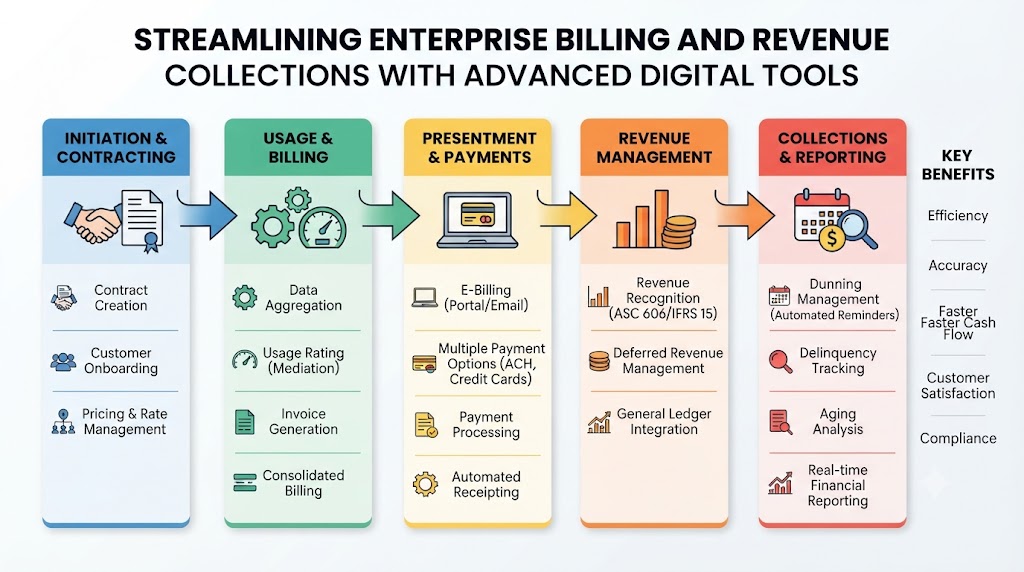
The financial journey from a closed sale to a final bank deposit involves numerous distinct steps. Disjointed workflows anywhere along this cycle cause delays that hurt overall business liquidity. Implementing comprehensive invoice to cash automation software unifies billing, collections, and matching into one fluid pipeline. Orders convert smoothly into professional tax documents, digital payment links attach automatically, and incoming funds sync instantly. This end-to-end digital integration eliminates manual handoffs between sales, billing, and accounting departments entirely. Complete process transparency ensures that leadership always knows exactly where company revenue stands. Seamless conversion from invoice to cash maximizes operational efficiency and profitability.
Improving Cash Flow with Accounts Receivable Automation
Healthy liquidity fuels every growing enterprise, yet waiting on slow payers constantly threatens financial stability. Chasing overdue accounts manually feels uncomfortable for staff and typically yields inconsistent, sluggish results. Integrating sophisticated accounts receivable automation software transforms how businesses handle outstanding customer balances. The platform systematically triggers polite follow-up sequences long before invoices reach critical overdue status. Offering multiple digital payment options within these automated reminders encourages clients to settle dues instantly. Consequently, Days Sales Outstanding metrics drop significantly, keeping working capital fluid and highly accessible. Proactive receivable management shields businesses from unexpected cash flow disruptions.
Automated Payment Reconciliation: Eliminating Manual Matching
Reconciling bank statements with ledger accounts traditionally counts as one of the most tedious monthly accounting chores. Matching hundreds of individual deposits against open bills manually drains valuable staff time and energy. Deploying advanced automated payment reconciliation software solves this challenge by executing matches algorithmically. The system instantly compares settlement files from payment processors against issued invoices with exceptional accuracy. Any mismatched or unidentified transactions automatically trigger flags for quick review by senior accountants. This eliminates human error and drastically shortens the monthly financial closing cycle. Flawless reconciliation guarantees that company balance sheets always reflect absolute ground truth.
Tracking Every Invoice Throughout Its Lifecycle
Lost paperwork and untraceable bills stand as major culprits behind delayed corporate revenues and strained partnerships. Without proper tracking, finance teams waste hours digging through email threads to find transaction statuses. Implementing specialized invoice payment tracking software gives companies real-time insights into every single bill issued. Every document moves through clear digital stages from creation and delivery to partial payment and final settlement. Automated status indicators immediately highlight whether a bill is paid, pending, overdue, or disputed. This granular tracking capability enables collection agents to follow up with precise, factual information. Complete lifecycle tracking guarantees that no company revenue slips through administrative cracks.
Managing Multiple Payment Gateways Efficiently
Modern consumers demand diverse payment methods, forcing businesses to integrate several distinct checkout processors simultaneously. Juggling multiple merchant accounts usually means managing separate login credentials, payout schedules, and fee structures. Leveraging a sophisticated multi gateway payment dashboard consolidates all processor data into one clean screen. Companies route transactions smoothly through reliable providers while viewing unified settlement reports instantly. This approach prevents administrative fatigue and eliminates the need to overhaul existing banking relationships. Furthermore, centralized oversight ensures that transaction fees and payout discrepancies are spotted immediately upon occurrence. Streamlining gateway management optimizes operational efficiency across the entire finance department.
Why Payment Collection Visibility Matters
Blind spots in revenue collection make accurate budgeting and working capital forecasting nearly impossible for leadership. Without a live overview of incoming funds, executives are forced to make critical decisions based on guesswork. Adopting comprehensive payment collection management software provides instant visibility into every single rupee entering the business. Finance professionals monitor collections across various digital channels without logging into multiple separate vendor accounts. This transparency helps identify seasonal collection trends and highlights chronically delayed accounts early in the cycle. Consequently, management intervenes proactively rather than reacting to sudden cash crunches after damage occurs. Clear financial visibility drives confident, data-backed strategic planning.
Simplifying Customer Payments with Payment Links
Securing timely revenue depends heavily on creating a frictionless checkout experience for every buyer. Traditional bank transfers involve tedious routing numbers and error-prone manual entry steps that discourage quick payments. Utilizing a dedicated payment link management platform allows companies to generate instant, clickable payment requests. Businesses distribute these digital links effortlessly through popular communication channels like messaging apps and electronic mail. Customers simply click the designated button and complete transactions using preferred digital wallets or net banking methods. Furthermore, setting automated expiration rules and reminder notifications encourages buyers to settle outstanding dues promptly. Reducing checkout friction directly translates into noticeably improved monthly cash flow metrics.
The Importance of GST-Compliant Invoicing
Navigating complex tax regulations demands absolute precision to avoid severe financial penalties and regulatory audits. Companies operating within domestic markets must generate tax documents that adhere strictly to local statutory frameworks. Utilizing specialized GST invoice software India businesses rely on ensures that every calculation remains completely error-free. These platforms automatically apply accurate tax splits including central, state, and integrated components based on client locations. Additionally, businesses customize billing templates easily with official corporate branding and unique serial numbering sequences. Maintaining compliant records protects organizations during tax season while building lasting trust with corporate partners. Accurate tax documentation serves as an undeniable pillar of healthy corporate governance.
Understanding Invoice and Payment Management Software
Dedicated financial platforms unify disparate billing, tracking, and collection tasks into one centralized dashboard. Employees manage every transaction from a single interface instead of jumping between banking portals and accounting sheets. This centralization guarantees that every department collaborates using accurate, real-time financial data. Modern systems handle everything from initial cost estimates to final settlement confirmations without missing a beat. Implementing invoice and payment management software empowers finance professionals to communicate more effectively across business units. Moreover, automated notifications keep internal staff and external clients perfectly aligned on upcoming deadlines. As a result, organizations experience significantly fewer billing disputes and faster cash turnover times.
The Growing Need for Financial Automation
Manual financial processing remains notoriously slow, expensive, and vulnerable to costly human oversight errors. Traditional administrative methods rapidly become unsustainable for growing enterprises as transaction volumes scale upward. Transitioning to intelligent accounts receivable automation software removes repetitive, low-value tasks from daily workflows. Staff members escape the trap of endless data entry, allowing them to focus on strategic financial analysis. Automated systems dispatch reminders, calculate taxes, and categorize receipts without requiring constant human supervision. Embracing digital automation accelerates operational velocity while significantly reducing overall administrative overhead costs. Modernizing financial infrastructure is essential for surviving in a fiercely competitive market.
Why Businesses Need Better Invoice and Payment Management
Fragmented financial operations create severe bottlenecks that actively stunt daily productivity and long-term scaling efforts. Teams constantly struggle to match incoming bank deposits with corresponding customer invoices through tedious manual methods. This lack of synchronization leads to delayed financial reporting and repetitive payment reminders that irritate clients. Furthermore, manual oversight leaves organizations vulnerable to expensive data entry mistakes that drain company resources. Implementing robust invoice and payment management software eliminates these administrative hurdles permanently. Centralizing all billing activities grants businesses immediate clarity into their true financial standing. Therefore, upgrading legacy systems remains mandatory for companies striving to maintain competitive advantages.
Common Queries Addressed Regarding PayManagerPro
What is PayManagerPro and how does it help growing businesses?
PayManagerPro functions as an advanced financial management platform designed to centralize invoicing, customer collections, and payment reconciliations.
Can I generate GST-compliant tax documents using this platform?
Yes, the software supports automated tax calculations including central, state, and integrated tax components for domestic businesses.
How do payment links work within the system?
Users generate secure digital checkout links with custom expiry rules and share them via electronic mail, messaging apps, or SMS.
Does the platform support multiple payment gateways?
Yes, it features a unified dashboard consolidating transaction data from various leading payment processors without replacing existing infrastructure.
How does automated payment reconciliation function?
The system algorithmically matches incoming gateway settlement files against issued invoices, highlighting discrepancies for quick review.
Is PayManagerPro suitable for multi-branch enterprises?
Yes, the platform offers role-based permissions, maker-checker controls, and secure application programming interfaces tailored for complex corporate structures.
Can I track the exact status of outstanding customer invoices?
Built-in tracking tools provide real-time visibility into whether bills are paid, pending, overdue, or currently in dispute.
What measures are in place to ensure data security?
The platform utilizes advanced encryption protocols, strict role-based access controls, and comprehensive audit trails to protect sensitive records.
How does automation improve monthly cash flow?
Automated reminder sequences and diverse digital payment options encourage clients to settle dues promptly, reducing overdue balances.
How do I get started with implementing PayManagerPro?
Businesses evaluate current workflow needs, explore platform integrations, and schedule personalized product demonstrations with our specialists.
Strategic Summary
Modernizing corporate liquidity requires discarding messy manual spreadsheets in favor of intelligent software automation. Consolidating every billing, collection, and reconciliation workflow grants financial teams total operational clarity. Modern platforms eliminate friction, safeguard profit margins, and maximize cash velocity across every organizational division. Leveraging these integrated solutions enables forward-thinking enterprises to direct their full energy toward sustainable market expansion. Ultimately, upgrading your corporate financial infrastructure today establishes an unshakeable foundation for tomorrow.

