
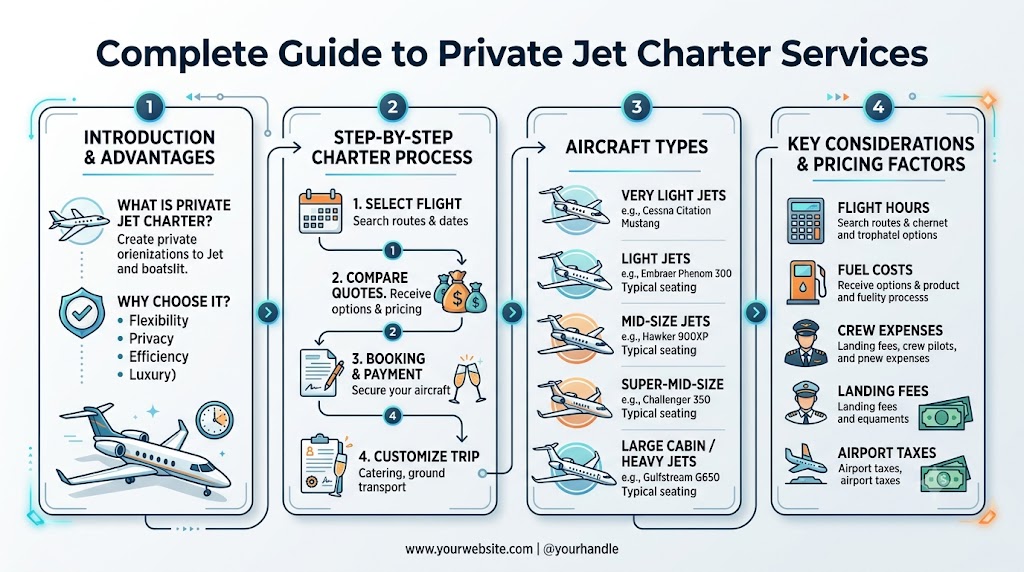
Introduction
Private jet charter is a flexible form of air travel in which an aircraft is arranged for a specific passenger, group, route, and schedule rather than relying on a published airline timetable. The service can range from a short regional flight in a light jet to long-range international travel in a large-cabin aircraft.
The important distinction is that private charter is not simply about booking a more luxurious seat. The real value comes from control over scheduling, airport selection, privacy, aircraft choice, and itinerary design. At the same time, charter introduces decisions that airline passengers rarely have to make, including aircraft suitability, operator credentials, repositioning costs, cancellation terms, weather limitations, and passenger documentation.
A good charter decision therefore starts with the mission rather than the aircraft. Define the passengers, route, dates, baggage, airport preferences, flexibility, and service requirements first. Then evaluate aircraft and operators against those requirements.
1. What Is a Private Jet Charter?
A private jet charter is an arranged flight using an aircraft dedicated to a particular customer or group.
Instead of purchasing an individual seat on a scheduled airline flight, the customer generally contracts for the aircraft or an agreed charter service. Depending on the arrangement, the charter provider may coordinate:
- Aircraft selection
- Flight scheduling
- Departure and arrival airports
- Ground transportation
- Catering
- Passenger services
- Special handling
- International travel requirements
- Changes to the itinerary
The aircraft may be operated directly by an aviation operator or supplied through a charter broker or management company.
This distinction matters because the company selling the charter and the company actually operating the aircraft may not always be the same organization.
Private Charter vs. Scheduled Airline
| Factor | Private Jet Charter | Scheduled Airline |
|---|---|---|
| Schedule | Customer-driven within operational constraints | Fixed published schedule |
| Aircraft | Selected according to mission | Determined by airline |
| Airport choice | Often much broader | Limited to airline network |
| Passenger group | Private group | Shared with other passengers |
| Privacy | High | Limited |
| Baggage flexibility | Often more flexible | Airline rules apply |
| Pricing | Usually quoted for the trip | Usually priced per seat |
| Operational flexibility | Higher | Lower |
| Planning complexity | Higher | Generally lower |
The important trade-off is simple: greater flexibility comes with greater responsibility for evaluating the charter arrangement.
2. Why People Use Private Jet Charter Services
Private charter makes the most sense when the advantages solve a genuine travel problem.
Common reasons include:
- Multiple destinations in a short period
- Travel to airports with limited scheduled service
- Business travel involving several meetings
- Group travel where airline schedules do not align
- Time-sensitive journeys
- Family or private travel requiring greater privacy
- Access to smaller regional airports
- Specialized baggage requirements
- International itineraries requiring customized planning
For some travelers, the biggest advantage is not luxury. It is time control.
If a business team can visit several locations without repeatedly routing through major airline hubs, the value may come primarily from reduced travel friction.
3. How Private Jet Charter Actually Works
A professional charter process normally involves several stages.
Step 1: Define the Mission
Start with the journey rather than asking, “Which jet should I book?”
Specify:
- Departure location
- Destination
- Travel dates
- Preferred departure time
- Number of passengers
- Baggage requirements
- One-way or round-trip travel
- Intermediate stops
- International requirements
- Airport preferences
- Catering requirements
- Ground transportation
- Special assistance
This information allows a provider to determine what aircraft and operating arrangement are appropriate.
Step 2: Determine Suitable Aircraft
Aircraft selection depends on more than passenger capacity.
A provider may evaluate:
- Range
- Payload
- Runway requirements
- Airport limitations
- Cabin configuration
- Baggage capacity
- Weather
- Fuel requirements
- Number of sectors
- Passenger comfort requirements
- International operating considerations
A larger aircraft is not automatically the better choice.
If four passengers are traveling a relatively short distance, a light or midsize aircraft may provide an appropriate balance of capability and cost. For a long international journey, a larger aircraft may become more appropriate because of range, cabin space, baggage capacity, and endurance.
Step 3: Receive a Charter Quote
A professional quote should be sufficiently detailed to understand what is and is not included.
Potential cost components include:
- Aircraft flight time
- Crew
- Fuel
- Airport charges
- Handling
- Navigation or operational fees
- Catering
- Ground transportation
- International permits or related services
- Repositioning
- Overnight crew expenses
- De-icing where applicable
- Special passenger requests
- Taxes and applicable government charges
Do not compare charter proposals solely on the headline price.
A lower initial quote can become less attractive if important operational charges are excluded.
4. Understanding Private Jet Charter Pricing
Private charter pricing is highly dependent on the actual mission.
There is no universally reliable “price per flight” because two apparently similar journeys can require very different aircraft and operational arrangements.
Major pricing factors
| Factor | Why It Matters |
|---|---|
| Aircraft category | Determines capability and operating economics |
| Flight duration | Affects aircraft and crew costs |
| Distance | Influences aircraft selection and fuel requirements |
| Passenger count | Affects aircraft suitability |
| Airport | Charges and operational constraints vary |
| Repositioning | Aircraft may need to travel without passengers |
| Waiting time | Crew and aircraft may incur additional costs |
| Overnight stay | Can create additional crew expenses |
| Catering | Depends on requirements |
| International travel | Can add operational complexity |
| Short-notice booking | May reduce aircraft availability |
| Schedule flexibility | Can improve or reduce available options |
Empty-leg opportunities
An empty leg occurs when an aircraft needs to reposition without passengers and a customer is able to use that positioning movement.
These flights can sometimes offer attractive pricing.
However, they are usually less flexible than a conventional charter because the aircraft’s underlying positioning requirement determines the route and timing.
Therefore:
Empty-leg travel is best viewed as an opportunity created by an existing aircraft movement, not as a guaranteed substitute for a fully flexible charter.
5. Choosing the Right Aircraft Category
The right aircraft depends on the mission.
Light Jets
Light jets are generally suited to shorter journeys and smaller passenger groups.
Strengths
- Lower operating cost than larger aircraft
- Suitable for relatively short sectors
- Smaller passenger groups
- Access to many regional airports
- Efficient for straightforward itineraries
Limitations
- Smaller cabins
- More limited baggage capacity
- Less suitable for very long journeys
- Fewer cabin amenities than larger aircraft
Midsize Jets
Midsize aircraft provide a useful balance between cabin comfort, range, and operating capability.
They can be appropriate when travelers need:
- More cabin space
- Greater range
- Additional baggage capacity
- Longer flight endurance
- More comfortable multi-hour travel
Super Midsize Jets
These aircraft sit between midsize and large-cabin categories.
They can be attractive for:
- Longer international sectors
- Larger passenger groups
- Greater cabin space
- More substantial baggage requirements
- Travelers seeking a balance between operating cost and long-range capability
Heavy and Large-Cabin Jets
Large-cabin aircraft are generally considered when the mission requires significant range, cabin space, passenger capacity, or specialized amenities.
Potential advantages include:
- Large cabins
- Separate seating areas
- More baggage capacity
- Long-range capability
- Greater comfort during extended flights
- More extensive onboard facilities
The drawback is straightforward: larger aircraft generally mean greater operating expense and may be unnecessary for a small or short-distance trip.
6. Do Not Choose an Aircraft by Seat Count Alone
A common mistake is to see an aircraft advertised as accommodating a particular number of passengers and assume that it automatically fits the mission.
Passenger capacity does not tell the entire story.
Consider:
Passenger configuration
Ten passengers in a spacious configuration may experience a very different journey from ten passengers in a denser layout.
Baggage
Golf equipment, musical instruments, bulky luggage, business equipment, or specialized gear can materially change aircraft suitability.
Range
An aircraft’s advertised range does not guarantee that it can fly every requested route under every condition with the desired payload.
Airport
An aircraft capable of operating the route may still not be the ideal aircraft for the selected airport because of runway, weight, weather, or operational considerations.
7. Selecting the Departure Airport
One of the major benefits of private charter is access to a broader selection of airports.
Instead of automatically choosing the largest commercial airport, evaluate:
- Distance from your starting point
- Airport operating hours
- Aircraft suitability
- Runway characteristics
- Customs availability for international travel
- Handling facilities
- Ground transportation
- Weather exposure
- Operating restrictions
A smaller airport can significantly reduce ground travel time.
However, not every private aviation airport can support every aircraft or international itinerary.
Airport selection must therefore be coordinated with the aircraft and operator.
8. Charter Broker vs. Aircraft Operator
This is one of the most important distinctions for first-time charter customers.
Charter Broker
A broker typically helps the customer source and arrange an aircraft from suitable operators.
Potential advantages
- Access to multiple operators
- Broader aircraft selection
- Competitive sourcing
- Help coordinating complex itineraries
- Single point of contact
Potential considerations
The customer should understand:
- Who operates the aircraft?
- Who holds operational responsibility?
- What operator is being proposed?
- How is the broker compensated?
- Are aircraft substitutions possible?
- Who is responsible if the proposed aircraft becomes unavailable?
Aircraft Operator
An operator is responsible for the operational side of the flight under its applicable regulatory framework.
A direct operator relationship can provide greater visibility into the actual operating organization.
Questions to ask
- Who is the operating carrier?
- What regulatory authority oversees the operation?
- What aircraft is actually being proposed?
- Is the aircraft operated directly by the quoted company?
- What happens if the aircraft becomes unavailable?
The key lesson is:
Always identify the actual aircraft operator, not just the company presenting the quote.
9. Safety and Operator Due Diligence
Safety should never be treated as a marketing feature.
A professional charter customer should evaluate the operator and the proposed aircraft before confirming the trip.
Depending on jurisdiction and operation, relevant considerations may include:
- Appropriate operating authorization
- Regulatory oversight
- Aircraft maintenance status
- Crew qualifications
- Operational history
- Safety management practices
- Insurance
- International operating capability
- Aircraft-specific limitations
If a broker is arranging the trip, ask what due-diligence process it uses to evaluate operators.
A useful principle
Do not judge operational quality solely by the aircraft’s appearance, cabin, website, or sales presentation.
The aircraft may be beautifully presented while the important operational questions remain unanswered.
10. Crew Considerations
The crew is an essential part of the charter operation.
Relevant factors can include:
- Pilot qualifications
- Aircraft-specific training
- Experience appropriate to the operation
- Crew duty limitations
- Rest requirements
- International operating experience where relevant
- Language and communication requirements
- Familiarity with the planned route or operating environment
Passengers do not need to manage crew scheduling themselves, but they should understand that a requested schedule must remain compatible with legal and operational crew requirements.
If a customer asks for an aggressive itinerary with multiple sectors and short turnaround times, the provider may need additional crew or schedule adjustments.
11. Weather and Operational Flexibility
Private charter provides greater scheduling flexibility, but it does not eliminate aviation constraints.
Weather can affect:
- Departure time
- Arrival time
- Route
- Airport selection
- Aircraft suitability
- Fuel requirements
- Diversion planning
Other operational issues can include:
- Air traffic restrictions
- Airport closures
- Maintenance
- Crew limitations
- Government restrictions
- Customs availability
- Slot requirements
- Aircraft repositioning
A professional provider should communicate these constraints clearly rather than promising an itinerary as though aviation operations were completely deterministic.
12. International Private Jet Charter
International charter introduces another layer of complexity.
Depending on the countries involved, planning may involve:
- Passports
- Visas
- Immigration procedures
- Customs
- Aircraft documentation
- Overflight permissions
- Landing permissions
- Airport operating requirements
- Sanctions or restricted destinations
- Local aviation regulations
Requirements can differ according to:
- Passenger nationality
- Destination
- Aircraft registration
- Operator
- Routing
- Purpose of travel
For international travel, provide passenger documentation early enough for the operator or broker to conduct the necessary checks.
13. What to Expect at the Airport
Private aviation often uses dedicated terminals or facilities rather than the standard airline passenger process.
The experience can involve:
- Arrival at the designated private aviation facility
- Passenger identity and documentation checks
- Security procedures
- Baggage handling
- Aircraft boarding
- Departure
However, procedures vary by airport and itinerary.
International flights can involve additional immigration and customs procedures.
Therefore, do not assume that “private jet” means no security or documentation requirements.
14. Catering and Onboard Services
Catering can range from simple refreshments to customized meals.
When arranging catering, communicate:
- Number of passengers
- Dietary requirements
- Allergies
- Preferred meals
- Departure time
- Flight duration
- Beverage preferences
- Children’s requirements where relevant
For short flights, extensive catering may have little practical value.
For longer flights, food and cabin service can become more important to the overall experience.
15. Ground Transportation
A charter itinerary should be viewed as a door-to-door journey, not just a flight.
Consider arranging:
- Airport transfers
- Chauffeur service
- Hotel transportation
- Multiple vehicle requirements
- Luggage transfers
- Business meeting transportation
The most efficient airport is not necessarily the airport closest to the city center. Ground transportation time should be included when comparing airports.
16. Pets and Special Requirements
If traveling with pets or specialized equipment, mention it before receiving the final aircraft proposal.
Potential considerations include:
- Pet policies
- Carrier requirements
- Cabin arrangements
- Cleaning procedures
- International animal-entry requirements
- Oversized baggage
- Sports equipment
- Medical or mobility requirements
Do not assume that every private aircraft automatically accommodates every special request.
17. Cancellation, Changes, and Delays
Read the contract carefully before payment.
Important provisions may include:
- Cancellation deadlines
- Refund rules
- Rescheduling charges
- Aircraft substitution
- Weather disruption
- Operator cancellation
- Passenger no-show
- Schedule changes
- Additional flight time
- Additional airport charges
- Repositioning charges
One question every customer should ask
“What happens financially and operationally if the aircraft cannot operate this flight as planned?”
The answer can be more important than the initial quote.
18. Aircraft Substitution
Aircraft substitution is not necessarily a problem.
An operator may need to replace an aircraft because of:
- Maintenance
- Scheduling
- Operational requirements
- Weather
- Crew availability
- Technical issues
The replacement aircraft should still meet the contractual and operational requirements of the trip.
Before booking, clarify:
- Can the operator substitute aircraft?
- Can the aircraft category change?
- What happens if the replacement has different capacity?
- What happens if baggage capacity changes?
- Is there a price adjustment?
19. Common Private Charter Mistakes
Mistake 1: Choosing the Lowest Quote
The lowest number does not necessarily represent the lowest total cost.
Better approach
Compare quotes on an all-in basis.
Mistake 2: Ignoring Repositioning
The aircraft may not be located at your departure airport.
That movement can become part of the economics of the charter.
Mistake 3: Choosing the Aircraft Before Defining the Mission
A specific jet may sound attractive but be poorly suited to the actual route.
Better approach
Define the mission first.
Mistake 4: Assuming Advertised Range Is Guaranteed
Range depends on operational conditions and payload.
Better approach
Ask the provider to confirm that the proposed aircraft can perform the actual mission under expected conditions.
Mistake 5: Forgetting Baggage
Passenger capacity and baggage capacity are separate considerations.
Mistake 6: Not Identifying the Operator
Knowing who actually operates the aircraft is fundamental.
Mistake 7: Treating the Quote as the Contract
The quote is not necessarily the complete commercial agreement.
Read the actual charter terms.
Mistake 8: Ignoring International Documentation
A private aircraft does not eliminate immigration, customs, or visa requirements.
Mistake 9: Overloading the Schedule
Trying to fit too many sectors into a single day can create operational pressure.
A good itinerary leaves reasonable room for real-world aviation constraints.
20. How to Compare Charter Providers
Use a structured evaluation rather than choosing based on presentation quality.
| Evaluation Area | Key Question |
|---|---|
| Operator identity | Who actually operates the aircraft? |
| Regulatory status | Is the operation appropriately authorized? |
| Aircraft | Does the aircraft genuinely fit the mission? |
| Safety | What due diligence is available? |
| Pricing | What is included in the quoted amount? |
| Flexibility | How are changes handled? |
| Communication | Who manages the trip? |
| International support | Can the provider handle the required jurisdictions? |
| Ground services | Can transfers and logistics be coordinated? |
| Contingency planning | What happens if the aircraft becomes unavailable? |
| Contract | Are cancellation and substitution terms clear? |
| Service | Does the provider understand the passenger’s priorities? |
21. A Practical Charter Decision Framework
A simple decision model can help.
Priority 1: Operational suitability
Can the aircraft and operator safely perform the requested mission?
If not, eliminate the option.
Priority 2: Schedule
Can the aircraft support the required departure, arrival, and intermediate stops?
Priority 3: Airport access
Does the proposed routing use airports that make sense for the entire journey?
Priority 4: Passenger requirements
Does the aircraft accommodate the passengers, baggage, pets, equipment, and service requirements?
Priority 5: Commercial terms
Compare the complete cost, not merely the initial quoted figure.
Priority 6: Flexibility
Understand how schedule changes, delays, cancellations, and aircraft substitutions are handled.
22. Questions to Ask Before Booking
Use this checklist when speaking with a charter provider.
Aircraft
- What aircraft is proposed?
- Who operates it?
- What is the cabin configuration?
- What is the usable baggage capacity?
- Can the aircraft perform the planned route without an unsuitable operational compromise?
- Is aircraft substitution possible?
Operator
- Who is the actual operating company?
- What regulatory authorization applies?
- What due diligence has been completed?
- Who will be responsible for operational decisions?
Pricing
- Is the quotation all-inclusive?
- Are repositioning costs included?
- Are airport and handling charges included?
- Are catering and ground transportation included?
- What additional charges could arise?
Schedule
- How flexible is the departure time?
- What happens if weather delays the flight?
- How are schedule changes handled?
- What happens if the aircraft becomes unavailable?
International travel
- Are all required permits being coordinated?
- What passenger documents are required?
- Are immigration and customs arrangements included?
Contract
- What are the cancellation terms?
- What are the refund conditions?
- What happens after an operator cancellation?
- What happens if the passenger changes the itinerary?
23. Private Jet Charter: When It Makes Sense
Private charter tends to make stronger practical sense when:
- Several travelers are moving together
- Airline schedules create substantial wasted time
- Multiple destinations are involved
- Smaller airports significantly reduce ground travel
- Privacy is important
- The trip is time-sensitive
- The group has specialized baggage
- Schedule control has meaningful business or personal value
The calculation should include time saved, not only flight cost.
For a business group, several hours saved across multiple travelers can materially change the economics of the trip.
24. When Scheduled Airlines May Be Better
Private charter is not automatically the superior choice.
Scheduled airlines may be more appropriate when:
- The traveler is alone or traveling with a very small group
- A convenient nonstop flight already exists
- The destination is well served
- Schedule flexibility is not important
- Cost efficiency is the primary objective
- The traveler does not require privacy or specialized services
Good travel planning is about matching the transportation method to the mission.
25. Safety, Privacy, and Security Considerations
Private aviation can provide greater privacy, but privacy does not automatically equal security.
For sensitive travel, consider:
- Passenger information handling
- Identity verification
- Payment security
- Confidential itinerary management
- Ground transportation arrangements
- Access to private terminals
- Communication protocols
- Data protection
Avoid unnecessarily distributing detailed passenger itineraries.
For business travelers, consider whether meeting schedules, executive movements, or confidential travel plans should be shared with only those who need the information.
26. Operational Planning for Complex Trips
Complex charter itineraries require more planning than a simple one-way journey.
For example, a hypothetical business group might need to visit three cities over two days.
The provider may need to coordinate:
Day 1
Departure → City A → City B
Day 2
City B → City C → Return
The planning must account for:
- Aircraft positioning
- Passenger boarding time
- Crew duty requirements
- Airport availability
- Fuel
- Weather
- Ground transportation
- Baggage
- Potential delays
The lesson is important:
A charter itinerary should be designed as an operational plan, not merely a sequence of desired departure times.
27. How to Get Better Charter Quotes
Provide complete information at the beginning.
Instead of saying:
“How much is a private jet to another city?”
Provide:
- Exact departure airport or preferred region
- Destination
- Date
- Preferred departure window
- Passenger count
- Baggage requirements
- One-way or round-trip requirement
- Return date and timing
- Pets or special equipment
- International requirements
- Flexibility
More complete information generally allows the provider to produce a more meaningful proposal.
Compare like-for-like
When comparing two quotes, make sure they cover:
- Same route
- Same dates
- Similar departure windows
- Comparable aircraft
- Same passenger requirements
- Same baggage assumptions
- Similar ground services
- Similar cancellation terms
- Similar included charges
Otherwise, the price comparison can be misleading.
28. Charter Booking Workflow
A disciplined booking process can look like this:
Define Travel Mission
        ↓
Identify Airports and Schedule
        ↓
Specify Passengers and Baggage
        ↓
Request Multiple Suitable Options
        ↓
Verify Actual Aircraft Operator
        ↓
Evaluate Aircraft Suitability
        ↓
Review Safety and Operational Credentials
        ↓
Compare All-In Pricing
        ↓
Review Contract Terms
        ↓
Confirm Passenger Documentation
        ↓
Confirm Final Itinerary
        ↓
Arrange Ground Services
        ↓
Travel
        ↓
Review Final Charges and Service
This workflow reduces the risk of making a decision based solely on the aircraft photograph or headline price.
29. What a High-Quality Charter Service Should Provide
A strong charter provider should make the customer feel that the trip is being actively managed, not simply sold.
Look for:
- Clear communication
- Transparent pricing
- Realistic scheduling
- Accurate aircraft information
- Strong operator due diligence
- Clear contract terms
- Contingency planning
- Responsive trip management
- International coordination where needed
- Professional handling of changes
A good provider should also be comfortable telling the customer when a requested plan is operationally impractical.
That is often a sign of professionalism rather than poor service.
30. Private Jet Charter Checklist
Before Requesting Quotes
- Confirm passengers
- Confirm departure and destination
- Confirm dates
- Establish preferred times
- Estimate baggage
- Identify pets or special equipment
- Identify preferred airports
- Determine international requirements
- Establish flexibility
Before Booking
- Identify actual operator
- Confirm aircraft
- Check aircraft suitability
- Review total pricing
- Understand repositioning charges
- Review cancellation terms
- Review aircraft substitution provisions
- Confirm required documentation
- Confirm ground transportation
Before Departure
- Reconfirm itinerary
- Confirm passenger information
- Confirm departure facility
- Confirm transportation
- Confirm catering
- Check for operational schedule changes
- Keep required travel documents accessible
31. Final Recommendation
The best private jet charter is not necessarily the newest aircraft, the largest cabin, or the cheapest quotation. It is the option where the aircraft, operator, route, schedule, commercial terms, and passenger requirements all fit together properly.
Start with the mission, then select the airport and aircraft. Identify the actual operator and evaluate the operational arrangement before focusing on amenities. Compare complete quotations rather than headline prices, and read cancellation, substitution, and disruption provisions carefully.
For straightforward travel, a smaller aircraft may be the most sensible choice. For complex or long-distance missions, larger aircraft and more extensive planning may be justified.
The strongest charter decisions come from treating private aviation as an operational service with luxury features, rather than treating it as luxury travel alone.
FAQs
Q1. What is a private jet charter?
A private jet charter is a customized flight arrangement in which an aircraft is made available for a specific passenger group and itinerary rather than selling individual seats on a scheduled airline service.
Q2. How much does a private jet charter cost?
Pricing depends on aircraft type, route, flight time, airport charges, repositioning, crew requirements, services, and other operational factors. A meaningful quote requires the actual travel mission.
Q3. Is private jet charter safer than commercial airline travel?
Safety should be evaluated based on the actual operator, regulatory oversight, aircraft, crew, maintenance, and operating practices rather than assuming that private aviation is inherently safer.
Q4. Can I choose the aircraft?
Usually, customers can express aircraft preferences, but the final selection must meet the route, passenger, airport, payload, range, and operational requirements.
Q5. Can private jets use smaller airports?
Many private aircraft can use airports that have limited or no scheduled airline service, but suitability depends on aircraft performance, airport characteristics, operating restrictions, and other requirements.
Q6. Can I charter a private jet internationally?
Yes, international charter is possible, but it may require additional planning for immigration, customs, visas, permits, aircraft documentation, and local regulations.
Q7. Does private charter eliminate airport security?
No. Security, identification, immigration, customs, and other procedures may still apply depending on the airport and itinerary.
Q8. Can I bring a pet on a private jet?
Pets may be accommodated on many private charter flights, but policies and international entry requirements vary. The provider should be informed before booking.
Q9. What is an empty-leg flight?
An empty leg is a repositioning flight where an aircraft would otherwise travel without passengers. When the timing and route align, a customer may be able to charter that movement under different commercial terms.
Q10. Should I use a broker or contact an operator directly?
Both approaches can work. A broker may provide access to multiple operators and aircraft, while direct booking can provide a more direct relationship with the operating company. In either case, identify who actually operates the aircraft and understand the contractual arrangement.
Q11. What should I look for in a charter quote?
Look beyond the headline price. Review aircraft, operator, route, schedule, repositioning, airport charges, catering, ground services, taxes, cancellation provisions, aircraft substitution, and other potential charges.
Q12. What is the biggest mistake first-time charter customers make?
One of the most common mistakes is treating private charter like an airline booking and focusing primarily on the price. Charter requires evaluating the complete operational and contractual arrangement.
Conclusion
Private jet charter is fundamentally about mission flexibility, time control, and customized aviation services.
The right choice starts with the journey, not the aircraft brochure.
Customers should verify the actual operator, aircraft suitability, pricing structure, and contractual protections before booking.
International and complex itineraries require additional operational and documentation planning.
The best charter provider combines transparent commercial terms with strong operational judgment and contingency planning.
When those elements align, private charter can become a highly effective transportation solution rather than simply a premium travel experience.

