
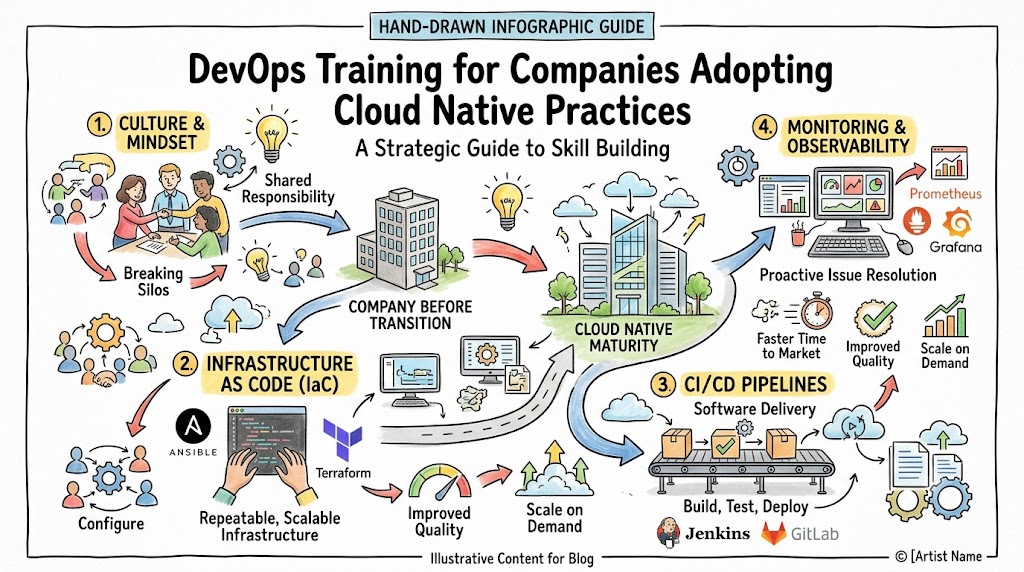
Introduction
Cloud-native technologies have transformed the way organizations build, deploy, and manage software applications. Businesses are increasingly moving away from traditional infrastructure toward containerized applications, Kubernetes orchestration, Infrastructure as Code (IaC), automated CI/CD pipelines, and microservices architectures. While these technologies offer flexibility, scalability, and faster software delivery, they also introduce new operational challenges that require skilled engineering teams.
Adopting cloud-native practices is not simply about deploying applications to the cloud—it requires a cultural shift, automation-first thinking, and continuous collaboration between development, operations, security, and platform teams. Without proper guidance and structured learning, organizations often struggle to realize the full benefits of their cloud transformation initiatives.
This is where professional DevOps Training becomes a strategic investment. Well-designed training programs help engineering teams understand modern DevOps principles, cloud-native architectures, Kubernetes, automation, observability, and security best practices while building the confidence needed to manage production environments effectively.
Organizations looking to strengthen their DevOps capabilities and cloud-native expertise can explore professional corporate training and consulting services at https://www.cotocus.com/.
Understanding Cloud Native Practices
Cloud-native development focuses on building applications that fully leverage cloud infrastructure and modern deployment models. Instead of relying on monolithic applications and manual operations, cloud-native systems are designed to be scalable, resilient, automated, and continuously deployable.
Cloud-native practices commonly include:
- Containerized applications
- Kubernetes orchestration
- Microservices architecture
- Infrastructure as Code (IaC)
- Continuous Integration and Continuous Delivery (CI/CD)
- GitOps workflows
- DevSecOps integration
- Automated monitoring and observability
- Platform engineering
- Self-service infrastructure
These practices help organizations respond quickly to changing business requirements while maintaining operational stability.
Why DevOps Training Is Essential for Cloud-Native Adoption
Many organizations invest in cloud technologies but fail to achieve expected business outcomes because teams lack practical knowledge of modern engineering workflows.
Professional DevOps Training bridges this gap by providing engineers with hands-on experience in automation, deployment strategies, cloud infrastructure, and collaborative software delivery practices.
Benefits of structured DevOps training include:
- Faster adoption of cloud-native technologies
- Improved engineering collaboration
- Reduced manual deployment effort
- Standardized operational processes
- Better infrastructure management
- Increased deployment confidence
- Stronger production reliability
- Enhanced automation capabilities
Training also helps teams understand not just individual tools but the complete software delivery lifecycle.
Building a Cloud-Native DevOps Culture
Successful cloud-native transformation extends beyond technology. It requires organizations to build a culture focused on collaboration, continuous improvement, and shared ownership.
Key cultural principles include:
Collaboration Across Teams
Development, operations, QA, security, and platform teams work together throughout the software lifecycle.
Automation First
Manual processes are gradually replaced with automated pipelines, infrastructure provisioning, testing, and deployments.
Continuous Learning
Engineering teams continuously improve skills as cloud technologies evolve.
Shared Responsibility
Developers take greater ownership of deployment quality while operations teams focus on platform reliability and automation.
Feedback and Observability
Monitoring and metrics help teams identify issues early and improve application performance.
Core Topics Covered in DevOps Corporate Training
An effective corporate DevOps training program should address both foundational concepts and advanced cloud-native practices.
DevOps Fundamentals
- DevOps principles
- Agile integration
- Collaboration models
- Version control
- Automation strategies
Continuous Integration and Continuous Delivery
- Source code management
- Automated testing
- Build pipelines
- Release automation
- Deployment strategies
- Rollback planning
Infrastructure as Code
- Terraform
- Infrastructure provisioning
- Environment consistency
- Resource automation
- State management
Containerization
- Docker fundamentals
- Container image creation
- Registry management
- Multi-container applications
Kubernetes
- Cluster architecture
- Pods and Deployments
- Services
- ConfigMaps
- Secrets
- Helm
- Scaling
- High availability
- Troubleshooting
GitOps
- Git-based deployment
- Declarative infrastructure
- Automated synchronization
- Change auditing
Monitoring and Observability
- Metrics
- Logging
- Distributed tracing
- Alerting
- Dashboards
- Performance monitoring
DevSecOps
- Secure pipelines
- Code scanning
- Dependency management
- Container security
- Compliance automation
Why Kubernetes Skills Matter
Kubernetes has become the standard platform for managing containerized workloads across cloud environments.
Organizations adopting cloud-native architectures need engineers who understand:
- Cluster management
- Application deployment
- Scaling
- Load balancing
- Networking
- Persistent storage
- Security
- Disaster recovery
- Rolling updates
- Resource optimization
Practical Kubernetes training enables teams to deploy reliable, scalable, and highly available applications with confidence.
CI/CD Automation for Faster Software Delivery
Continuous Integration and Continuous Delivery enable organizations to release software frequently while maintaining quality.
A structured CI/CD training program teaches teams how to:
- Automate builds
- Execute automated testing
- Perform continuous deployments
- Validate releases
- Reduce deployment failures
- Improve release consistency
Automation shortens release cycles while minimizing human error.
Infrastructure as Code for Modern Operations
Cloud-native organizations increasingly rely on Infrastructure as Code (IaC) to provision and manage infrastructure.
Key benefits include:
- Repeatable environments
- Version-controlled infrastructure
- Reduced configuration drift
- Faster provisioning
- Easier disaster recovery
- Improved compliance
Terraform has become one of the most widely adopted IaC tools due to its cloud-agnostic capabilities and declarative approach.
Integrating Security into DevOps
Security is an essential component of cloud-native engineering rather than a separate phase.
Modern DevOps training introduces practices such as:
- Secure coding principles
- Static application security testing
- Dependency scanning
- Container image scanning
- Secret management
- Policy enforcement
- Compliance automation
Integrating security early helps reduce vulnerabilities while maintaining development speed.
Observability and Reliability
Cloud-native environments generate large volumes of operational data. Engineers must understand how to use this information to maintain healthy production systems.
Important observability concepts include:
- Application metrics
- Centralized logging
- Distributed tracing
- Performance monitoring
- Alert management
- Incident response
These capabilities help teams identify and resolve issues before they impact users.
Platform Engineering and Developer Productivity
Platform engineering has become increasingly important for organizations operating at scale.
Internal developer platforms provide:
- Self-service infrastructure
- Standardized deployment workflows
- Reusable templates
- Automated environments
- Consistent developer experiences
- Reduced operational overhead
Training in platform engineering helps organizations build systems that enable developers to deliver software more efficiently.
Business Benefits of DevOps Training
Organizations investing in DevOps training often experience improvements across multiple areas of software delivery.
Some of the key business benefits include:
- Faster product releases
- Improved deployment quality
- Reduced downtime
- Better collaboration
- Increased automation
- Improved cloud utilization
- Greater operational consistency
- Enhanced system reliability
- Better engineering productivity
- Stronger security practices
These improvements contribute to long-term business agility and customer satisfaction.
Who Should Attend This Training?
DevOps training is valuable for professionals across different roles, including:
- DevOps Engineers
- Cloud Engineers
- Software Developers
- Platform Engineers
- SRE Engineers
- Release Managers
- Build Engineers
- Infrastructure Engineers
- Security Engineers
- Technical Architects
- Engineering Managers
- IT Operations Teams
- Cloud Migration Teams
- Corporate Engineering Departments
Tools and Technologies Covered
| Area | Tools / Topics | Business Value |
|---|---|---|
| Version Control | Git, GitHub, GitLab | Collaborative development |
| CI/CD | Jenkins, GitHub Actions, Azure DevOps | Faster software delivery |
| Containers | Docker | Portable application deployment |
| Container Orchestration | Kubernetes, Helm | Scalable cloud-native applications |
| Infrastructure as Code | Terraform | Automated infrastructure management |
| Cloud Platforms | AWS, Azure, Google Cloud | Scalable cloud operations |
| GitOps | Argo CD, Flux | Reliable deployments |
| Monitoring | Prometheus, Grafana | Better production visibility |
| Logging | ELK, Loki | Faster troubleshooting |
| DevSecOps | Security Scanning, Policy Automation | Secure software delivery |
Why Choose Cotocus for Corporate DevOps Training?
Selecting the right training partner is as important as choosing the right technology. Organizations benefit from training that combines conceptual understanding with practical implementation.
Cotocus focuses on helping engineering teams build real-world capabilities through structured learning, hands-on exercises, and industry-relevant practices. Its approach emphasizes cloud-native technologies, automation, DevOps culture, Kubernetes, CI/CD, Infrastructure as Code, DevSecOps, and platform engineering, enabling organizations to prepare teams for modern software delivery challenges.
Businesses interested in professional DevOps consulting and enterprise training can learn more by visiting https://www.cotocus.com/.
Frequently Asked Questions
1. Why is DevOps training important for cloud-native adoption?
DevOps training equips teams with the skills needed to automate deployments, manage cloud infrastructure, implement CI/CD pipelines, and operate Kubernetes environments effectively.
2. Who should attend corporate DevOps training?
Corporate DevOps training is suitable for developers, cloud engineers, DevOps professionals, SRE teams, platform engineers, IT managers, and organizations undergoing digital transformation.
3. Does DevOps training include Kubernetes and Docker?
Yes. Most modern DevOps training programs include Docker, Kubernetes, container orchestration, CI/CD automation, Infrastructure as Code, and cloud-native deployment practices.
4. How does DevOps improve cloud migration projects?
DevOps enables automated infrastructure provisioning, standardized deployments, continuous testing, monitoring, and faster application delivery, making cloud migration more efficient and reliable.
5. What business value does DevOps corporate training provide?
Organizations benefit through faster software releases, improved collaboration, better automation, enhanced security, increased operational efficiency, and more reliable production systems.
Conclusion
Cloud-native transformation is reshaping how organizations develop and operate software. Technologies such as Kubernetes, containers, Infrastructure as Code, CI/CD, DevSecOps, observability, and platform engineering have become essential for building scalable and resilient applications. However, these technologies deliver the greatest value only when engineering teams possess the right skills and practical experience.
Investing in professional DevOps training helps organizations build capable teams, streamline software delivery, improve automation, strengthen security, and maintain reliable production systems. Whether your organization is beginning its cloud-native journey or looking to optimize existing DevOps practices, structured training provides a strong foundation for long-term success.
To explore enterprise DevOps training, cloud consulting, and modern engineering solutions, visit https://www.cotocus.com/.

