
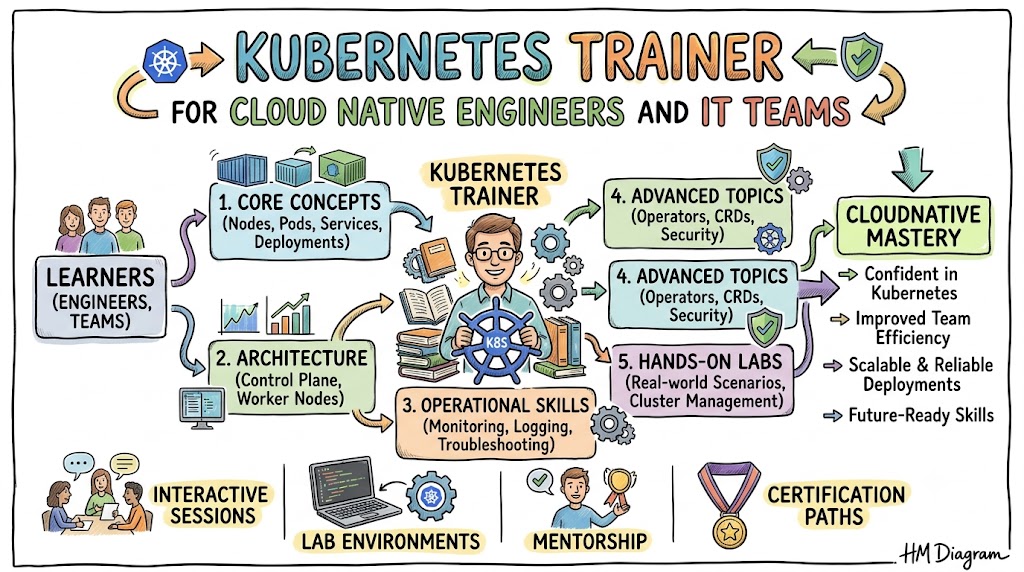
Introduction
Cloud-native technologies have transformed the way organizations build, deploy, and operate modern applications. As businesses continue adopting microservices, containers, and hybrid cloud environments, Kubernetes has become the preferred platform for orchestrating containerized workloads. However, implementing Kubernetes successfully requires more than installing a cluster—it demands practical knowledge, operational experience, and a deep understanding of production environments.
This is where an experienced Kubernetes Trainer plays an essential role. Organizations investing in structured learning enable their engineering teams to deploy applications faster, improve system reliability, strengthen security, and simplify infrastructure management.
Rajesh Kumar has built a strong reputation for helping professionals and enterprises develop practical DevOps and Kubernetes skills through real-world learning experiences. His expertise spans DevOps, Site Reliability Engineering (SRE), Platform Engineering, DevSecOps, cloud automation, Infrastructure as Code, and CI/CD implementation. Professionals interested in learning more about his training and consulting services can visit https://www.rajeshkumar.xyz/.
This article explains why Kubernetes expertise matters, how professional training accelerates cloud-native adoption, and why organizations benefit from learning from an experienced industry practitioner.
Who Is Rajesh Kumar?
Rajesh Kumar is recognized for helping engineering teams bridge the gap between theory and production-ready DevOps practices. His work focuses on enabling organizations to improve software delivery, infrastructure automation, cloud operations, and operational excellence.
His expertise includes:
- DevOps implementation
- Kubernetes orchestration
- Docker containerization
- Site Reliability Engineering
- DevSecOps practices
- Platform Engineering
- CI/CD Pipeline Training
- GitOps implementation
- Terraform automation
- Jenkins automation
- Cloud architecture
- Enterprise DevOps consulting
Rather than focusing only on certification objectives, his training emphasizes solving practical challenges faced by software engineers, cloud architects, operations teams, and enterprise technology organizations.
Why Organizations Need an Experienced DevOps Trainer
Modern software delivery requires close collaboration between developers, operations teams, quality engineers, and security professionals. Without proper training, organizations often struggle with inconsistent deployment processes, manual operations, and production issues.
An experienced DevOps Trainer helps organizations build a culture of automation, collaboration, and continuous improvement.
Benefits of DevOps Corporate Training include:
- Standardized engineering practices
- Faster software releases
- Reduced deployment failures
- Improved collaboration across teams
- Better infrastructure automation
- Increased operational efficiency
- Improved monitoring and observability
- Higher application availability
For organizations looking for a trusted DevOps Trainer in India, practical enterprise-focused training provides lasting value beyond classroom concepts.
Why Kubernetes Has Become Essential
Kubernetes has become the industry standard for managing containerized workloads because it automates many operational tasks that would otherwise require manual intervention.
Organizations use Kubernetes to:
- Deploy applications consistently
- Scale services automatically
- Recover workloads after failures
- Manage rolling updates
- Improve resource utilization
- Support hybrid and multi-cloud deployments
- Increase application availability
- Simplify infrastructure management
As cloud-native adoption grows, Kubernetes skills have become essential for modern engineering teams.
Kubernetes Trainer and Kubernetes Corporate Training
A skilled Kubernetes Trainer helps engineers understand both the technical concepts and operational practices needed for production environments.
Professional Kubernetes Corporate Training typically combines theoretical knowledge with practical implementation.
Key learning areas include:
Kubernetes Architecture
Participants learn the components that make up a Kubernetes cluster, including:
- Control Plane
- Worker Nodes
- API Server
- Scheduler
- etcd
- Controller Manager
- kubelet
- kube-proxy
Understanding these components helps engineers troubleshoot and manage production clusters more effectively.
Container Fundamentals
Before mastering Kubernetes, engineers need a strong understanding of containers.
Training covers:
- Docker basics
- Images
- Containers
- Registries
- Networking
- Volumes
- Multi-stage builds
- Image optimization
This practical approach forms the foundation of effective Docker Kubernetes Training.
Application Deployment
Participants learn how Kubernetes manages applications using:
- Pods
- ReplicaSets
- Deployments
- StatefulSets
- DaemonSets
- Jobs
- CronJobs
Hands-on exercises help teams understand deployment strategies used in production environments.
Service Discovery
Reliable communication between services is critical in microservice architectures.
Training covers:
- Services
- ClusterIP
- NodePort
- LoadBalancer
- Ingress
- DNS
- Network policies
These concepts improve application accessibility and network reliability.
Configuration Management
Applications often require different configurations across environments.
Training explains:
- ConfigMaps
- Secrets
- Environment variables
- Persistent storage
- Storage classes
- Persistent Volume Claims
This enables consistent deployments across development, testing, and production.
Docker Kubernetes Training for Production Environments
Containers have become the standard packaging mechanism for modern applications.
Comprehensive Docker Kubernetes Training focuses on:
- Building optimized container images
- Running secure containers
- Managing container lifecycle
- Image scanning
- Resource management
- Container networking
- Logging
- Persistent storage
- Production deployment
Rather than isolated Docker examples, training demonstrates how containers operate within enterprise Kubernetes clusters.
CI/CD Pipeline Training for Kubernetes
Continuous Integration and Continuous Delivery are closely connected with Kubernetes.
Professional CI/CD Pipeline Training teaches teams how to automate application delivery using modern DevOps workflows.
Topics include:
- Source code management
- Automated builds
- Automated testing
- Image creation
- Container registries
- Deployment automation
- Rollback strategies
- Release management
Organizations benefit through:
- Faster releases
- Reduced manual work
- Better software quality
- Lower deployment risk
- Improved developer productivity
Jenkins Training for Kubernetes Automation
Automation is one of the biggest advantages of Kubernetes.
Professional Jenkins Training helps engineers build automated deployment pipelines capable of deploying applications to Kubernetes clusters.
Training typically covers:
- Pipeline creation
- Declarative pipelines
- Shared libraries
- Build automation
- Test automation
- Kubernetes agents
- Deployment automation
- Artifact management
These capabilities reduce manual effort while improving deployment consistency.
Terraform Training for Infrastructure as Code
Infrastructure provisioning should be automated alongside application deployment.
Terraform Training teaches engineers how to manage cloud infrastructure using code.
Learning topics include:
- Infrastructure as Code
- Modules
- Variables
- State management
- Remote backends
- Cloud provisioning
- Kubernetes infrastructure
- Automation workflows
This enables organizations to create repeatable infrastructure while reducing configuration errors.
GitOps Training for Modern Operations
GitOps has become an increasingly popular operational model for Kubernetes.
Professional GitOps Training demonstrates how Git repositories become the single source of truth for infrastructure and application configuration.
Key concepts include:
- Git workflows
- Continuous reconciliation
- Automated deployments
- Configuration management
- Version control
- Rollback
- Audit trails
- Infrastructure consistency
GitOps simplifies operations while improving deployment reliability.
Beyond Kubernetes: Building Complete Cloud-Native Skills
Modern engineering teams benefit from learning complementary technologies alongside Kubernetes.
These include:
| Area | Tools / Topics | Business Value |
|---|---|---|
| Terraform Training | Infrastructure as Code | Automated cloud provisioning |
| Jenkins Training | CI/CD Automation | Faster software delivery |
| CI/CD Pipeline Training | Build, Test, Deploy | Reliable release process |
| GitOps Training | Argo CD, Git workflows | Consistent deployments |
| Docker Kubernetes Training | Containers and orchestration | Cloud-native application delivery |
| AWS DevOps | Cloud automation | Scalable infrastructure |
| Monitoring & Observability | Prometheus, Grafana, Logging | Better production visibility |
| DevSecOps | Security automation | Secure software delivery |
| SRE | Reliability engineering | Higher availability |
| Platform Engineering | Developer platforms | Improved engineering productivity |
Why Organizations Choose Rajesh Kumar
Organizations value experienced trainers who combine technical depth with practical implementation knowledge.
Key strengths include:
- Hands-on enterprise experience
- Practical learning approach
- Real production examples
- Strong DevOps ecosystem expertise
- Cloud-native architecture knowledge
- Automation-first mindset
- Focus on operational excellence
- Guidance tailored to working professionals
- Support for enterprise technology teams
- Experience across multiple DevOps tools and platforms
The emphasis remains on helping engineers apply concepts confidently in real production environments rather than simply completing theoretical exercises.
Who Benefits Most from Kubernetes Training?
Professional Kubernetes training is valuable for:
- Cloud Engineers
- DevOps Engineers
- Software Developers
- Platform Engineers
- SRE Teams
- Infrastructure Engineers
- Cloud Architects
- IT Managers
- Engineering Managers
- Corporate Learning teams
- Startups
- Enterprise IT organizations
- Digital transformation initiatives
- Cloud migration teams
Whether an organization is beginning its cloud-native journey or scaling existing Kubernetes deployments, structured learning significantly improves project outcomes.
Business Benefits of Kubernetes and DevOps Training
Organizations investing in Kubernetes and DevOps capability development often experience improvements in several operational areas.
Common benefits include:
- Faster software delivery
- Improved deployment consistency
- Better infrastructure automation
- Reduced operational complexity
- Improved application scalability
- Higher platform reliability
- Stronger collaboration between teams
- Enhanced security practices
- Better cloud resource utilization
- Greater confidence during production releases
These improvements help organizations build resilient, scalable, and efficient technology platforms.
Frequently Asked Questions
1. Why should companies hire a Kubernetes Trainer?
An experienced Kubernetes Trainer provides structured, practical learning that helps engineers deploy, manage, troubleshoot, and scale Kubernetes clusters efficiently while avoiding common implementation mistakes.
2. What is included in Kubernetes Corporate Training?
Kubernetes Corporate Training typically covers Docker, Kubernetes architecture, deployments, networking, storage, Helm, monitoring, security, CI/CD integration, troubleshooting, and production best practices.
3. How does Docker Kubernetes Training help engineers?
Docker Kubernetes Training teaches professionals how to build, package, deploy, and manage containerized applications using modern cloud-native practices and automation.
4. Why should organizations invest in CI/CD Pipeline Training?
CI/CD Pipeline Training enables engineering teams to automate software delivery, reduce manual deployment errors, improve release quality, and accelerate development cycles.
5. Who should attend Kubernetes training?
Cloud engineers, DevOps engineers, software developers, SRE professionals, platform engineers, operations teams, and organizations adopting cloud-native technologies all benefit from structured Kubernetes training.
Conclusion
As organizations continue embracing cloud-native technologies, Kubernetes has become a foundational skill for modern engineering teams. However, mastering Kubernetes requires more than understanding commands or deploying sample applications. It requires practical knowledge of automation, observability, security, infrastructure, and production operations.
Working with an experienced Kubernetes Trainer helps professionals develop the confidence to manage real-world environments while enabling organizations to improve scalability, reliability, and operational efficiency. Combined with expertise in DevOps, Site Reliability Engineering, Platform Engineering, DevSecOps, Terraform, Jenkins, GitOps, and CI/CD, comprehensive training equips teams to meet the demands of modern software delivery.
Professionals and organizations looking to strengthen their cloud-native capabilities and explore practical training or consulting opportunities can learn more by visiting https://www.rajeshkumar.xyz/.

