
Introduction
Modern software engineering teams need more than individual tools to deliver reliable applications. They need a connected technology stack that supports the complete software delivery lifecycle, from writing code and testing applications to deploying, monitoring, and improving production systems.
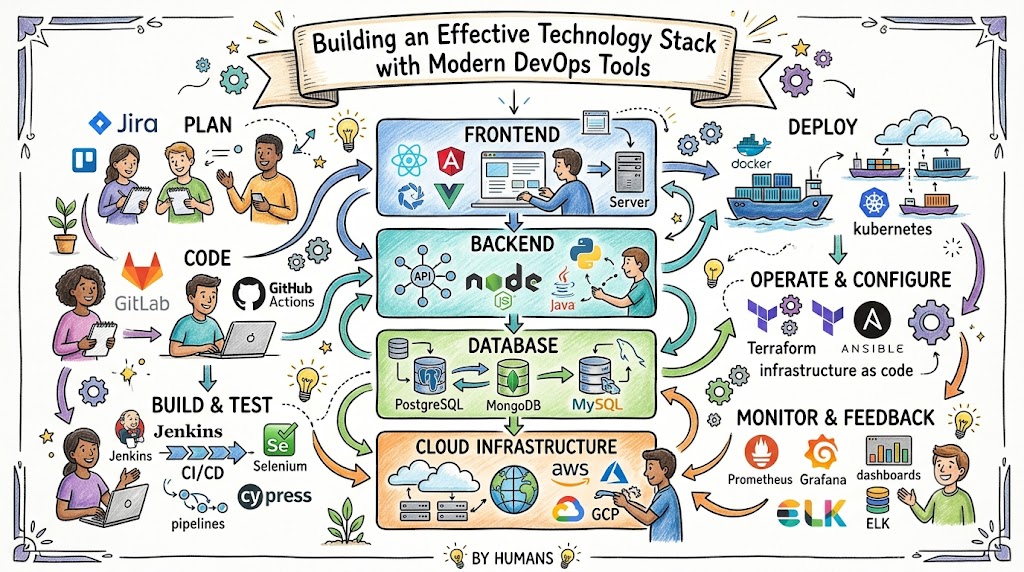
Modern DevOps Tools help teams create this connected environment by automating repetitive processes, improving collaboration, increasing system visibility, and reducing operational risks. A well-designed DevOps technology stack allows developers, operations teams, security professionals, and engineering leaders to work together using shared workflows and measurable insights.
However, building a DevOps stack is not simply about selecting the most popular tools. Every organization has different requirements based on application architecture, cloud strategy, security needs, team experience, and business objectives.
A startup may need a lightweight automation stack, while an enterprise organization may require advanced governance, multi-cloud support, security controls, and reliability measurement.
This guide explains how engineering teams can build an effective DevOps technology stack, which tool categories are important, how different tools work together, and how to make better technology decisions.
What Is a DevOps Technology Stack?
A DevOps technology stack is a collection of tools, platforms, and practices used to manage the complete software delivery lifecycle.
It connects:
- Software development
- Testing
- Deployment
- Infrastructure management
- Security
- Monitoring
- Incident response
- Engineering improvement
A complete DevOps stack usually includes:
- Source code management
- CI/CD automation
- Testing tools
- Container platforms
- Infrastructure automation
- Cloud platforms
- Configuration management
- Monitoring and observability
- Security automation
- Engineering intelligence
Why Building the Right DevOps Stack Matters
A poorly designed technology stack can create:
- Manual processes
- Slow deployments
- Difficult troubleshooting
- Security gaps
- Tool dependency problems
An effective DevOps stack provides:
Faster Software Delivery
Automation reduces time spent on:
- Building applications
- Running tests
- Deploying releases
- Managing infrastructure
Better Reliability
Monitoring, testing, and automation help teams detect and prevent failures.
Improved Collaboration
Shared tools connect:
- Developers
- Operations teams
- Security teams
- Platform teams
Better Engineering Decisions
Metrics and visibility help teams understand performance and improvement opportunities.
Core Components of a Modern DevOps Technology Stack
1. Source Code Management Layer
The foundation of every DevOps stack is source code management.
These tools help teams:
- Store application code
- Manage versions
- Review changes
- Collaborate safely
Popular Tools
GitHub
Provides:
- Code repositories
- Collaboration workflows
- Automation capabilities
GitLab
Provides:
- Source control
- CI/CD integration
- Security features
Bitbucket
Provides:
- Repository management
- Atlassian ecosystem integration
Selection Considerations
Choose based on:
- Team workflow
- Existing integrations
- Security requirements
- Collaboration needs
2. Continuous Integration and Delivery Layer
CI/CD is the automation engine of a DevOps stack.
It helps teams:
- Automatically build applications
- Run tests
- Package releases
- Deploy changes
Common CI/CD Tools
| Tool | Purpose | Best Fit |
|---|---|---|
| Jenkins | Flexible automation pipelines | Enterprise workflows |
| GitHub Actions | Repository-based automation | GitHub users |
| GitLab CI/CD | Integrated DevOps workflows | GitLab teams |
| CircleCI | Cloud-based automation | Development teams |
| Argo CD | GitOps deployment | Kubernetes environments |
3. Testing Automation Layer
Testing ensures that software changes are reliable before production deployment.
Testing tools support:
- Unit testing
- Integration testing
- API testing
- Security testing
- Performance testing
Common tools include:
- Selenium
- JUnit
- Cypress
- SonarQube
A strong DevOps stack integrates testing directly into CI/CD pipelines.
4. Containerization Layer
Containers provide consistency between development and production environments.
Docker
Docker helps teams:
- Package applications
- Manage dependencies
- Create portable environments
Kubernetes
Kubernetes manages containers at scale.
It supports:
- Application deployment
- Scaling
- Service management
- Automated recovery
Containers are now an important part of many cloud-native DevOps stacks.
5. Infrastructure as Code Layer
Infrastructure as Code allows teams to manage infrastructure using automated configuration.
Benefits include:
- Repeatable environments
- Faster provisioning
- Reduced manual errors
- Better infrastructure control
Popular Tools
Terraform
Used for:
- Cloud infrastructure provisioning
- Multi-environment management
Ansible
Used for:
- Configuration automation
- System management
Pulumi
Used for:
- Developer-friendly infrastructure management
6. Cloud Platform Layer
Cloud platforms provide the foundation where modern applications run.
Major cloud environments include:
- Amazon Web Services
- Microsoft Azure
- Google Cloud Platform
Cloud platforms provide:
- Compute
- Storage
- Networking
- Databases
- Security services
A DevOps stack should align with the organization’s cloud strategy.
7. Monitoring and Observability Layer
Observability helps teams understand system behavior.
It provides visibility into:
- Metrics
- Logs
- Traces
- Application performance
- Infrastructure health
Common Tools
| Tool | Capability | Best Fit |
|---|---|---|
| Prometheus | Metrics monitoring | Cloud-native teams |
| Grafana | Dashboards | Visualization needs |
| Datadog | Full observability | Enterprise monitoring |
| New Relic | Application monitoring | Application-focused teams |
8. Security and DevSecOps Layer
Security should be part of every DevOps workflow.
Security tools help with:
- Vulnerability scanning
- Code analysis
- Dependency checks
- Container security
- Compliance monitoring
A modern DevOps stack integrates security from development to production.
9. Incident Management Layer
Reliable systems require effective incident response.
Incident management tools support:
- Alert handling
- Team communication
- Incident tracking
- Recovery processes
They help engineering teams reduce downtime and improve response workflows.
Complete Modern DevOps Technology Stack Example
| Layer | Purpose | Example Tools |
|---|---|---|
| Planning | Task management | Jira, GitHub Projects |
| Source Control | Code management | GitHub, GitLab |
| CI/CD | Automation | Jenkins, GitHub Actions |
| Testing | Quality assurance | Selenium, SonarQube |
| Containers | Application packaging | Docker |
| Orchestration | Container management | Kubernetes |
| Infrastructure | Automation | Terraform, Ansible |
| Cloud | Hosting platform | AWS, Azure, Google Cloud |
| Monitoring | Observability | Prometheus, Grafana, Datadog |
| Security | Protection | DevSecOps tools |
| Intelligence | Performance measurement | DevOpsIQ |
How to Build an Effective DevOps Technology Stack
Step 1: Understand Business and Technical Requirements
Before choosing tools, evaluate:
- Application complexity
- Team size
- Deployment needs
- Security requirements
- Cloud strategy
Avoid selecting tools only because they are popular.
Step 2: Start With Strong Foundations
Build around:
- Version control
- Automation
- Testing
- Monitoring
These areas provide the biggest impact.
Step 3: Automate Gradually
Do not automate everything immediately.
Start with:
- Build processes
- Testing workflows
- Deployment tasks
- Infrastructure management
Step 4: Improve Integration Between Tools
A good stack should connect:
- Code repositories
- CI/CD pipelines
- Cloud platforms
- Monitoring systems
- Security tools
Integration reduces manual work and improves visibility.
Step 5: Measure Performance
Use engineering metrics such as:
- Deployment frequency
- Lead time
- Change failure rate
- Time to restore service
These DORA metrics help teams understand delivery performance.
Real-World DevOps Stack Examples
Startup DevOps Stack
Focus:
- Speed
- Simplicity
- Low maintenance
Possible components:
- GitHub
- GitHub Actions
- Docker
- Cloud services
- Managed monitoring
Enterprise DevOps Stack
Focus:
- Governance
- Security
- Scalability
Possible components:
- Enterprise Git platforms
- Advanced CI/CD systems
- Kubernetes
- Infrastructure automation
- Observability platforms
Cloud-Native Engineering Stack
Focus:
- Container-based applications
- Automation
- Reliability
Common technologies:
- Kubernetes
- Terraform
- GitOps
- Prometheus
- Grafana
Common Mistakes When Building a DevOps Stack
Choosing Too Many Tools
Problem
Too many tools create complexity.
Solution
Select tools based on actual requirements.
Ignoring Team Skills
Problem
Advanced tools may remain unused without proper knowledge.
Solution
Invest in training and practical DevOps Projects.
Missing Security Integration
Problem
Security becomes an afterthought.
Solution
Include DevSecOps practices from the beginning.
Poor Monitoring Strategy
Problem
Teams cannot understand system behavior.
Solution
Implement observability early.
DevOps Skills Needed to Manage Modern Tool Stacks
Important technical skills:
- Linux
- Networking
- Git
- Scripting
- CI/CD
- Docker
- Kubernetes
- Cloud platforms
- Infrastructure as Code
- Monitoring
- Security
Important professional skills:
- Communication
- Troubleshooting
- Problem-solving
- Collaboration
- Continuous learning
DevOps Projects for Building Practical Experience
Project 1: Create a CI/CD Pipeline
Goal:
Automate application delivery.
Tools:
- GitHub
- Jenkins
- Docker
Skills:
- Pipeline automation
- Deployment workflows
Project 2: Automate Cloud Infrastructure
Goal:
Create repeatable infrastructure.
Tools:
- Terraform
- Cloud platform
Skills:
- Infrastructure automation
- Cloud management
Project 3: Build a Monitoring Platform
Goal:
Monitor application reliability.
Tools:
- Kubernetes
- Prometheus
- Grafana
Skills:
- Observability
- Incident analysis
DORA Metrics and Engineering Intelligence
A modern DevOps stack generates valuable engineering information.
Teams can measure:
Deployment Frequency
How often software changes are released.
Lead Time for Changes
How quickly changes move into production.
Change Failure Rate
How frequently deployments create issues.
Time to Restore Service
How quickly teams recover from failures.
These metrics help organizations improve engineering workflows.
They should be used for system improvement, not individual performance judgment.
How DevOpsIQ Supports Modern Engineering Teams
DevOpsIQ provides engineering intelligence by connecting delivery and operational information.
It helps teams:
- Understand deployment patterns
- Analyze incidents
- Track reliability trends
- Measure SLO performance
- Identify improvement opportunities
The Pulse Score provides a transparent service health view, while engineering timelines connect deployments, failures, rollbacks, and recovery activities.
This helps engineering leaders make decisions using measurable information combined with technical context.
BestDevOps Learning Support
BestDevOps helps professionals understand modern DevOps practices through:
- DevOps tutorials
- Tool comparisons
- Learning roadmaps
- Certification guidance
- Interview preparation
- Practical projects
It supports beginners learning DevOps and experienced engineers improving delivery practices.
Frequently Asked Questions
1. What is a DevOps technology stack?
A DevOps technology stack is a combination of tools used to manage software development, deployment, infrastructure, security, and monitoring.
2. Why do companies need a DevOps stack?
Companies use DevOps stacks to automate workflows, improve reliability, and deliver software faster.
3. Which tools are essential in a DevOps stack?
Most stacks include source control, CI/CD, containers, infrastructure automation, monitoring, and security tools.
4. Should every company use the same DevOps tools?
No. Tool selection depends on architecture, requirements, team skills, and business needs.
5. How do DevOps tools improve reliability?
They improve reliability through automation, testing, monitoring, and faster incident recovery.
6. What skills are needed for DevOps tools?
Engineers need cloud, automation, scripting, infrastructure, and troubleshooting skills.
7. Is Kubernetes required for every DevOps stack?
No. Kubernetes is useful for many cloud-native systems but depends on application requirements.
8. What are DORA metrics tools?
They help teams measure software delivery performance using engineering data.
9. How can teams avoid tool complexity?
Teams should select tools carefully and prioritize integration over quantity.
10. How does BestDevOps support DevOps learning?
BestDevOps provides tutorials, roadmaps, comparisons, projects, and career resources.
Key Takeaways
- A DevOps stack connects tools across the software delivery lifecycle.
- The right tools improve automation, reliability, and visibility.
- Tool selection should depend on team needs, not popularity.
- Integration between tools is more valuable than using many disconnected solutions.
- DORA metrics help teams measure improvement.
- Continuous learning is essential for DevOps professionals.
Conclusion
Building an effective technology stack with modern DevOps tools requires a strategic approach. Successful engineering teams do not simply collect popular tools; they create connected workflows that support development, automation, infrastructure management, security, monitoring, and continuous improvement.
The right DevOps technology stack helps teams deliver software faster while maintaining reliability and operational visibility. Source control, CI/CD automation, containers, infrastructure as Code, observability, and security tools work together to create a stronger engineering foundation.
For professionals, understanding how these tools fit together is a key part of developing DevOps Engineer Skills and following a practical DevOps Roadmap. Hands-on experience through DevOps Projects helps engineers understand real implementation challenges.

