
Introduction
Private charter flights can be a practical travel option when a trip requires greater flexibility, privacy, or coordination than a standard commercial itinerary can provide. While private aviation is often associated with luxury travel, there are many situations where the value comes from convenience and schedule control rather than luxury alone. Business meetings, destination weddings, family celebrations, sporting events, corporate retreats, and multi-city trips can all create circumstances where a private charter may be worth considering. The right choice depends on factors such as the number of travelers, destination, schedule, airport availability, aircraft requirements, and budget. Understanding when private charter travel makes sense can help travelers make a more informed decision.
What Is a Private Charter Flight?
A private charter flight involves arranging an aircraft for a specific trip rather than purchasing an individual seat on a regularly scheduled commercial flight.
Depending on the aircraft and operator, charter travel can provide greater flexibility around:
- Departure times
- Arrival airports
- Passenger groups
- Itinerary planning
- Cabin environment
- Baggage requirements
The exact options available depend on the aircraft, operator, airports, route, weather, and applicable aviation regulations.
Unlike commercial aviation, where travelers generally select from an airline’s published schedule, a charter itinerary can often be organized around the specific requirements of the trip.
That flexibility is one of the main reasons travelers consider private aviation.
Why Choose a Private Charter for Certain Occasions?
Not every trip requires a private aircraft. However, certain occasions can make charter travel particularly attractive.
The potential advantages include:
- Greater schedule flexibility
- A private travel environment
- Easier group coordination
- Potential access to additional airports
- Customized travel arrangements
- More control over the itinerary
- Less dependence on commercial schedules
The value of these benefits depends heavily on the individual journey.
For a solo traveler taking a simple route with frequent nonstop commercial service, a private charter may not provide enough additional value to justify the expense. For a group traveling to a time-sensitive event, the calculation can be very different.
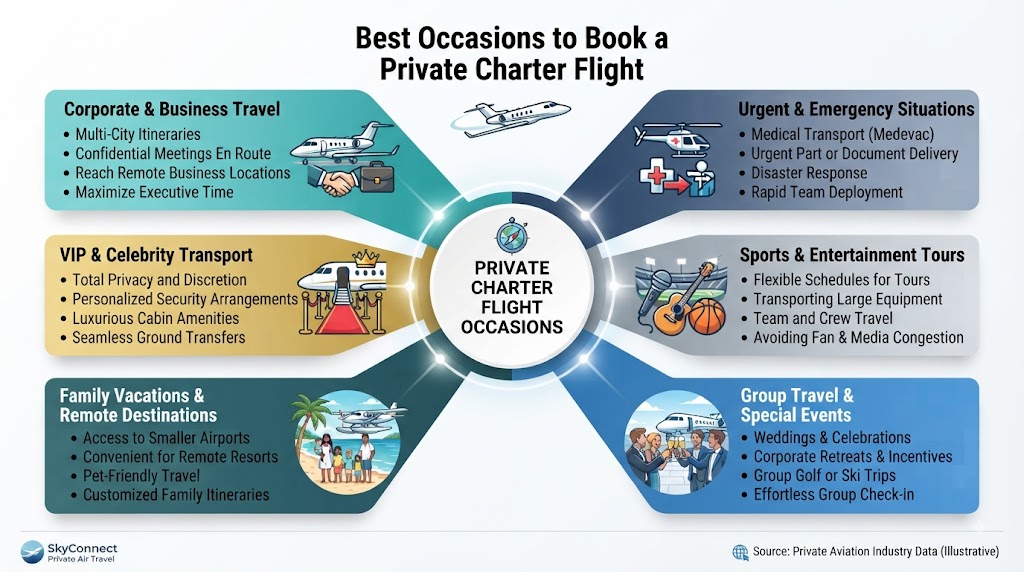
Best Occasions to Book a Private Charter Flight
1. Important Business Meetings
Business travel is one of the situations where schedule flexibility can have significant value.
Executives and business leaders may consider private charter travel for:
- High-level meetings
- Investor discussions
- Board meetings
- Negotiations
- Business presentations
- Client visits
- Important corporate events
A commercial itinerary may require travelers to work around fixed departure times, connections, and airport schedules.
A private charter can potentially be arranged around the meeting schedule, subject to aircraft and operational availability.
For executives with multiple commitments in different locations, controlling the travel schedule can also make itinerary planning easier.
2. Corporate Retreats and Company Events
Corporate groups often have to coordinate transportation for several people at the same time.
Private charter travel may be suitable for:
- Corporate retreats
- Leadership meetings
- Team-building events
- Company celebrations
- Executive gatherings
- Incentive trips
Keeping a group on one aircraft can simplify travel coordination.
Instead of managing numerous individual airline reservations, travelers can follow a shared itinerary.
This can also make arrival and departure planning easier when the event has a fixed schedule.
3. Weddings and Destination Weddings
A wedding can involve extensive travel planning, particularly when the event takes place away from the guests’ home locations.
Private charter travel may be considered for:
- Wedding parties
- Family groups
- Destination wedding guests
- Pre-wedding celebrations
- Honeymoon-related travel
- Wedding-related group transportation
One of the biggest advantages for a wedding group can be coordination.
Rather than arranging separate commercial tickets for many guests, the group may be able to travel together on a shared itinerary.
The decision should still consider passenger numbers, destination airport availability, aircraft capacity, and overall budget.
4. Family Vacations
Families may consider private charter travel when traveling with several generations or a larger group.
Potential examples include:
- Multi-generational vacations
- Extended family trips
- School holiday travel
- Family reunions
- Special family celebrations
- Multi-destination vacations
Traveling together can make the journey easier to coordinate, especially when children, older family members, or significant amounts of luggage are involved.
Private travel can also provide a more controlled cabin environment compared with a commercial flight.
However, travelers should evaluate the overall cost and itinerary before assuming that charter travel is the best option.
5. Milestone Celebrations
Some occasions are important enough that the travel experience becomes part of the celebration.
Examples include:
- Significant birthdays
- Anniversaries
- Retirement celebrations
- Graduation celebrations
- Family reunions
- Major personal achievements
A private charter can create a shared travel experience for the group while providing more control over the itinerary.
For travelers already planning a special trip, the aircraft can become part of the overall occasion rather than simply transportation between two airports.
6. Sporting Events
Major sporting events can create significant transportation challenges.
Private charter flights may be considered for:
- Championship events
- Tournament travel
- Golf trips
- Group sports trips
- Away games
- Major sporting weekends
The primary consideration is often timing.
Sports events generally begin at a specific time, making schedule reliability and coordination important.
A charter itinerary may provide greater flexibility than relying exclusively on available commercial schedules.
Travelers should still consider airport restrictions, aircraft availability, event timing, and potential weather disruptions.
7. Music, Entertainment, and Production Travel
Entertainment professionals often operate according to demanding schedules.
Private charter aviation may be considered for:
- Concert tours
- Film production
- Television production
- Entertainment events
- Production teams
- Touring groups
A production schedule may require people and equipment to move between several locations within a limited period.
Private aviation can potentially help coordinate the movement of a group around a customized itinerary.
The aircraft must be selected based on passenger numbers, baggage, equipment requirements, range, and airport capabilities.
8. Multi-City Business Trips
A multi-city itinerary can become complicated when travelers depend entirely on commercial flight schedules.
For example, a business leader may need to visit several cities for:
- Client meetings
- Facility inspections
- Investor discussions
- Site visits
- Regional business tours
- Corporate events
A customized charter schedule can potentially make it easier to organize multiple stops around business commitments.
The value becomes especially relevant when the traveler has limited time and the destinations do not align conveniently with commercial schedules.
However, each airport and route must be evaluated individually.
9. Remote Destination Travel
Some travelers want to reach destinations that are not conveniently served by scheduled commercial flights.
Depending on the aircraft and operating requirements, private charter travel may provide access to additional airports.
This can potentially reduce the ground transportation required after landing.
However, private aircraft cannot automatically operate from every airport.
Airport infrastructure, runway characteristics, aircraft performance, operating restrictions, weather, and other factors must be considered.
Travelers should therefore confirm airport suitability before finalizing a charter itinerary.
10. Urgent Business or Time-Sensitive Travel
Business situations sometimes require travel on short notice.
Examples may include:
- Important meetings
- Time-sensitive business opportunities
- Operational issues
- Urgent project requirements
- Executive commitments
Private charter travel may provide more scheduling flexibility than waiting for a suitable commercial departure.
However, availability is not guaranteed.
Aircraft positioning, crew availability, airport restrictions, weather, and other operational considerations can affect whether a particular flight can be arranged.
11. Group Travel
Group travel can be one of the strongest reasons to consider a charter flight.
Potential groups include:
- Corporate teams
- Families
- Wedding parties
- Sports teams
- Event attendees
- Professional organizations
- Friends traveling together
Coordinating dozens of individual commercial reservations can be complicated.
A private charter can potentially allow the group to follow one itinerary and travel together.
The economics of charter travel can also be different for larger groups because the aircraft is being chartered rather than individual seats being purchased separately.
However, travelers should compare the total charter cost against the total cost of commercial alternatives before making a decision.
12. Special Privacy Requirements
Privacy can be an important consideration for certain travelers.
Business executives may want to discuss confidential matters during travel. Families may prefer a private cabin environment. Public figures may value greater separation from crowded terminals and shared cabins.
Private charter travel can provide a more private environment, but travelers should not assume that it guarantees absolute privacy or security.
Appropriate planning and communication with the charter provider remain important.
Holiday and Peak Travel Periods
Peak travel periods can create additional demand for commercial flights.
Examples include:
- Major holidays
- School vacation periods
- Long weekends
- Festival periods
- Major sporting events
- Large conferences
Some travelers consider private charter flights during these periods because they want greater flexibility around departure times and airport options.
However, peak demand can also affect charter aircraft availability and pricing.
Booking early and discussing the complete itinerary can help travelers understand their options before committing to a plan.
When Private Charter May Not Be the Best Choice
Private aviation is not automatically the right solution for every trip.
Commercial aviation may be more practical when:
- A traveler is flying alone
- The itinerary is simple
- A convenient nonstop commercial flight is available
- The traveler has a flexible schedule
- Minimizing travel cost is the primary objective
- The destination is well served by frequent airline service
The decision should be based on the complete travel picture.
A private charter may offer convenience and flexibility, but those benefits should be weighed against the total cost and requirements of the trip.
Factors to Consider Before Booking a Private Charter
Travel Schedule
Consider how important departure and arrival flexibility are.
A traveler with a very specific schedule may place greater value on charter flexibility than someone who can easily adjust to commercial flight times.
Number of Travelers
Passenger count is one of the most important considerations.
A charter aircraft should be selected based on the number of passengers and their requirements rather than simply choosing the largest available aircraft.
Destination and Airport
Airport selection can influence both convenience and aircraft suitability.
Consider:
- Airport location
- Runway requirements
- Operating restrictions
- Weather
- Ground transportation
- Aircraft performance
Aircraft Type
Aircraft vary significantly in:
- Passenger capacity
- Range
- Cabin configuration
- Baggage capacity
- Performance
- Airport compatibility
The aircraft should match the itinerary rather than being selected solely based on appearance or cabin size.
Total Travel Requirements
Before booking, travelers should discuss:
- Passenger numbers
- Baggage
- Pets where permitted
- Ground transportation
- Special equipment
- Accessibility requirements
- Catering or dietary requests
Clear information helps the charter provider determine the appropriate arrangements.
Budget
Private charter pricing can vary significantly.
Factors may include:
- Aircraft type
- Flight distance
- Passenger count
- Aircraft positioning
- Airport fees
- Crew requirements
- Schedule
- Availability
- Additional services
Travelers should review the complete price rather than focusing only on an initial advertised figure.
Weather and Operational Conditions
Private aviation is still aviation.
Weather, airport conditions, aircraft limitations, crew requirements, and other operational factors can affect a charter schedule.
Travelers should understand that a private aircraft does not eliminate weather-related delays or operational limitations.
How to Plan a Private Charter for a Special Occasion
Step 1: Define the Purpose of the Trip
Start by identifying why the trip is being arranged.
Is it for:
- Business
- A wedding
- A family vacation
- A sporting event
- A corporate retreat
- Entertainment
- A celebration
The purpose will help determine the most appropriate itinerary.
Step 2: Determine the Passenger Group
Establish the number of passengers and identify any special requirements.
This information is essential for selecting an appropriate aircraft.
Step 3: Choose the Preferred Schedule
Identify preferred departure and arrival times.
If possible, provide some flexibility because aircraft positioning and airport availability can affect scheduling.
Step 4: Review Airport Options
Consider airports that provide convenient access to both the origin and destination.
A smaller airport may sometimes be more convenient, but aircraft and operational limitations must be checked.
Step 5: Select an Appropriate Aircraft
Aircraft selection should be based on:
- Passenger count
- Range
- Baggage
- Destination
- Airport requirements
- Cabin requirements
Step 6: Review Charter Details
Before confirming the trip, review:
- Aircraft
- Departure airport
- Arrival airport
- Schedule
- Passenger information
- Baggage requirements
- Ground transportation
- Additional services
- Applicable fees
Step 7: Confirm the Booking
Review the final itinerary and applicable booking, cancellation, and change terms before confirming.
Private Charter vs Commercial Travel
| Factor | Private Charter | Commercial Flight |
|---|---|---|
| Schedule | Generally more customizable | Based on published schedules |
| Airport choice | Potentially broader | Usually limited to scheduled airports |
| Privacy | Private cabin | Shared cabin |
| Group coordination | Group can generally share one itinerary | Multiple reservations may be required |
| Flexibility | Generally higher | Depends on airline schedules |
| Aircraft choice | Can be selected according to requirements | Determined by airline |
| Cost structure | Aircraft charter cost | Individual seat pricing |
| Best suited for | Groups, special events, flexible business trips, complex itineraries | Standard scheduled travel |
Neither option is universally better. The appropriate choice depends on the traveler’s priorities, itinerary, group size, and budget.
Common Mistakes to Avoid When Booking a Charter Flight
1. Choosing an Aircraft Without Considering Passenger Needs
The largest aircraft is not necessarily the best aircraft.
Passenger count, baggage, route, and airport requirements should guide the decision.
2. Focusing Only on the Base Price
Travelers should understand the complete cost and ask about applicable fees and additional services.
3. Forgetting Baggage Requirements
Large amounts of luggage or special equipment may influence aircraft selection.
4. Ignoring Airport Limitations
Not every aircraft can operate from every airport.
5. Leaving Schedule Details Unclear
Departure and arrival requirements should be communicated clearly before booking.
6. Failing to Confirm Passenger Information
Passenger details should be reviewed carefully before travel.
7. Not Reviewing Change or Cancellation Policies
Travel plans can change. Understanding the applicable terms before booking can prevent unpleasant surprises.
8. Assuming Every Aircraft Can Operate Every Route
Aircraft range, airport characteristics, weather, and operational considerations can affect route planning.
9. Ignoring Weather Considerations
Private aircraft are also affected by weather conditions.
10. Waiting Too Long During Peak Travel Periods
High-demand periods can affect aircraft availability and pricing, making early planning particularly useful.
Private Charter Travel Checklist
Before booking, travelers can review the following:
- Travel date
- Preferred departure time
- Preferred arrival time
- Passenger count
- Destination
- Departure airport
- Arrival airport
- Aircraft requirements
- Baggage
- Ground transportation
- Special requests
- Weather considerations
- Total pricing
- Additional fees
- Cancellation terms
- Change policies
- Final booking confirmation
Having this information ready can make the charter planning process more efficient.
Benefits of Choosing the Right Private Charter
Greater Schedule Flexibility
Private charter travel can provide more control over departure timing compared with fixed commercial schedules.
Easier Group Coordination
A shared aircraft can simplify transportation for families, corporate teams, wedding parties, and other groups.
Greater Privacy
A private cabin provides a separate environment for passengers traveling together.
Convenient Airport Options
Depending on aircraft capabilities and airport requirements, charter travel may provide access to airports that are more convenient for the final destination.
Personalized Travel Planning
A charter itinerary can be structured around the requirements of the trip rather than only around an airline’s published schedule.
How FLYAIAA.COM Fits Into Private Aviation Planning
Choosing a private charter flight involves more than simply selecting an aircraft.
Travelers need to consider their itinerary, passenger requirements, airport options, timing, aircraft capabilities, and overall travel objectives.
FLYAIAA.COM can serve as a resource for readers researching private aviation and charter flight options. Travelers should evaluate the details of their individual trip and confirm the applicable aircraft, availability, pricing, and operational arrangements before booking.
Frequently Asked Questions
1. What is the best occasion to book a private charter flight?
Private charter flights can be particularly useful for business trips, weddings, group vacations, sporting events, corporate retreats, milestone celebrations, and complex or time-sensitive itineraries.
2. Are private charter flights suitable for business travel?
Yes. Business travelers may value the schedule flexibility, privacy, and group coordination that private charter travel can provide, particularly for multi-city or time-sensitive trips.
3. Can families book private charter flights for vacations?
Yes. Families may consider private charter travel for multi-generational vacations, large family groups, special celebrations, or itineraries that are difficult to coordinate using commercial schedules.
4. Is private charter travel suitable for weddings?
It can be. Destination weddings and larger wedding groups may benefit from traveling together on a coordinated itinerary.
5. Can groups book a private charter flight together?
Yes. Groups such as corporate teams, families, wedding parties, and sports groups can potentially charter an aircraft together, subject to aircraft capacity and operational requirements.
6. Are private charter flights useful for multi-city trips?
They can be particularly useful when travelers need to visit several locations within a limited period and commercial schedules do not align conveniently with the itinerary.
7. Can private charter flights reach smaller airports?
Potentially, depending on the aircraft, airport characteristics, operating requirements, weather, and other restrictions. Not every aircraft can use every airport.
8. What factors affect private charter pricing?
Pricing can depend on aircraft type, route, passenger count, aircraft positioning, airport fees, schedule, availability, and additional services.
9. How far in advance should travelers book a private charter?
There is no single ideal timeframe for every trip. Earlier planning can be especially useful for peak travel periods, large groups, specific aircraft requirements, or complex itineraries.
10. What should travelers consider before booking a private charter flight?
Travelers should consider passenger count, schedule, destination airports, aircraft requirements, baggage, total cost, cancellation terms, and potential weather or operational factors.
Final Thoughts
Private charter flights can make sense for many different occasions, but the best reason to book one is not simply the desire for luxury. The real value may come from schedule flexibility, group coordination, privacy, airport options, and the ability to organize travel around a specific event or business requirement.
Important meetings, destination weddings, family celebrations, sporting events, corporate retreats, entertainment schedules, and multi-city business trips can all create circumstances where private aviation deserves consideration.

