
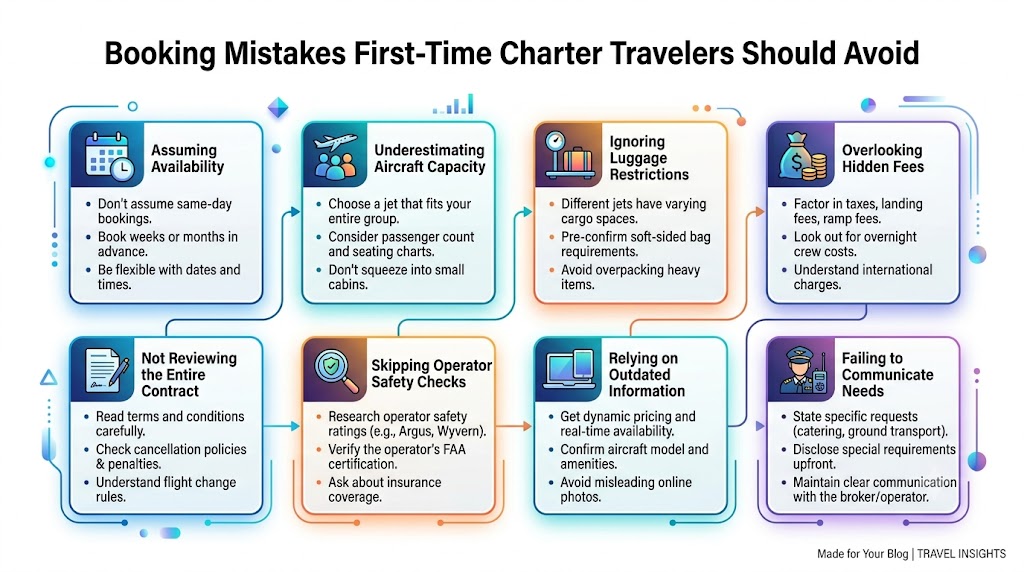
Booking a private charter can feel very different from purchasing a standard airline ticket. Instead of selecting a published flight from a fixed schedule, travelers often discuss their preferred itinerary, passenger requirements, aircraft options, airports, services, and timing with a charter provider.
That flexibility can make the planning process more personalized, but it also creates more details to review. First-time travelers may focus on the aircraft or headline price while overlooking baggage, airport suitability, cancellation terms, special requests, or the exact services included in the agreement.
Understanding these potential mistakes before making a booking can help travelers communicate more clearly, compare options more effectively, and approach private charter travel with realistic expectations.
How Private Charter Booking Differs From Airline Booking
Traditional airline travel generally follows published routes and schedules. Travelers select an available flight, purchase a ticket, and follow the airline’s established procedures.
Charter travel can involve a more customized process.
Depending on the provider and itinerary, travelers may discuss:
- Departure and arrival locations
- Preferred travel times
- Number of passengers
- Aircraft requirements
- Baggage
- Catering
- Ground transportation
- Special requests
- International travel requirements
- Changes or cancellation terms
This flexibility means travelers should provide accurate information from the beginning. A small change in passenger numbers, baggage, timing, or routing can affect the proposed arrangements.
Common Booking Mistakes First-Time Charter Travelers Should Avoid
1. Booking Without Clearly Defining the Itinerary
One of the most common mistakes involves requesting a charter without providing enough information about the trip.
A provider needs to understand the basic requirements before presenting suitable options.
Important details can include:
- Departure location
- Destination
- Travel date
- Preferred departure time
- Return date and time, if applicable
- Number of passengers
- Baggage requirements
- Potential additional stops
- Preferred airports
- Schedule flexibility
A vague request can create unrealistic expectations.
Better Approach
Prepare the basic itinerary before requesting a quote. If some details remain flexible, communicate that clearly.
For example, instead of simply asking for a private flight between two cities, explain the preferred date, passenger count, approximate timing, baggage requirements, and whether alternative airports are acceptable.
2. Focusing Only on the Headline Price
Price naturally matters when planning private travel, but the first number a traveler sees may not answer every question about the total arrangement.
Depending on the booking, travelers may need to clarify items such as:
- Aircraft-related charges
- Airport fees
- Ground services
- Catering
- Additional services
- Applicable taxes
- Other charges specified in the agreement
The exact pricing structure varies by provider, aircraft, route, airport, and itinerary.
Better Approach
Ask:
“What exactly is included in this quoted price, and are there any additional charges I should know about?”
Then review the written quotation and agreement carefully.
3. Choosing an Aircraft Without Considering the Trip
First-time travelers may assume that the largest, newest, or most luxurious aircraft automatically represents the most suitable choice.
That approach can overlook the actual requirements of the trip.
Aircraft can differ in:
- Passenger capacity
- Cabin configuration
- Baggage capacity
- Range
- Airport compatibility
- Cabin amenities
- Seating arrangements
- Available workspace
The appropriate aircraft depends on the itinerary and traveler requirements.
Better Approach
Instead of asking only which aircraft looks most impressive, ask whether the proposed aircraft suits:
- The number of passengers
- The route
- The baggage
- The desired airport
- The schedule
- The travel purpose
4. Providing Incomplete Passenger Information
Passenger details can affect charter planning.
Travelers should provide accurate information about the people traveling and disclose relevant requirements early in the process.
Depending on the trip and provider, useful information may include:
- Number of passengers
- Passenger names where required
- Relevant age-related considerations
- Mobility requirements
- Pets
- Special baggage
- Other travel needs
Requirements can vary according to the operator, destination, aircraft, and applicable regulations.
Better Approach
Do not wait until the final stage to mention an important passenger requirement. Share relevant information during the initial planning process.
5. Underestimating Baggage Requirements
Private charter travel does not mean that baggage planning becomes irrelevant.
Aircraft have different cabin and baggage configurations. A traveler carrying a few standard bags has different requirements from a group traveling with sports equipment, business equipment, musical instruments, or oversized items.
Potential baggage considerations include:
- Number of bags
- Bag dimensions
- Weight
- Sports equipment
- Oversized items
- Fragile equipment
- Pets and related items
Better Approach
Tell the charter provider about unusual or bulky baggage before confirming the booking.
Do not assume that the baggage capacity of one aircraft applies to another.
6. Assuming Every Airport Works the Same Way
One advantage of charter travel can be access to a wider range of airports than travelers may normally consider when flying commercially. However, travelers should not assume that any aircraft can use any airport under any circumstances.
Airport suitability can depend on:
- Aircraft characteristics
- Runway conditions
- Airport facilities
- Operating requirements
- Local restrictions
- Airport availability
- Route considerations
- International procedures
Better Approach
Ask the provider whether the requested departure and arrival airports are suitable for the proposed aircraft and itinerary.
If the preferred airport cannot support the trip, ask about practical alternatives.
7. Assuming the Schedule Is Completely Unlimited
Flexible scheduling is one reason travelers consider charter aviation, but flexibility does not mean that every requested departure time is automatically available.
Planning can involve factors such as:
- Aircraft availability
- Crew availability
- Airport operating conditions
- Weather
- Air traffic
- Operational requirements
- International procedures
Better Approach
Provide a preferred time along with reasonable alternatives when possible.
If the timing is especially important, communicate that requirement early rather than assuming it can be changed later without consequences.
8. Ignoring Cancellation and Change Policies
Travel plans can change. First-time charter travelers sometimes concentrate so heavily on arranging the flight that they forget to understand what happens if the itinerary changes.
Review the provider’s actual terms concerning:
- Cancellation
- Date changes
- Departure-time changes
- Route changes
- Passenger changes
- Deposits
- Refunds
- Additional charges
There is no single cancellation policy that applies to every charter arrangement.
Better Approach
Read the cancellation and modification provisions before making a payment or confirming the trip.
If any wording is unclear, ask the provider to explain it.
9. Not Asking What Is Included
A traveler may assume that certain services automatically form part of a charter booking.
That assumption can create confusion.
Depending on the provider and aircraft, travelers may need to clarify:
- Aircraft
- Crew
- Catering
- Ground transportation
- Airport services
- Connectivity
- Special requests
- Taxes and fees
- Other services
Better Approach
Ask for a clear breakdown of what the quotation includes.
A simple written checklist can prevent misunderstandings later.
10. Assuming Every Charter Aircraft Has the Same Amenities
Private aircraft can differ considerably from one another.
Possible differences include:
- Seating arrangements
- Cabin size
- Connectivity
- Entertainment
- Lavatory facilities
- Catering arrangements
- Storage
- Workspace
- Sleeping arrangements where applicable
A feature available on one aircraft should not automatically be assumed to exist on another.
Better Approach
If a particular amenity matters to your trip, ask whether it is available on the specific aircraft being proposed.
Do not rely on general descriptions of an aircraft category alone.
11. Forgetting Ground Transportation
The flight is only one part of the overall journey.
Travelers may also need to consider how they will reach the airport and continue to their final destination.
Ground transportation may include:
- Airport transfers
- Hotel transportation
- Business transportation
- Local car services
- Transportation for groups
- Transfers between airports and other locations
Better Approach
Ask whether ground transportation can be coordinated and whether it forms part of the charter arrangement or needs separate booking.
12. Leaving Special Requests Until the Last Minute
Special requests can require additional planning.
Examples may include:
- Dietary requirements
- Catering preferences
- Mobility assistance
- Pets
- Special baggage
- Ground transportation
- Business equipment
- Special-event arrangements
Not every request can be accommodated, and availability can vary.
Better Approach
Mention special requirements as early as possible.
Early communication gives the provider an opportunity to determine what can be arranged for the specific aircraft and itinerary.
13. Not Clarifying International Travel Requirements
International charter travel introduces additional considerations.
Travelers may need to review requirements related to:
- Passports
- Visas
- Customs
- Immigration
- Entry requirements
- Departure procedures
- Airport-specific requirements
These requirements can vary according to the destination, nationality, travel purpose, and current regulations.
Better Approach
Confirm applicable requirements well before departure and use official government or aviation sources for current immigration and entry information.
Do not assume that private aviation eliminates standard international travel requirements.
14. Assuming the Quote Is the Final Agreement
A quotation provides important information, but travelers should distinguish between an initial quote and the actual booking agreement.
Before confirming, review:
- Itinerary
- Departure and arrival airports
- Travel dates
- Departure times
- Passenger information
- Aircraft information
- Price
- Included services
- Additional charges
- Cancellation terms
- Change policies
- Payment requirements
- Special requests
Better Approach
Review the complete written agreement rather than relying only on a phone conversation or initial estimate.
If an important promise or request was discussed verbally, ask for confirmation in writing.
15. Comparing Charter Options Only by Price
Two charter options may appear similar at first but differ in important ways.
A meaningful comparison should consider more than the quoted amount.
| Factor | Questions to Ask |
|---|---|
| Aircraft | Does it suit the trip? |
| Schedule | Does the proposed timing work? |
| Airport | Is the airport convenient and suitable? |
| Passengers | Does the aircraft meet the group’s needs? |
| Baggage | Can the planned baggage be accommodated? |
| Price | What is included? |
| Policies | What happens if plans change? |
| Services | Which additional services are confirmed? |
| Communication | Is information provided clearly? |
| Agreement | Are the important terms documented? |
The goal is not simply to find the lowest number. It is to understand what each option actually provides.
16. Choosing Based Only on Luxury Features
Cabin appearance and amenities can attract attention, especially for first-time charter travelers.
However, those features should not distract from practical considerations.
Travelers should also examine:
- Aircraft suitability
- Schedule
- Airport convenience
- Passenger requirements
- Baggage
- Pricing
- Cancellation terms
- Communication
- Special requests
- Overall itinerary
A visually impressive aircraft may not match the specific needs of a particular journey.
17. Not Confirming the Final Details
Even after a charter has been arranged, travelers should review the final details before departure.
A final review can include:
- Departure airport
- Arrival airport
- Travel date
- Departure time
- Passenger information
- Aircraft information
- Baggage
- Catering
- Ground transportation
- Special requests
- Payment status
- Provider contact information
Better Approach
Keep a written copy of the confirmed itinerary and relevant contact information.
If anything has changed since the original booking, verify the updated details with the provider.
How to Avoid Common Charter Booking Problems
A structured approach can make the booking process easier.
Step 1: Define the Trip
Start with:
- Where you are departing from
- Where you are going
- When you want to travel
- How many people are traveling
- How much baggage you have
- Whether your schedule is flexible
Step 2: Provide Complete Information
Give the charter provider accurate information from the beginning.
This includes passenger details, baggage, pets, special requirements, and international travel needs where relevant.
Step 3: Request a Detailed Quote
Ask what the price includes and whether additional charges may apply.
Step 4: Review the Aircraft
Confirm that the proposed aircraft fits the passenger group, baggage, itinerary, airport requirements, and travel objectives.
Step 5: Review the Agreement
Read the actual terms covering payment, cancellation, changes, services, and other important conditions.
Step 6: Confirm Special Requests
Discuss catering, transportation, pets, equipment, and other requirements before the trip.
Step 7: Confirm the Final Itinerary
Review all important details before departure and ask about any changes.
First-Time Charter Traveler Checklist
Use this checklist before confirming a charter:
- Confirm departure location
- Confirm destination
- Confirm travel dates
- Confirm preferred departure time
- Confirm passenger count
- Provide required passenger information
- Discuss baggage
- Mention unusual or oversized items
- Review aircraft suitability
- Ask what the quote includes
- Ask about additional charges
- Review cancellation terms
- Review change policies
- Confirm special requests
- Discuss ground transportation
- Check international requirements if applicable
- Review the final itinerary
- Keep provider contact details available
Questions to Ask Before Booking a Charter
First-time travelers can use the following questions when speaking with a charter provider:
- What aircraft is being proposed for my trip?
- Is the aircraft suitable for my passenger group and itinerary?
- What is included in the quoted price?
- Are there any additional charges?
- How much baggage can the proposed aircraft accommodate?
- Is my preferred departure airport suitable for the aircraft?
- What are the cancellation terms?
- What happens if I need to change the date or departure time?
- Can special catering be arranged?
- Can ground transportation be coordinated?
- What documentation is required?
- Who should I contact if something changes?
- Which requested services are confirmed?
- What terms should I review before making payment?
Common Charter Booking Mistakes at a Glance
| Booking Mistake | Why It Can Cause Problems | Better Approach |
|---|---|---|
| Incomplete itinerary | The provider may not have enough information to plan appropriately | Provide dates, locations, passengers, timing, and flexibility |
| Focusing only on price | The headline figure may not explain every included or additional cost | Review the complete pricing details |
| Ignoring baggage | Aircraft have different baggage capabilities | Share baggage requirements early |
| Choosing an aircraft without checking suitability | The aircraft may not match the trip’s practical requirements | Discuss aircraft fit with the provider |
| Not reviewing cancellation terms | Changes may create unexpected costs or restrictions | Read the actual booking terms |
| Assuming amenities | Aircraft configurations differ | Confirm important amenities |
| Delaying special requests | Some arrangements may require advance planning | Communicate early |
| Ignoring ground transportation | The flight may not cover the entire journey | Plan transfers separately or coordinate them |
| Not confirming final details | Changes can create confusion before departure | Review the final itinerary |
| Assuming all providers work identically | Policies and services can vary | Compare the actual terms and services |
Choosing a Charter Option: A Practical Decision Guide
There is no universal charter option that suits every traveler.
Instead, consider your individual requirements.
For Business Travel
Pay particular attention to:
- Schedule
- Airport convenience
- Workspace requirements
- Connectivity
- Ground transportation
- Passenger timing
For Family Travel
Consider:
- Passenger numbers
- Baggage
- Child-related requirements
- Pets where applicable
- Catering
- Ground transportation
For Leisure Travel
Focus on:
- Destination
- Airport convenience
- Schedule
- Baggage
- Cabin preferences
- Special requests
For International Travel
Give additional attention to:
- Documentation
- Immigration
- Customs
- Airport requirements
- Timing
- Destination-specific rules
The right choice depends on the complete travel requirement rather than one feature or one price.
Myths About Charter Booking
Myth 1: Private Charter Booking Requires Almost No Planning
Fact: Charter travel can provide flexibility, but travelers still need to provide accurate information and review important booking details.
Myth 2: The Quoted Price Always Includes Everything
Fact: Pricing structures vary. Travelers should ask exactly what the quotation includes and whether additional charges apply.
Myth 3: Every Private Aircraft Has the Same Amenities
Fact: Aircraft can differ significantly in cabin configuration, equipment, connectivity, baggage space, and other features.
Myth 4: Any Airport Can Be Used for Any Charter
Fact: Airport suitability depends on factors involving the aircraft, airport, route, operator, and applicable requirements.
Myth 5: Flexible Scheduling Means There Are No Operational Limitations
Fact: Aircraft availability, crew availability, weather, airport conditions, air traffic, and other operational factors can affect scheduling.
Myth 6: Changing a Charter Itinerary Is Always Simple
Fact: Changes may affect availability, pricing, aircraft arrangements, or other booking terms.
Myth 7: Private Aviation Means Baggage Never Needs to Be Discussed
Fact: Baggage capacity varies by aircraft, so travelers should communicate their requirements before booking.
How to Make Your First Charter Booking Smoother
A successful booking starts with good communication.
Be Specific
Give the provider complete itinerary information rather than a vague request.
Ask Questions
If you do not understand an aircraft feature, charge, policy, or requirement, ask before confirming.
Get Important Details in Writing
Written confirmation helps reduce misunderstandings about the itinerary and services.
Be Realistic About Flexibility
Charter travel can offer scheduling options, but operational limitations still apply.
Plan Special Requirements Early
Catering, baggage, pets, transportation, and other requests may require additional coordination.
Review Before Paying
Do not rely entirely on assumptions. Read the booking terms and confirm the important details.
Frequently Asked Questions
Q1. What is the biggest mistake first-time charter travelers make?
One common mistake is assuming that charter booking works exactly like buying an airline ticket. Charter arrangements often require more detailed communication about the itinerary, aircraft, passengers, baggage, services, and booking terms.
Q2. What information should I provide when requesting a charter quote?
Provide your departure and destination, travel dates, preferred timing, passenger count, baggage requirements, and any important special requests.
Q3. Why should I ask what is included in the charter price?
The initial price may not explain every service or potential charge. Asking for a detailed breakdown helps you understand the actual booking arrangement.
Q4. Can I choose any aircraft I want?
Aircraft availability and suitability depend on the itinerary, passenger requirements, airport, route, and operator. Travelers should discuss aircraft options with the provider.
Q5. How should I handle baggage when booking a charter?
Tell the provider how many bags you have and mention oversized, heavy, fragile, or specialized equipment. Baggage capacity varies by aircraft.
Q6. Can private charter flights use smaller or alternative airports?
Some charter operations may use airports that are different from major commercial airports, but airport suitability depends on the aircraft, route, airport conditions, operator, and applicable requirements.
Q7. Are charter schedules completely flexible?
Charter travel can offer scheduling flexibility, but availability and timing remain subject to operational factors such as aircraft availability, crew, airport conditions, weather, and air traffic.
Q8. What should I know about cancellation and change policies?
Review the provider’s actual agreement for cancellation deadlines, date changes, itinerary modifications, deposits, refunds, and applicable charges.
Q9. Can I request special catering?
Special catering may be possible depending on the provider, aircraft, location, and timing. Discuss dietary requirements and preferences early.
Q10. Should I arrange ground transportation separately?
That depends on the provider and booking. Ask whether transportation can be coordinated and whether it is included in the charter arrangement.
Q11. What should international charter travelers check before booking?
Travelers should review passport, visa, customs, immigration, entry, and airport-specific requirements applicable to their journey.
Q12. Why should I review the charter agreement carefully?
The agreement can contain important information about pricing, itinerary, payment, cancellation, changes, services, and other conditions.
Q13. What questions should first-time charter travelers ask?
Ask about the aircraft, price, included services, baggage, airports, schedule, cancellation terms, special requests, ground transportation, and final itinerary.
Q14. How early should I communicate special requests?
As early as practical. Early communication gives the provider more opportunity to determine whether a request can be accommodated.
Q15. What should I confirm before the day of travel?
Confirm the date, departure time, airports, passenger details, aircraft information, baggage, special services, ground transportation, payment status, and provider contact details.
Final Thoughts
First-time charter travelers can avoid many booking problems by treating the process as a detailed travel-planning exercise rather than simply purchasing a seat.
Clear itinerary information helps providers understand the trip and identify suitable options.
Travelers should review aircraft suitability, baggage, pricing, services, airport arrangements, and booking terms before confirming.
Special requests and international requirements deserve early attention.
A final review of the confirmed itinerary can also prevent avoidable misunderstandings.
With careful questions and realistic expectations, travelers can approach their first charter booking with greater clarity and confidence.

