
Charter travel can offer a convenient and personalized way to reach a destination, but passengers should still approach every journey with appropriate safety awareness. Good preparation starts before departure and includes choosing a suitable charter provider, confirming travel details, communicating special requirements, and understanding passenger responsibilities.
Travelers do not need to evaluate aircraft systems or make technical aviation decisions themselves. Those responsibilities belong to qualified aviation professionals. However, passengers can take practical steps to make sure important information is communicated clearly and that they understand the procedures relevant to their journey.
What Does Safety Mean When Traveling by Charter?
Charter travel safety involves more than the aircraft itself. From a passenger’s perspective, it includes the decisions and preparations made before departure as well as appropriate behavior during the flight.
Important considerations can include:
- Choosing an appropriate charter provider
- Understanding who operates the flight
- Providing accurate passenger information
- Communicating luggage requirements
- Sharing special travel requirements
- Understanding departure arrangements
- Paying attention to passenger safety briefings
- Following crew instructions
- Staying informed about schedule changes
The technical aspects of flight safety are managed by qualified aviation professionals and regulated according to the applicable aviation framework.
For passengers, the most useful approach is to prepare carefully, communicate accurately, and follow professional guidance.
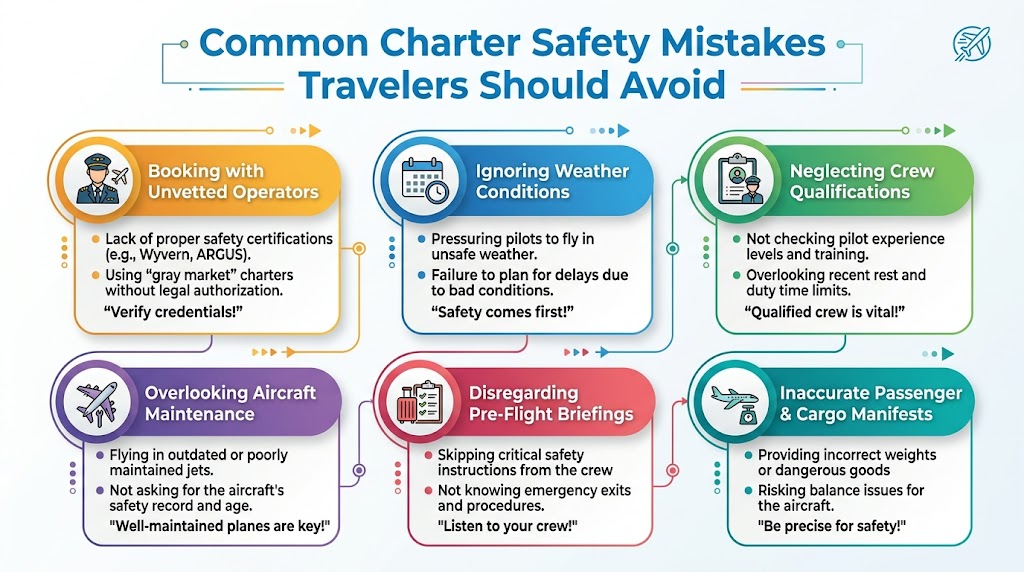
Common Charter Safety Mistakes Travelers Should Avoid
Choosing a Charter Provider Based Only on Price
Price is naturally an important consideration when planning a charter journey, but it should not be the only factor.
A very low quoted price may not provide enough information about the complete service arrangement. Travelers should consider the overall booking and operating details rather than comparing prices alone.
Before booking, consider reviewing:
- Provider information
- Operating arrangements
- Relevant authorization or certification information
- Aircraft information where available
- Customer support
- Booking terms
- Safety-related information provided by the company
The objective is not to conduct a technical safety inspection. Instead, travelers should make sure they understand who is providing and operating the service.
Failing to Understand Who Operates the Flight
The company arranging a charter journey and the actual flight operator may not always be the same organization.
This distinction can matter because passengers may need to know whom to contact about:
- Flight details
- Departure information
- Aircraft changes
- Schedule updates
- Special requirements
- Operational communications
Before traveling, ask the charter provider to clarify the operating arrangements if they are not already clear.
Understanding the service structure can make communication easier if plans change.
Not Confirming Passenger and Flight Details
Small errors in a booking can create unnecessary complications.
Travelers should review important information before departure, including:
- Passenger names
- Passenger count
- Departure airport
- Arrival airport
- Date
- Scheduled departure time
- Destination
- Contact information
- Luggage requirements
If any information changes after the original booking, communicate the change to the provider as early as possible.
Ignoring Luggage Restrictions
Luggage is not simply a convenience issue in aviation. Aircraft have limitations relating to available space and weight.
Travelers should provide accurate information about their baggage before departure.
This may include:
- Number of bags
- Approximate size
- Heavy items
- Oversized items
- Sporting equipment
- Special equipment
Passengers should also ask the provider about restrictions on particular items.
Do not assume that luggage accepted on a commercial airline will automatically be suitable for a particular charter aircraft.
Failing to Share Special Requirements
Travelers should communicate relevant requirements before the day of departure.
Examples can include:
- Accessibility needs
- Mobility assistance
- Medical equipment
- Traveling with children
- Pets where permitted
- Special luggage
- Other passenger-specific requirements
The availability of these services can depend on the aircraft, operator, airport, route, and applicable requirements.
Providing information early gives the provider an opportunity to explain what can and cannot be accommodated.
Not Paying Attention to the Passenger Safety Briefing
Frequent flyers sometimes assume that they already know everything covered in a passenger safety briefing.
That can be a mistake.
Aircraft configurations and safety equipment can differ. Even travelers who have flown frequently should pay attention to the briefing provided for their specific journey.
Passengers should understand general information concerning:
- Seat belts
- Emergency exits
- Safety equipment
- Crew instructions
- Aircraft-specific passenger procedures
The briefing is intended to provide information relevant to the aircraft and flight being undertaken.
Ignoring Seat Belt Instructions
Passengers should follow crew instructions regarding seat belts throughout the flight.
Unexpected aircraft movement can occur, including turbulence. Wearing a seat belt when instructed can help passengers remain properly secured.
Travelers should also listen for any additional instructions provided by the crew during the journey.
Assuming Charter Flights Are Risk-Free
No transportation method should be described as completely risk-free.
Charter aviation operates within aviation safety frameworks, but travelers should still understand that flights can be affected by circumstances such as:
- Weather
- Airport conditions
- Aircraft availability
- Operational requirements
- Schedule changes
A realistic approach to charter travel involves following professional guidance rather than assuming that a scheduled flight will always operate exactly as originally planned.
Not Checking Departure Details
Private and charter flights may use airports or facilities with procedures that differ from those travelers are familiar with at major commercial terminals.
Before departure, confirm:
- Airport
- Terminal or facility
- Meeting location
- Departure time
- Identification requirements
- Check-in instructions
- Parking or access information where relevant
Follow the provider’s specific instructions instead of relying on assumptions based on previous commercial airline experiences.
Ignoring Weather and Schedule Updates
Weather and operational conditions can affect aviation schedules.
Travelers should keep communication channels open and monitor messages from the charter provider.
If a provider contacts passengers about a change, travelers should:
- Read the updated information carefully.
- Confirm the revised departure details.
- Keep their contact information available.
- Ask questions if anything is unclear.
- Remain flexible when circumstances require changes.
Operational decisions should be left to qualified aviation professionals.
Leaving Important Information Until the Last Minute
Last-minute changes can make travel coordination more difficult.
This is particularly relevant for information involving:
- Passenger changes
- Luggage
- Accessibility
- Medical equipment
- Pets
- Special equipment
- Children
- Additional travel requirements
Whenever possible, communicate these details during the booking process rather than waiting until departure day.
How to Evaluate a Charter Provider From a Safety Perspective
Travelers can perform reasonable due diligence before booking a charter service.
Consider reviewing:
Provider Information
Understand who is arranging the trip and how the service is structured.
Operating Information
Determine who will actually operate the flight.
Regulatory Information
Where applicable, verify relevant authorization or certification information through appropriate official sources.
Aircraft Information
Ask what aircraft is planned for the journey when this information is relevant to the booking.
Customer Communication
Consider whether the provider gives clear information about:
- Departure procedures
- Schedule changes
- Passenger requirements
- Luggage
- Contact information
Booking Terms
Read cancellation, modification, payment, and other relevant terms before confirming the journey.
Passengers should not attempt to independently assess technical aircraft airworthiness. Those matters should be handled by qualified aviation professionals and the applicable regulatory system.
Safety Questions Travelers Can Ask Before Booking a Charter
Asking questions before booking can help travelers understand the service.
Consider asking:
- Who will operate the flight?
- What aircraft is planned for the journey?
- What are the luggage limitations?
- Where should passengers meet before departure?
- What identification is required?
- What happens if the aircraft or schedule changes?
- How are weather-related changes communicated?
- Who should passengers contact before departure?
- Are there specific procedures for children or accessibility requirements?
- Are there restrictions on special equipment or luggage?
The answers will vary depending on the operator, aircraft, airport, and journey.
How Travelers Can Prepare for a Charter Flight
Good preparation can reduce avoidable confusion.
Confirm Travel Documents
Make sure you have the identification and travel documents required for the journey.
Review Departure Instructions
Read the provider’s instructions carefully, especially if the flight departs from an unfamiliar airport or facility.
Provide Accurate Passenger Information
Make sure the provider has the correct passenger details.
Confirm Luggage
Provide accurate information about the number and type of bags you plan to bring.
Communicate Special Requirements
Tell the provider about relevant accessibility, medical, family, pet, or equipment requirements early.
Save Contact Information
Keep the provider’s contact details accessible before and during your journey.
Monitor Updates
Check for messages about departure times, meeting locations, or other changes.
Listen to the Crew
Pay attention to the passenger safety briefing and follow crew instructions throughout the flight.
Charter Safety Tips for Families and Groups
Families With Children
Families should consider additional planning requirements before departure.
Discuss:
- Seating arrangements
- Child-seat requirements
- Passenger supervision
- Luggage
- Special needs
- Boarding arrangements
Child-seat availability and requirements can vary, so families should confirm the details with the provider beforehand.
Children should also be prepared to follow crew instructions.
Groups
Groups should provide accurate passenger numbers and coordinate their luggage before departure.
Useful considerations include:
- Confirming the total number of travelers
- Checking luggage capacity
- Communicating special requirements
- Sharing meeting information with all passengers
- Making sure everyone knows the departure arrangements
Good coordination can reduce confusion at the airport.
Charter Safety Considerations for Business Travelers
Business travelers may have particularly tight schedules, but aviation safety decisions should never be driven by a meeting deadline.
Business travelers should consider:
- Allowing appropriate schedule flexibility
- Confirming luggage requirements
- Communicating passenger changes
- Keeping contact information available
- Monitoring operational updates
- Understanding departure procedures
If weather or another operational issue causes a delay, travelers should follow the provider’s guidance rather than attempting to pressure aviation professionals into continuing an unsafe operation.
Special Requirements Travelers Should Discuss Before Departure
Some passengers have requirements that need additional planning.
These may include:
- Mobility assistance
- Accessibility requirements
- Medical equipment
- Pets
- Sporting equipment
- Oversized baggage
- Traveling with children
- Other special arrangements
Not every aircraft or operator can accommodate every request.
The best approach is to communicate the requirement before booking or as early as possible after booking.
What Travelers Should Do When Charter Plans Change
Charter schedules can change for legitimate operational reasons.
Potential factors can include:
- Weather
- Airport conditions
- Aircraft availability
- Operational requirements
- Other circumstances affecting the flight
When plans change, passengers should:
- Follow provider instructions.
- Keep their phone or other communication method available.
- Confirm revised departure information.
- Ask for clarification if information is unclear.
- Remain flexible when possible.
- Avoid making assumptions about operational decisions.
Safety-related decisions should remain with the qualified professionals responsible for the flight.
Passenger Responsibilities During a Charter Flight
Passengers also have a role in maintaining a safe and organized cabin environment.
Travelers should:
- Follow crew instructions.
- Pay attention to safety briefings.
- Use seat belts as instructed.
- Keep personal belongings appropriately secured.
- Inform crew about relevant concerns.
- Avoid disruptive behavior.
- Follow applicable aircraft rules.
Passengers do not need to understand the technical details of flight operations to contribute positively to the safety environment.
Following instructions and communicating clearly are two of the most important things travelers can do.
Common Misconceptions About Charter Flight Safety
“Private Flights Do Not Need the Same Safety Considerations.”
Private or charter travel still involves aircraft operations and passenger safety procedures.
Passengers should take safety briefings and crew instructions seriously.
“I Have Flown Before, So I Can Skip the Briefing.”
Previous experience does not guarantee that every aircraft has the same configuration or procedures.
Pay attention to the briefing for the specific flight.
“The Cheapest Charter Is Automatically the Best Value.”
Price is only one consideration.
Travelers should also understand the provider, operating arrangements, aircraft information, passenger requirements, and booking terms.
“The Departure Time Can Never Change.”
Aviation schedules can be affected by weather and operational circumstances.
Travelers should remain prepared for reasonable changes.
“I Do Not Need to Tell the Provider About My Luggage.”
Accurate luggage information can be important for planning the flight.
Always disclose relevant baggage details.
Charter Travel Safety Checklist
Before traveling, use this practical checklist:
- Confirm the charter provider
- Understand who operates the flight
- Confirm departure and arrival locations
- Verify passenger information
- Confirm luggage requirements
- Communicate special needs
- Review departure instructions
- Save provider contact information
- Check for schedule updates
- Arrive at the designated location on time
- Pay attention to the safety briefing
- Follow crew instructions
- Follow seat-belt instructions
- Keep personal items appropriately secured
Charter Safety Planning: Common Mistakes vs. Better Practices
| Common Mistake | Better Practice |
|---|---|
| Choosing only by price | Consider provider and operational information |
| Ignoring the actual operator | Confirm who operates the flight |
| Not sharing luggage details | Provide accurate baggage information |
| Ignoring safety briefings | Pay attention to the crew |
| Assuming schedules cannot change | Monitor provider updates |
| Delaying special requests | Communicate requirements early |
| Guessing about airport procedures | Follow provider instructions |
| Ignoring seat-belt instructions | Follow crew guidance |
| Assuming every aircraft is identical | Pay attention to aircraft-specific information |
What Should Travelers Check Before Booking a Charter?
Before confirming a charter journey, consider the following areas:
Provider Information
Understand who is arranging and operating the flight.
Aircraft Information
Ask for relevant aircraft details when appropriate.
Passenger Requirements
Confirm passenger numbers, luggage, and special needs.
Departure Arrangements
Understand where and when you need to arrive.
Communication
Know how the provider will communicate schedule or operational changes.
Flexibility
Understand that weather and other operational circumstances can affect schedules.
Booking Terms
Review cancellation, payment, and modification policies.
A well-informed booking process can help prevent avoidable misunderstandings.
Frequently Asked Questions
Q1. Are charter flights safe for travelers?
Charter flights operate within applicable aviation regulations and safety frameworks, but passengers should still follow normal safety practices, pay attention to crew instructions, and choose providers carefully.
Q2. What should I check before booking a charter flight?
Check the provider, operating arrangements, aircraft information where relevant, passenger requirements, luggage limitations, departure instructions, booking terms, and communication procedures.
Q3. How can I evaluate a charter provider?
Review available information about the provider and operator, relevant regulatory authorization, operating arrangements, customer communication, and booking terms. Technical aircraft assessments should be left to qualified aviation professionals.
Q4. Should I ask who operates the charter flight?
Yes. Knowing who operates the aircraft can help you understand the service arrangement and who is responsible for operational communication.
Q5. Why is luggage information important for charter travel?
Aircraft have limitations relating to weight and available baggage space. Accurate luggage information helps the provider determine whether the planned arrangements are appropriate.
Q6. Should passengers pay attention to the safety briefing?
Yes. Passengers should listen to the safety briefing because aircraft configurations and procedures can vary.
Q7. Can weather affect a charter flight?
Yes. Weather can affect aviation operations and schedules. Travelers should monitor provider communications and follow professional guidance.
Q8. What should families consider when booking a charter flight?
Families should consider passenger numbers, seating arrangements, luggage, child-seat requirements, accessibility needs, and other special requirements.
Q9. What should business travelers consider before a charter flight?
Business travelers should allow reasonable schedule flexibility, provide accurate passenger and luggage information, and monitor communications about operational changes.
Q10. Should I disclose special accessibility or medical requirements?
Yes. Relevant requirements should be communicated as early as possible so the provider can explain available options and limitations.
Q11. Can the aircraft or schedule change after booking?
Changes can occur because of operational circumstances, aircraft availability, weather, or other factors. Travelers should follow the provider’s updated instructions.
Q12. What should passengers do if they do not understand a safety instruction?
Passengers should ask the crew for clarification rather than guessing. Crew instructions should be followed throughout the journey.
Conclusion
Safe charter travel begins with careful preparation rather than simply choosing a flight. Travelers should understand the provider and operating arrangements, communicate accurate passenger and luggage information, and share special requirements early. Paying attention to safety briefings and following crew instructions remain important throughout the journey. Weather and operational circumstances can also affect schedules, so travelers should remain flexible and monitor provider updates. By avoiding common planning mistakes and relying on qualified aviation professionals, passengers can approach charter travel with greater awareness and confidence.

