
Introduction
My name is Jordan, a technical editor who loves breaking down complex technology into easy concepts. Building a robot is thrilling, but the real work starts after deployment. Smart machines need constant care, software patches, and safety monitoring to stay productive. RobotOps solves this challenge. It combines monitoring, bug tracking, and fleet management to keep automated hardware running smoothly. You can explore helpful learning resources on RobotsOps.com, which provides great insights into modern robotics systems.
Decoding RobotOps Fundamentals
RobotOps refers to robotics operations. It sets up a practical framework for managing intelligent machines throughout their entire lifecycle. Engineers build the hardware, deploy it into workspaces, and track daily health metrics. Teams push software updates whenever new features launch. They also repair worn parts and coordinate large groups of machines at once. This discipline differs from standard app development because physical machines navigate unpredictable real-world environments.
Mastering Robot Fleet Management
Controlling one robot is easy, but managing dozens creates major hurdles. Hardware breaks down unexpectedly, and Wi-Fi signals drop out. Batteries drain quickly, and sensors can fail without notice. Safety remains crucial because robots share spaces with people. Fleet monitoring helps operators watch every unit simultaneously. Visualize a busy fulfillment hub where fifty automated carts transport goods. If one cart stalls, the entire supply chain slows down. RobotOps helps teams spot these bottlenecks early.
Table 1: Core RobotOps Pillars
| Pillar | Simple Meaning | Main Objective |
| Deployment | Installing a new robot | Preparing hardware for active duty |
| Monitoring | Tracking system health | Spotting hardware flaws early |
| Fleet Control | Managing multiple units | Keeping all machines coordinated |
Streamlining Fleet Control Operations
Fleet management involves directing numerous machines from a central dashboard. Operators track robot coordinates and check live status indicators. They monitor battery levels so carts never lose power mid-task. Dispatchers assign jobs and review automated alerts whenever a unit requires assistance. Remote support allows engineers to resolve software bugs without touching the physical machine. Overall efficiency rises when these tools function together.
| Feature | Function | Benefit |
| Status Checker | Displays active units | Keeps work on schedule |
| Power Alert | Warns of low charge | Prevents sudden halts |
| Task Dispatcher | Routes carts to jobs | Increases fulfillment speed |
Industrial Robotics and Factory Automation
Industrial robotics focuses on heavy-duty machines deployed inside manufacturing plants. These systems use robotic arms, sensitive controllers, and precise sensors to execute repetitive tasks. They handle assembly lines, precision welding, and product packaging. Factory automation speeds up production while keeping human workers safe from hazardous conditions. RobotOps helps technical teams manage these massive installations long after initial setup ends.
Table 2: Real-World Robot Categories
| Robot Type | Primary Job | RobotOps Priority |
| Articulated Arm | Welding heavy frames | Precise joint control and updates |
| AGV Transporter | Hauling warehouse parts | Battery tracking and path routing |
| Delivery Drone | Transporting packages | Remote telemetry and GPS checks |
Robotics Software and ROS 2 Basics
Robotics software contains the logic that directs machine movement and logic. Developers frequently rely on ROS 2, which stands for Robot Operating System 2. It utilizes modular code blocks called nodes that exchange data through topics and actions. This data flow helps machines actuate motors and interpret sensor inputs. ROS 2 integrates cleanly into standard RobotOps workflows.
Validating Code Through Simulation
Robot simulation lets engineers test software inside a virtual environment before touching physical hardware. Teams verify navigation paths, obstacle avoidance, and sensor responses safely. This practice uncovers software bugs early in development. Repeated virtual tests ensure the robot avoids collisions. Simulation accelerates progress, though real-world testing remains essential.
Utilizing Autonomous Mobile Robots
Autonomous mobile robots travel independently without human operators guiding their wheels. They use onboard LiDAR sensors and digital maps to navigate warehouse aisles safely. They haul inventory while bypassing people and sudden obstacles. RobotOps supports these intelligent mobile units by monitoring power levels and scheduling daily routes.
Inside the Robotics Operations Center
A robotics operations center serves as the central command hub for machine fleets. Staff members watch large monitors to check system alerts and live robot health. They analyze telemetry data streamed directly from active units. This centralized view helps technicians track faults and maximize overall fleet uptime.
Field Scenarios in Action
- A distribution center operates forty mobile robots, and central software alerts technicians when a wheel drive overheats.
- A hospital deploys corridor delivery units, and engineers push an overnight code patch to fix a minor mapping error.
- A manufacturing facility tests a robotic welding arm in a digital twin simulation prior to floor installation.
Common Mistakes to Avoid When Choosing Event Venues
- Skipping weather checks before locking down an outdoor festival space.
- Ignoring maximum occupancy limits and crowding too many guests inside.
- Failing to set up visible entry and exit signs for attendees.
- Neglecting to arrange adequate vehicle parking nearby.
- Omitting sound checks before musical performances begin.
- Overlooking health regulations when hiring local food caterers.
- Forgetting to rent backup generators in case grid power drops.
- Booking entertainers without signing formal written contracts.
How Learners Benefit from RobotsOps.com
RobotsOps.com supplies valuable educational resources dedicated to RobotOps. The platform explains robotics operations and fleet management clearly. Students and developers can review software tutorials and simulation guides. It also covers mobile robots and industrial automation topics. Readers explore control centers and ROS 2 frameworks without confusion. The tone remains factual and educational to help learners expand their expertise.
The RobotOps Workflow Loop
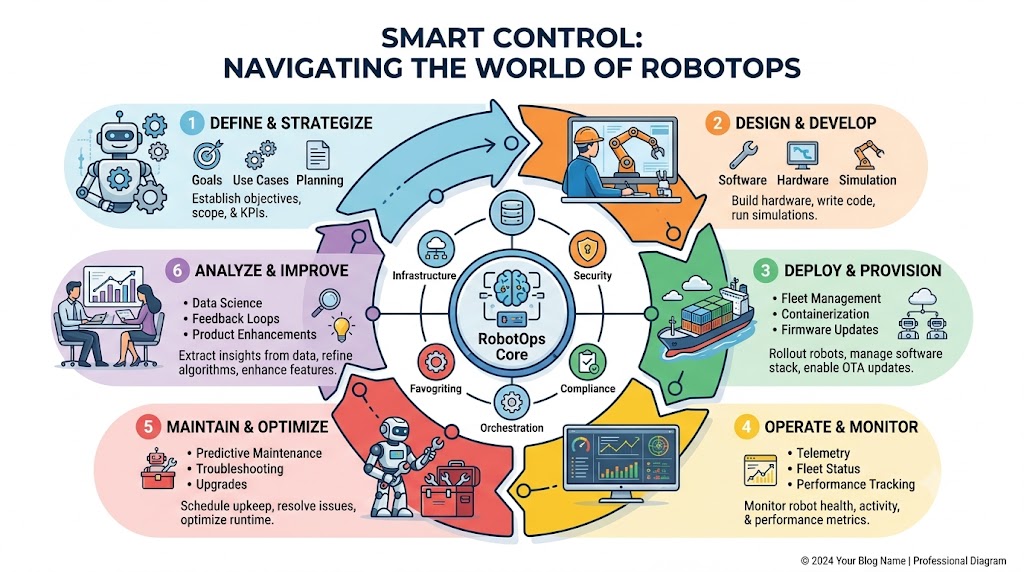
First, teams plan the project architecture and write foundational source code. Next, they assemble the hardware and test basic electrical components. After that, they run virtual checks in a simulator to verify navigation logic. Then, they deploy the machine into a live workspace for active tasks. Technicians monitor machine telemetry and patch errors as they emerge. Finally, engineers refine the software to maintain a continuous improvement cycle.
Frequently Asked Questions
Q1: What does RobotOps signify?
RobotOps stands for robotics operations. It merges software engineering practices with daily management routines to support hardware fleets. It helps teams deploy, monitor, update, and maintain physical machines across warehouses, hospitals, and factories.
Q2: Why do robots require specialized workflows?
Robots combine delicate physical hardware with intricate computer code. Unlike standard office computers, they operate in unpredictable physical spaces. They face mechanical wear, battery limits, and sensor obstructions, demanding dedicated operational care.
Q3: What is robot fleet management?
Robot fleet management involves coordinating multiple machines from a unified interface. It allows operators to track locations, monitor power levels, assign tasks, and review system health from a single command screen.
Q4: What is ROS 2?
ROS 2 stands for robot operating system 2. It is an open-source framework utilized by developers to write robot software. It enables distinct code modules to communicate via nodes and topics to control physical motion.
Q5: How does simulation assist engineers?
Robot simulation lets developers test control software in a safe virtual space prior to hardware deployment. It helps uncover navigation bugs, test sensor reactions, and validate safety protocols without risking expensive equipment.
Q6: What defines an autonomous mobile robot?
An autonomous mobile robot travels independently using onboard sensors and digital maps. It moves inventory across warehouses or delivers medical supplies in hospitals while avoiding unexpected obstacles along its route.
Q7: What occurs inside an operations center?
An operations center acts as the central monitoring hub for robot fleets. Operators observe live telemetry streams, review system warnings, push remote software patches, and investigate hardware faults promptly.
Q8: How do industrial robots aid factories?
Industrial robots handle repetitive or hazardous physical tasks like welding, assembly, and palletizing. They boost production speed, enhance assembly precision, and protect human workers from dangerous environments.
Q9: Can beginners learn RobotOps easily?
Yes, beginners can grasp RobotOps by studying foundational topics like deployment, monitoring, and simulation. Platforms like RobotsOps.com provide structured guides designed to help learners master these concepts step by step.
Q10: Why is system monitoring essential?
Monitoring provides teams with real-time visibility into machine health, network strength, and performance metrics. It allows operators to catch minor mechanical or software glitches before they cause expensive operational downtime.
Q11: How does RobotOps differ from standard software?
Traditional software runs purely on cloud servers or desktop computers. RobotOps handles both digital code and physical hardware interacting with the real world, introducing challenges like battery limits and physical wear.
Q12: Where can individuals find additional study materials?
Learners can explore comprehensive guides, tutorials, and articles on RobotsOps.com. The platform covers everything from ROS 2 and simulation tools to advanced fleet control and automation workflows.
Final Perspective
Advanced hardware demands ongoing attention long after leaving the manufacturing floor. By uniting RobotOps, fleet management, robotics software, simulation, and ROS 2, engineers build resilient automated architectures. Industrial machinery and mobile robots continuously transform how modern facilities operate. Effective monitoring keeps these valuable assets productive and secure. You can discover additional guides and broaden your technical knowledge by visiting RobotsOps.com as you advance your robotics career.

